


new-zealand-graduate-work-visa-2026-eligibility

New Zealand Graduate Work Visa 2026: The Complete Guide for International Students

New Zealand Graduate Work Visa 2026 pathway that gives more international graduates a structured way to stay, work, and build a future here. This guide covers everything you need to know — eligibility, requirements, key differences, and what to do right now to prepare.

New Zealand Graduate Work Visa 2026: The Complete Guide for International Students

You’ve spent months—maybe years—studying in New Zealand. You’ve built a life here, made friends, and fallen in love with the country. And now, as graduation approaches, there’s one question that keeps coming up: what happens to your visa?

If you don’t currently qualify for a post-study work visa, the answer used to be frustratingly simple—you’d have to leave. But that’s changing. From 16 November 2026, New Zealand is introducing a brand-new New Zealand Graduate Work Visa 2026 pathway that gives more international graduates a structured way to stay, work, and build a future here.

Migrate to New Zealand with expert guidance from the UAE, and book your free eligibility check today with trusted New Zealand visa consultants in  Abu Dhabi, Dubai , Sharjah and across the GCC.

This guide covers everything you need to know — eligibility, requirements, key differences, and what to do right now to prepare.

What Has New Zealand Just Announced?

In March 2026, Immigration New Zealand confirmed two significant updates to the country’s post-study work visa framework, both taking effect from 16 November 2026:

  • A brand-new Short-Term Graduate Work Visa — a 6-month open work visa for graduates who don’t qualify for the PSWV.
  • Expanded eligibility for the existing Post-Study Work Visa—opening the door to Graduate Diploma holders at NZQCF Level 7.

These changes are part of New Zealand’s broader strategy to retain skilled international graduates and address growing skill shortages across key sectors, including healthcare, technology, engineering, and the trades. Put simply, New Zealand wants international students to stay — and these new visa rules make that easier.

These updates are part of New Zealand’s broader effort to make it easier for international students to migrate to New Zealand and transition into skilled employment pathways from the UAE, Bahrain, Kuwait, Oman, Qatar & Saudi Arabia.

What Is the New Short-Term Graduate Work Visa?

Think of the Short-Term Graduate Work Visa as a bridge. It’s designed for international graduates who have completed a qualifying study program in New Zealand but don’t meet the criteria for the longer Post Study Work Visa. Instead of being forced to leave immediately, this visa gives you six months of breathing room to find a job, get your career started, and ideally transition to an Accredited Employer Work Visa (AEWV) for a longer stay.

Here are the key things to know upfront:

  • 6 months of open work rights — you can work for any employer in any industry
  • Available from 16 November 2026
  • One-time only—it cannot be extended, and you cannot apply for it again
  • Primary purpose: to help you secure employment and potentially move to an AEWV

This pathway is especially important for students who want to migrate to New Zealand long-term but do not immediately qualify for the post-study work visa.

Short-Term Graduate Work Visa: Full Eligibility Checklist

Before you apply, you’ll need to tick every box on this list. If you miss even one requirement, your application may be declined.

  • Your qualification must be at NZQCF Level 5, Level 6, or Level 7
  • You must have studied full-time for at least 24 weeks in New Zealand
  • Your qualification must NOT be an English language, foundation, or bridging course
  • Your qualification must disqualify you from eligibility for a post-study work visa.
  • You must have at least NZD $5,000 in available funds to support yourself
  • You must NOT have previously held a Short-Term Graduate Work Visa or Post-Study Work Visa
  • Your application must be submitted within 3 months of your student visa expiry
  • You must meet health requirements—a valid medical certificate and chest X-ray may be required depending on your intended length of stay
  • If you studied under the New Zealand Scholarship Programme, you’ll need written approval from the Ministry of Foreign Affairs and Trade or Education New Zealand

If you’re unsure whether your specific qualification meets the NZQCF Level Criteria, don’t guess—speak with visa consultants for New Zealand in Abu Dhabi, Dubai, Sharjah, UAE, or across the GCC to get it confirmed before you apply. An incorrect application wastes time and money.

What's Changing for the Post Study Work Visa in 2026?

The Post-Study Work Visa (PSWV) has long been the preferred option for graduates wanting to stay and work in New Zealand, offering longer work rights and more flexibility. But previously, it was only available to graduates who completed a degree at NZQCF Level 7 or above.

From November 2026, eligibility is being expanded. Here’s what’s new:

  • Graduates who have completed a Graduate Diploma at NZQCF Level 7 will now also be eligible for the PSWV
  • The Graduate Diploma must have been studied full-time in New Zealand for its entire duration
  • Cross-crediting or recognition of prior learning does not count—the full qualification must be completed in New Zealand
  • Applicants must also hold a bachelor’s degree—this can be from New Zealand or overseas, and there is no time limit on when it was awarded
  • You will need to provide proof of your bachelor’s degree certificate and an official academic transcript

This requirement is a significant change for a lot of students who chose a graduate diploma pathway. If this applies to you, it means you could qualify for the full Post Study Work Visa rather than the short-term option — a much stronger foundation for your long-term immigration plans.

Short-Term Graduate Work Visa vs Post Study Work Visa: Key Differences

Not sure which visa applies to you? Here’s a side-by-side breakdown:

FeatureShort-Term Graduate Work VisaPost Study Work Visa (PSWV)
Duration6 monthsUp to 3 years
Who it's forGraduates not eligible for PSWVEligible Level 7+ graduates
Work rightsOpen — any employerOpen — any employer
Extendable?NoYes (conditions apply)
Business ownershipNot permittedPermitted
Family sponsorshipNot permittedPermitted
AEWV PathwayYesYes
One-time only?Yes — cannot be reappliedNo
Available from16 November 2026Currently available (expanded Nov 2026)

The bottom line: if you can qualify for the PSWV, that’s the stronger pathway. The Short-Term Graduate Work Visa is the safety net — and a genuinely useful one — for those who fall outside the PSWV criteria.

Can This Visa Lead to Permanent Residency in New Zealand?

This is one of the most common questions we get at Trenity—and it’s the right one to be asking.

The Short-Term Graduate Work Visa is not a pathway to permanent residency on its own. It’s a temporary visa with a six-month window. But it can be the first step in a longer journey that does lead to PR.

Here’s how the pathway typically works:

  • Step 1: Graduate and apply for the Short-Term Graduate Work Visa (or PSWV if eligible)
  • Step 2: Find employment with a New Zealand-accredited employer
  • Step 3: Apply for and receive an Accredited Employer Work Visa (AEWV)
  • Step 4: Build work experience and meet the criteria for the Skilled Migrant Category
  • Step 5: Apply for New Zealand permanent residency

This journey takes time — usually several years — and the requirements for each step can change. But thousands of international graduates have successfully walked this path, and New Zealand’s current immigration direction clearly aims to make it more accessible.

What Are the Restrictions on the Short-Term Graduate Work Visa?

Open work rights sound fantastic — and they are. But this visa does come with some restrictions you need to know about before you apply:

  • You cannot own, establish, or operate a business while on this visa
  • You cannot sponsor your partner for a work visa
  • You cannot support dependent children applying for student visas
  • The visa cannot be extended beyond its 6-month validity—no exceptions
  • The visa can only ever be granted once in your lifetime—if you use it, it’s gone

These restrictions are designed to keep this visa focused on its core purpose: helping recent graduates find employment and transition to longer-term work options. If your situation involves family members or business plans, those conversations need to happen separately.

Step-by-Step: How to Prepare Your Application

The visa doesn’t open until 16 November 2026 — but that doesn’t mean you should wait until then to start preparing. Here’s what smart graduates are doing right now:

Step 1 — Confirm your qualification level

Check whether your program sits at NZQCF Level 5, 6, or 7. If you’re not sure, contact your institution’s international student office or check the New Zealand Qualifications Authority (NZQA) website.

Step 2—Check your PSWV eligibility first

Before assuming you need the Short-Term Graduate Work Visa, confirm whether you might actually qualify for the Post Study Work Visa — especially given the expanded eligibility for Graduate Diploma holders from November 2026. The PSWV is the stronger option where available.

Step 3—Gather your documents now

You’ll need: academic transcripts, your qualification certificate, proof of full-time study duration, evidence of NZD $5,000 in available funds, and your passport. If applicable, your bachelor’s degree certificate and transcript. Health documentation (medical certificate / chest X-ray) may also be required.

Step 4—Note your student visa expiry date

You must apply within 3 months of your student visa expiry. Miss this window and you lose your chance at this visa entirely. Put a reminder in your calendar now.

Step 5—Start your job search before you graduate

Six months is not as long as it sounds when you factor in application timelines, onboarding processes, and notice periods. Update your CV, get active on LinkedIn, attend career fairs, and research which New Zealand employers are accredited with Immigration New Zealand.

Step 6 — Submit through the Immigration New Zealand portal

Applications will be submitted through the official Immigration New Zealand online portal from 16 November 2026. Make sure your documents are all in order before you start the online form.

Is New Zealand Still Worth It for International Students in 2026?

With so many countries competing for international students, it’s fair to ask whether New Zealand is still the right choice. And honestly? The answer is yes — and the evidence is in these very policy changes.

When a government expands post-study work rights and creates new visa pathways for graduates, it’s sending a clear message: we want you here. New Zealand is actively investing in retaining international talent, not just collecting tuition fees.

Beyond the visa policies, New Zealand offers something harder to quantify — quality of life. Clean air, safe cities, a welcoming multicultural society, and a job market that genuinely rewards skilled professionals. Sectors like healthcare, information technology, construction, and engineering are experiencing real skill shortages, meaning graduates in these fields often find employment faster than they expect.

At Trenity Consultants, we’ve helped hundreds of students navigate the transition from graduation to employment to long-term residency in New Zealand. The path isn’t always straightforward, but it’s very much achievable with the right guidance.

How Trenity Consultants Can Help You

Visa rules are detailed, and the difference between qualifying and not often comes down to a single document, one missed deadline, or a qualification level you weren’t sure about. That’s not the kind of thing you want to get wrong.

At Trenity Consultants, our New Zealand immigration specialists stay on top of every policy update, so you don’t have to. Whether you’re still choosing your study program, approaching graduation, or have already finished and need to move quickly—we can help.

Here’s what we do for our clients:

  • Full eligibility assessment — we tell you exactly which visa you qualify for and why
  • Document checklist and review — we make sure nothing is missing before you submit
  • Application preparation and lodgement—we handle the entire process end-to-end
  • Post-visa planning—we help you map out the pathway from graduate visa to AEWV to PR
  • Ongoing immigration support — visa conditions change, and we keep you updated

New Zealand Graduate Work Visa 2026 : Frequently Asked Questions

Here are the questions our consultants get asked most often about the new New Zealand Graduate Work Visa 2026 changes:

Q: When can I apply for the Short-Term Graduate Work Visa?

Applications open from 16 November 2026. If your student visa expires before this date, check with Immigration New Zealand about bridging options.

Q: Can I work for any employer on this visa?

Yes. The Short-Term Graduate Work Visa provides full open work rights, meaning you can work for any employer in New Zealand across any industry.

What happens if I can't find a job within 6 months?

The visa cannot be extended and cannot be reapplied for. If you haven't secured employment by the end of the 6-month period, you would need to explore other visa options or leave New Zealand. This is why starting your job search early — ideally before graduation — is so important.

I already held a Post Study Work Visa. Can I apply for the Short-Term Graduate Work Visa?

No. If you have previously held either a Post Study Work Visa or a Short-Term Graduate Work Visa, you are not eligible for the Short-Term Graduate Work Visa.

How much money do I need to have available when I apply?

You must demonstrate access to at least NZD $5,000 in available funds at the time of application. This is to show Immigration New Zealand that you can financially support yourself while you search for work.

Can I bring my family with me on this visa?

No. The Short-Term Graduate Work Visa does not allow you to sponsor a partner for a work visa or support dependent children for student visas. Family sponsorship options would need to be explored separately.

I completed a Graduate Diploma. Do I qualify for the Post Study Work Visa now?

From 16 November 2026, graduates who completed a Graduate Diploma at NZQCF Level 7 will be eligible for the PSWV — provided they also hold a bachelor's degree and completed the entire diploma full-time in New Zealand. Cross-credited or prior-learning recognition does not count.

Q: Do I need to apply within a specific timeframe after graduation?

Yes. Your application must be submitted within 3 months of your student visa expiry date. If you miss this window, you cannot apply for the Short-Term Graduate Work Visa.

Final Thoughts

New Zealand’s decision to introduce the Short-Term Graduate Work Visa and expand Post-Study Work Visa eligibility is a genuine win for international students. More pathways mean more opportunities — but they also mean more complexity. The more options that exist, the more important it becomes to understand exactly which one applies to your situation.

The New Zealand Graduate Work Visa 2026 changes take effect from 16 November 2026. If you’re graduating around or after that date, now is the time to start preparing. Review your qualification level, check your eligibility, get your documents in order, and start thinking about your employment targets.

And if you want someone in your corner who knows this process inside out — that’s what Trenity Consultants is here for.

Need Immigration Assistance? Connect With Trenity Consultants Near You

Choose your nearest office and visit your local country page for personalized immigration guidance.

🇦🇪
Abu Dhabi
United Arab Emirates
Immigration Consultants in Abu Dhabi
Visit Page
🇦🇪
Dubai
United Arab Emirates
Immigration Consultants in Dubai
Visit Page
🇦🇪
Sharjah
United Arab Emirates
Immigration Consultants in Sharjah
Visit Page
🇰🇼
Kuwait
Kuwait
Immigration Consultants in Kuwait
Visit Page
🇧🇭
Bahrain
Bahrain
Immigration Consultants in Bahrain
Visit Page
🇶🇦
Qatar
Qatar
Immigration Consultants in Qatar
Visit Page
🇴🇲
Oman
Oman
Immigration Consultants in Oman
Visit Page
🇸🇦
Riyadh
Saudi Arabia
Immigration Consultants in Riyadh
Visit Page
🇸🇦
Jeddah
Saudi Arabia
Immigration Consultants in Jeddah
Visit Page

Share:

Ccountries with highest Schengen visa approval—Get to know more with Trenity Consultants!

Traveling to Europe in 2026? Here are the top easiest Schengen countries to get visa in 2026

The Easiest Schengen Countries for Quick Visa Approval - Get Fast Schengen Visa Appointments in Abu Dhabi with Trenity Consultants

Which Schengen Country Is Easiest to Get a Visa in 2026?

Getting a Schengen visa is probably one of the first things you should do if you want to go to Europe in 2026.  It can be easier to choose a country with a higher approval rate now that there are new rules and more people applying.  This guide will help you choose the best countries for your application, explain important rules, and help you avoid common mistakes so that your trip goes well.

Top 10 Schengen Countries Where Getting a Visa Is Easy

Recent statistics from 2024 show which countries are most likely to give out Schengen visas.  The average approval rate was about 52.2%, but some countries were much more welcoming than others:

  1. Lithuania: 97.2% approval rate
  2. Estonia: 98% (highest volume-adjusted)
  3. Iceland: 91%
  4. Slovakia: 89%
  5. Italy: 88%
  6. Romania: 88%
  7. Switzerland: 88%
  8. Hungary: 87%
  9. Norway: 87%
  10. Greece: 86%

Applying through one of these countries gives you the best chance of getting your Schengen visa approved. Here is a quick comparison to help you decide:

CountryApproval RateAvg. Processing TimeAppointment WaitBest For
Estonia98%5–7 daysShortFirst-time applicants
Lithuania97%7–10 daysShortIndian & Pakistani applicants
Iceland91%5–7 daysShortFast approval
Slovakia89%7–10 daysShortUAE & Gulf applicants
Italy88%10–15 daysModerateTourism-focused trips
Romania88%7–10 daysShortFirst-time applicants
Switzerland88%10–15 daysModerateBusiness travel
Hungary87%7–10 daysShortUAE & Gulf applicants
Norway87%10–15 daysShortStraightforward applications
Greece86%10–15 daysModerateTourism

Don’t “Visa Shop”: Follow the Correct Schengen Visa Process in 2026

The rules for the Schengen visa in 2026 say that you have to apply based on your real travel plans. You might want to apply in the country with the highest approval rate.  This is how it works:

  • If you’re visiting only one Schengen country, apply for your visa through that country’s embassy or its authorized visa center.

  • If your trip includes multiple Schengen countries, submit your application to the embassy of the country where you’ll spend the most time (your main destination).

  • If you’ll spend an equal amount of time in each country, apply through the embassy of the country you’ll enter first.

You could get your application turned down or have problems later if you don’t follow these embassy rules and apply to the wrong country.

Understanding how long it takes to process and why it was rejected

In 2025, nearly 12 million people applied for Schengen visas—a 1.8% increase on the year before. Processing times remain busy in 2026, especially during the summer and Christmas periods. The overall refusal rate has improved to 14.8% in 2025, down from 17.9% in 2022, which means your chances of approval are better now than they have been in years. Apply as early as possible and book your appointment well in advance to avoid delays.

How Long Does a Schengen Visa Take to Get Approved in 2026?

Most people assume getting a Schengen visa takes forever—but that is not always true. The official processing time is 15 calendar days, but in reality, it depends a lot on which country you apply through.

Countries like Slovakia, Lithuania, and Iceland tend to move much faster. Many applicants get their visa back in 5 to 10 working days when applying through these embassies.

If you apply through France, Germany, or Spain—especially from the UAE—you could wait 3 to 4 weeks just for an appointment, not to mention the additional time for the decision.

A few things that will affect how long your application takes:

  • The embassy you apply through—busy ones like France and Spain are simply slower
  • The time of year—avoid applying close to summer or Christmas if you can
  • Your documents—one missing paper can set you back weeks
  • Your nationality — some passports require extra checks, which adds time
  • The safest approach is to apply at least 4 to 6 weeks before your trip.
  • You are allowed to apply up to 6 months in advance, so there is no reason to leave it last minute.

Easiest Schengen Visa for Indian Passport Holders in 2026

A lot of our clients at Trenity come to us with the same question — which Schengen country is actually easy to get approved from if you hold an Indian passport? The honest answer is that it depends on where you apply, but some countries are consistently easier than others.

From the UAE, Lithuania and Slovakia are currently two of the best options. Appointments are easier to get, processing is faster, and approval rates are strong.

Estonia and Hungary are also worth considering—they do not get as much traffic as the bigger embassies, which means shorter queues and quicker turnaround.

Iceland technically has the highest approval rate at 91%, but appointment availability can be limited depending on where you are applying from.

The most common reasons we see Indian applications get rejected are weak bank statements, a vague travel itinerary, or nothing in the application that shows you plan to come back home. If your bank statements show at least 3 months of steady income, your flights and hotels are confirmed, and your cover letter clearly explains why you are travelling and when you are returning, your chances go up significantly.

Which Schengen Country Is Easiest to Get a Visa Appointment in 2026?

Here is something a lot of people do not realise until it is too late — the hardest part of getting a Schengen visa in 2026 is often not the approval; it is just getting an appointment.

France, Germany, Spain, and the Netherlands are notoriously difficult for appointments right now, especially if you are applying from the UAE or Gulf. Wait times of 4 to 8 weeks are common, and during peak travel season it can be even longer. If you want a faster appointment, these countries are your best bet right now:

  • Lithuania: usually 1 to 2 weeks via VFS Global
  • Slovakia: appointments generally available within 2 weeks
  • Estonia: low demand means shorter waits
  • Luxembourg:  smaller embassy, much quicker
  • Hungary: VFS in the UAE typically has slots within 2 to 3 weeks

One thing worth knowing: if you are visiting multiple Schengen countries and spending roughly equal time in each, you do not have to apply through the most popular one. You can apply through whichever country you enter first—so it is worth planning your itinerary around a country with easier appointments if you have flexibility.

How to Increase Your Schengen Visa Approval Chances

To improve your chances of approval, ensure that you provide accurate and complete documentation. Each Schengen country may have specific requirements, so always check the latest visa guidelines on their official website or consult with experts.

If you are unsure about the application process, it’s advisable to work with experienced professionals such as the Best Europe Immigration Consultants. These experts can help you navigate the complex visa application process and increase your chances of a successful application by providing expert advice on documentation, timelines, and strategies for overcoming common hurdles.

How Nationality Influences Schengen Visa Success Rates

Your nationality and the country you apply through both matters.  For example, in 2024, 97.6% of Liberians approved, but only a small number of people from Comoros and Guinea-Bissau did.  No matter where you’re from, it’s important to be well-prepared, especially if this is your first time applying.

What the EES and ETIAS Mean for Your Schengen Visa in 2026

Here is the EES section rewritten to sound human:


If you are planning to apply for a Schengen visa in 2026, there are two big changes to European border control that you genuinely need to know about before you apply.

EES — Entry/Exit System (already live)

The EES went fully live on 10 April 2026, and it changes things quite significantly. Passport stamping is done. Now, every time you cross into or out of a Schengen country, the system records your fingerprints, photo, and travel document details digitally in a central database.

What this really means is that border guards and embassies can instantly see your complete travel history—every entry, every exit, and crucially, any overstays or past rejections. Even if you overstayed by just a few days on a previous trip, that is now on permanent record, and it will come up when you apply again.

ETIAS—launching later in 2026

ETIAS is essentially Europe’s version of the US ESTA—an online travel authorization you apply for before you travel. It is due to launch in the last quarter of 2026. The key thing to understand here is that ETIAS only applies to people who currently travel to Europe without a visa, like UK, US, or Australian passport holders. If you are Indian, Pakistani, or hold most Asian passports and already go through the Schengen visa process, this does not affect you at all. Your application process stays exactly the same.

What does this mean for your application?

Be honest about your travel history—all of it. The EES means there is no way to hide a previous overstay or rejection anymore. If your record is clean, you have absolutely nothing to worry about. If it is not, be upfront in your application and clearly explain the circumstances instead of hoping it goes unnoticed.

Easiest Schengen Countries for Visa: Final Tips for First-Time Applicants

Refer to the 2025 statistics to find the which were the top Schengen countries for visa approval in summer 2025.  If you want to go to Europe soon.  Pick the country you want to apply to based on where you really want to go, apply early, and obey the rules for 2026.  If this is your first time applying, Lithuania, Estonia, and Iceland are the strongest choices in 2026.

Schengen Visa Questions Answered for 2026

Q: Which Schengen country is the easiest to get a visa in 2026?

Honestly, Lithuania and Estonia are leading the pack right now. Lithuania sits at a 97% approval rate and Estonia is even higher at 98% on a volume-adjusted basis. Iceland, Slovakia, and Romania are also solid choices. If you are applying from the UAE, India, or Pakistan specifically, Lithuania and Slovakia tend to work out best — the queues are shorter and the process is just more straightforward.

Q: Which Schengen visa is easiest to get for Indian passport holders?

From what we see with our clients, Lithuania and Slovakia are consistently the best bet for Indian passport holders in 2026. Appointments come through faster, approval rates are high, and most applications are processed within 7 to 10 days. If you are based in the UAE, Hungary and Estonia are also worth looking at — both have good VFS availability right now.

Q: How long does a Schengen visa take to process in 2026?

The official answer is 15 calendar days, but that is really the maximum — not what usually happens. If you apply through Lithuania, Slovakia, or Estonia, a lot of applicants are getting their visa back in 5 to 10 working days. The one time to be careful is summer, roughly June through August, when every embassy slows down. To be safe, give yourself at least 4 to 6 weeks before your travel date.

Q: Which Schengen country has the highest visa approval rate in 2026?

Based on the latest European Commission data, Estonia is actually at the top with a 98% approval rate, followed by Lithuania at 97% and Iceland at 91%. These numbers are based on 2025 applications so they are as current as it gets. Worth noting though — high approval rates partly reflect the type of applicants these countries receive, so strong documentation still matters regardless of where you apply.

Q: Which Schengen country is easiest to get a visa appointment in 2026?

This is honestly one of the biggest frustrations people face right now. France, Germany, Spain, and the Netherlands are a nightmare for appointments from the UAE — you are often looking at 4 to 8 weeks just to get a slot. Lithuania, Slovakia, Estonia, and Luxembourg are a completely different story. Most people get appointments within 1 to 2 weeks through VFS Global. If timing matters to you, this alone is a good reason to plan your trip around one of these countries.

Q: Is it hard to get a Schengen visa from the UAE in 2026?

It really does not have to be. The overall Schengen refusal rate has actually dropped to 14.8% — the best it has been since before the pandemic. If you apply through Lithuania, Slovakia, or Hungary from the UAE, have your documents in order, and give yourself enough time, your chances are genuinely good. Most rejections we see come down to weak bank statements or a travel plan that does not quite add up — both of which are completely avoidable with the right preparation.

Q: What is the EES and does it affect my Schengen visa application in 2026?

The EES — Entry/Exit System — went fully live on 10 April 2026. In simple terms, it means passport stamping is finished. Every time you cross into or out of a Schengen country, your fingerprints, photo, and travel details are now recorded digitally. It does not change the visa application process itself, but it does mean that if you have ever overstayed a Schengen visa — even by a few days — that is now permanently on record and embassies can see it. If your travel history is clean, you have nothing to worry about.

Q: What is ETIAS and do I need it in 2026?

ETIAS is a new online travel authorisation that is launching in the last quarter of 2026 — think of it like the US ESTA. Here is the important part though: it only applies to people who currently travel to Europe without a visa, like UK, US, and Australian passport holders. If you are Indian, Pakistani, Bangladeshi, or hold most Asian passports and already apply for a Schengen visa, ETIAS has nothing to do with you. Your process stays exactly the same.

How to Get Fast Schengen Visa Appointments in Abu Dhabi, United Arab Emirates

If you’re applying from the Middle East, getting help from reliable specialists for Europe immigration can really speed up the process of getting a Schengen visa appointment.  

Experienced immigration consultants can help you avoid mistakes, make sure your papers are ready, and know the most recent rules for 2026. They can help you make an early appointment, advise you on your paperwork, and improve your chances of getting approved.

Share:

Digital Nomad Visa 2026: Your Guide to Working Remotely in Europe

Remote Work Meets European Living: Top Digital Nomad Visas 2026

Top Digital Nomad Visas in 2026

Remote Work Meets European Living: Top Digital Nomad Visas for 2026

A few years ago, moving to Europe felt like a distant dream for most people in the UAE and GCC. You either had to secure a company willing to sponsor your visa, quit your current job to study abroad, or deal with mountains of complicated immigration paperwork. It was stressful, expensive, and risky.

But remote work changed everything.

Today, if your job is online, your office can be anywhere. That’s precisely why Digital Nomad Visa 2026 programs are becoming so popular across Europe. This special residency permit lets you keep your current job or freelance clients while legally living in Europe.

Countries like Portugal, Spain, Greece, and Croatia are leading the pack, offering incredible lifestyles, exceptional internet, and straightforward paths to temporary residency.

If you are considering making the jump,  Digital Nomad Visa consultants  in Abu Dhabi, UAE, like Trenity Consultants, can help you figure out which country fits your life best and handle the paperwork for you.

What Exactly is a Digital Nomad Visa?

Put simply, a digital nomad visa lets you live in a foreign country while working for employers or clients located outside of that country.

For example:

  • You live in Portugal but keep your remote job with a company in Dubai.
  • You sit in a café in Spain while managing your freelance design business.
  • You stay on a Greek island while running an online store.

The golden rule is that your money must come from outside the country where you live. Because you aren’t competing for local jobs, these governments are eager to welcome you to live, spend money, and contribute to their local economies.

That’s also why countries like Portugal, Spain, Greece, and Croatia are now considered among the best digital nomad visa destinations in Europe for 2026.

Why Is Everyone Moving to Europe in 2026?

It’s not just about changing your office view—it’s about changing your lifestyle. Remote workers are choosing Europe for a few very practical reasons:

Travel Freedom: Most European digital nomad visas give you easier access to travel across the Schengen Zone without constantly applying for tourist visas.

Built for Remote Work: Major cities are packed with fast Wi-Fi, modern coworking spaces, laptop-friendly cafés, and excellent public transport.

A Better Pace of Life: Many people moving from busy business hubs are looking for walkable cities, coastal views, and a healthier work-life balance.

Safety and Comfort: These countries offer top-tier healthcare, incredibly safe neighborhoods, and a high standard of living.

Best Digital Nomad Visa Countries in Europe for 2026

1. Portugal Digital Nomad Visa 2026: Europe’s Long-Term Favorite

Portugal is arguably one of the best digital nomad visa destinations in Europe for 2026. It is perfect for remote workers looking for a stable lifestyle, a welcoming expat community, and possible long-term residency opportunities. Cities like Lisbon and Porto are filled with tech startups, freelancers, and online entrepreneurs from around the world.

Why Do People Love Portugal?

Warm weather, friendly locals, amazing food, and excellent infrastructure make Portugal a top choice for digital nomads.

Best Cities in Portugal for Digital Nomads

  • Lisbon
  • Porto
  • Braga
  • Madeira

Ideal For: Freelancers, entrepreneurs, and remote corporate employees.

2. Spain Digital Nomad Visa 2026: Best for City Life & Remote Workers

Spain is one of the most popular Digital Nomad Visa Europe options for professionals who enjoy a vibrant and social lifestyle. It combines historic charm with modern coworking spaces, trendy cafés, and a strong remote work culture.

You can spend your mornings working remotely and your evenings enjoying beaches, tapas, and city life.

Why Do People Love Spain?

Incredible networking opportunities, lively cities, excellent public transportation, and a strong work-life balance.

Best Cities in Spain for Digital Nomads

  • Barcelona
  • Madrid
  • Valencia
  • Malaga

Ideal For: Marketers, creatives, freelancers, and startup founders who enjoy fast-paced city living.

3. Greece Digital Nomad Visa 2026: Best for a Relaxed Lifestyle

Greece is becoming one of the best digital nomad visa countries in Europe for people looking for a slower and more peaceful lifestyle. Compared to many Western European countries, Greece offers a lower cost of living and a relaxed atmosphere.

It is ideal for remote professionals who want better work-life balance while enjoying beautiful coastlines and Mediterranean weather.

Why Do People Love Greece?

Affordable rent, beautiful beaches, relaxed daily life, and warm weather throughout most of the year.

Best Places in Greece for Digital Nomads

  • Athens
  • Thessaloniki
  • Crete
  • Santorini

Ideal For: Solo business owners, writers, freelancers, and remote workers looking to escape burnout.

4. Croatia Digital Nomad Visa 2026: Best Affordable Option in Europe

Croatia has quickly become one of the top Digital Nomad Visa Europe destinations for first-time remote workers and budget-conscious professionals. It offers beautiful coastal cities, modern infrastructure, and a growing international nomad community at a more affordable cost compared to several Western European countries.

Why Do People Love Croatia?

Safe cities, affordable living, beautiful nature, and a fast-growing remote work culture.

Best Cities in Croatia for Digital Nomads

  • Split
  • Zagreb
  • Dubrovnik
  • Zadar

Ideal For: First-time digital nomads, independent consultants, freelancers, and budget-conscious remote workers.

Digital Nomad Visa 2026 – Fees & Processing Time

Documents Required for a Digital Nomad Visa in Europe

The exact requirements may differ from country to country, but most Digital Nomad Visa Europe programs ask for similar documents during the application process.

Here are the basic documents you will usually need:

  • A valid passport
  • Proof of stable remote income
  • A remote employment contract or freelance agreements
  • Recent bank statements
  • International health insurance coverage
  • A police clearance certificate or background check
  • Proof of accommodation, such as a rental agreement or hotel booking

The Most Important Requirement: Stable Income

The biggest thing immigration officers look for is proof of consistent monthly income.

It’s not just about how much you earn — your financial documents also need to look clear and reliable. If your bank statements show irregular income, missing transactions, or temporary contracts, your application may face delays or even rejection.

This is why many applicants choose to work with experienced consultants before applying. At Trenity Consultants, we help remote professionals prepare proper documentation, review financial records, and avoid common application mistakes.

Common Mistakes That Can Delay Your Digital Nomad Visa 2026

Applying for a Digital Nomad Visa in Europe may sound straightforward, but even small mistakes can cause delays or rejections.

Many applications stall because of incomplete paperwork or unclear financial records.

Some of the Most Common Issues Include the Following:

  • Messy Financial Documents : Submitting irregular bank statements, unclear income records, or unverified earnings can create problems during the review process.
  • Missing Information: Many applicants forget important details like document translations, signatures, or supporting paperwork. Even small missing details can slow down your application.
  • Choosing the Wrong Visa: Not every Digital Nomad Visa Europe program is the same. Some are better for long-term residency plans, while others are mainly temporary options. Choosing the wrong visa category can affect your future plans.
  • Inconsistent Remote Work Proof: Immigration officers want to clearly see that your income comes from remote work outside the country where you plan to live.

Because European immigration systems are highly detail-oriented, many professionals across the UAE and GCC prefer to work with Trenity Consultants, reliable immigration consultants in Abu Dhabi, to avoid unnecessary delays. Our team carefully reviews your documents, organizes your financial records properly, and ensures that we prepare your application correctly before submission.

Ready to Start Your Europe Journey?

One of the biggest advantages of a digital nomad visa 2026 is that you no longer have to choose between career growth and lifestyle freedom.

You can continue working remotely, keep your current income, and still experience life in Europe.

Whether you see yourself walking through the streets of Lisbon, working near the beaches of Spain, enjoying the peaceful lifestyle of Greece, or exploring the affordable coastal cities of Croatia, there are now more opportunities than ever for remote professionals.

The right country depends on your work style, income, lifestyle preferences, and long-term plans.

If you are ready to explore your options, Trenity Consultants can help you understand the best Digital Nomad Visa Europe pathway for your profile and guide you through the application process step by step.

Explore Digital Nomad Visa Opportunities in 2026 with Trenity Consultants

Choosing the right migration pathway is one of the most important steps in your Australia PR journey.

At Trenity Consultants, we help applicants understand suitable digital nomad visa options based on their profession, income level, remote work setup, and long-term lifestyle goals.

Our team provides guidance on:

  • Digital Nomad Visa pathways in Europe & beyond
  • Remote work residency permits
  • Country-specific income and eligibility requirements
  • Long-term relocation and settlement options for remote professionals

Whether you are a remote employee, freelancer, or entrepreneur, our consultants aim to provide updated and transparent guidance to help you legally live and work abroad while maintaining your career.

You can connect with our regional offices below and choose the location most convenient for you:

📍 UAE – Abu Dhabi, Dubai, Sharjah

📍 Kuwait 

📍 Bahrain

📍 Qatar

📍 Oman

📍 Saudi ArabiaRiyadh, Jeddah

Begin Your Digital Nomad Journey with Trenity Consultants today!

Share:

Australia 2026–27 Migration Program opens 185,000 PR spots. Explore Subclass 189, employer visas, family migration & skilled PR pathways.

Australia Migration PR Program: Australia Opens 185,000 PR Places for Skilled Migrants in 2026–27

Australia Migration PR Program: Australia Opens 185,000 PR Places for Skilled Migrants in 2026–27

Australia Migration PR Program: Australia Opens 185,000 PR Places for Skilled Migrants in 2026–27

Australia has officially announced its 2026–27 Migration Program, confirming a total permanent migration intake of 185,000 places. The latest announcement reinforces Australia’s continued commitment to attracting skilled professionals to support industries facing workforce shortages across the country.

This is one of the most important migration updates of the year for professionals planning to apply for permanent residency in Australia. We expect increased allocations for employer-sponsored and independent skilled migration categories to create stronger opportunities for qualified applicants worldwide.

The Australia Migration PR Program 2026–27 also reflects the government’s growing preference for skilled migrants already contributing to the Australian workforce through temporary work visas and international education pathways.

At Trenity Consultants, our experienced Australia immigration consultants help skilled professionals explore suitable migration pathways, including Subclass 189, employer-sponsored visas, and state nomination programs. Connect with trusted, skilled visa consultants in the UAE for updated guidance.

Australia 185,000 PR Places: Key Highlights of the 2026–27 Migration Program

In 2026–27, the Australian government continues to maintain a balanced migration approach for the upcoming year, with most allocations continuing under the Skilled Migration Program.

Program Category Allocations 2026–27
Total Migration Intake185,000
Skilled Migration Program132,240
Family Migration Program52,460
Special Eligibility Stream300
Employer-Sponsored Visas58,040
Skilled Independent Visa Subclass 18921,090

Major Highlights:

  • Total migration intake maintained at 185,000 places
  • Significant increase in employer-sponsored visas
  • More allocations for Skilled Independent Visa Subclass 189
  • State nomination opportunities continue expanding
  • Onshore skilled applicants remain a priority

The new migration allocations demonstrate Australia’s long-term commitment to addressing skill shortages while supporting economic growth and workforce stability.

For personalized Australia PR eligibility guidance, connect with Trenity Consultants—trusted Australian immigration consultants in Dubai and the GCC. Our skilled visa experts can help you choose the right migration pathway based on your profile and goals.

Employer-Sponsored Visas Receive a Major Increase

One of the biggest highlights of the Australia Migration PR Program 2026-27 is the significant rise in employer-sponsored permanent visas.
The allocation has increased from 44,000 to 58,040 places, creating stronger opportunities for skilled professionals who already have employment prospects in Australia.

This increase is expected to benefit industries experiencing ongoing labour shortages, including:

  • Healthcare
  • Information Technology
  • Engineering
  • Construction
  • Education
  • Science and Research

Australia continues to prioritize professionals who can contribute immediate value to the country’s labour market and economy. For many temporary visa holders, this increase may provide a faster and more practical pathway toward permanent residency.

Skilled Independent Visa Subclass 189 Allocations Increase

Among the most preferred pathways, the Skilled Independent Visa Subclass 189 continues to attract global professionals worldwide.

Under the latest migration update, allocations for Subclass 189 have increased from 16,900 to 21,090 places.
This visa category is highly popular because it allows skilled migrants to:

  • Live permanently in Australia
  • Work anywhere in Australia
  • Study in Australia
  • Access healthcare benefits
  • Apply for Australian citizenship in the future

We expect that applicants with competitive points scores, relevant work experience, and occupations listed on Australia’s skilled occupation list will benefit the most.

The increase in Subclass 189 allocations highlights Australia’s continued focus on attracting highly skilled global talent.
If you’re considering the Subclass 189 visa route, it’s important to carefully assess your points score, occupation, and eligibility before applying. Professional guidance can help you better understand where you stand in the current Australia PR framework.

State Nomination Opportunities Continue Growing

The latest migration program has also expanded allocations for state-nominated visa pathways.
Approximately 35,500 places are expected to be available across various state and territory nomination programs, providing additional opportunities for skilled professionals willing to live and work in specific Australian regions.
Many Australian states continue inviting applicants in high-demand occupations, especially in sectors such as:

  • Nursing and Healthcare
  • ICT and Cybersecurity
    Engineering
  • Education and Teaching
    Skilled Trades and
  • Construction
  • Hospitality and Tourism

For many applicants, state nomination pathways can significantly strengthen their chances of receiving an invitation for permanent residency.

Australia’s Family Migration Program Remains Stable

Australia’s Family Migration Program continues to support both family reunification and long-term migration objectives.
A total of 52,460 places have been allocated across:

  • Partner visas
  • Parent visas
  • Child visas
  • Other family categories

This balanced approach reflects Australia’s long-term migration strategy of supporting both economic growth and family unity.

Skilled Migrants Already in Australia Continue to Receive Priority

Another important feature of the Australia Migration Program 2026–27 is the strong preference for onshore applicants.

Approximately 129,590 places are expected to go to candidates already living in Australia, including:

  • Temporary skilled workers
  • International students
  • Graduate visa holders
  • Skilled professionals seeking permanent residency pathways

The Australian government believes prioritizing onshore applicants can help address workforce shortages more quickly while supporting industries already relying on skilled foreign workers.

This approach is expected to benefit individuals already contributing to Australia’s economy and labour market.

Indian Professionals Expected to Benefit Strongly from Australia Migration PR Program

Indian professionals are expected to remain one of the largest beneficiary groups under the Australia Migration PR Program 2026–27.

Demand for skilled workers in Australia continues to remain strong across industries such as:

  • Healthcare
  • Information Technology
  • Engineering
  • Construction
  • Education
  • Research and Science

The increase in employer-sponsored visas and skilled migration allocations is expected to create stronger opportunities for Indian professionals seeking long-term career growth and settlement opportunities in Australia.
International students studying in Australia may also benefit from improved pathways toward permanent residency in the coming years.

Australia Skilled Migration Update: Final Thoughts

The announcement of 185,000 migration places for 2026–27 confirms that Australia continues to view skilled migration as a long-term economic strategy.

The increase in employer-sponsored visas, higher allocations for Skilled Independent Visa Subclass 189, and continued support for state nomination programs together create strong opportunities for genuine skilled applicants worldwide.

For professionals planning to apply for permanent residency in Australia, staying informed about evolving migration policies and choosing the right pathway will remain extremely important.

If you want to understand how these updates may impact work visas and long-term migration pathways, read our detailed guide on Australia Work Permit Changes 2026

Looking for Trusted Australian Immigration Consultants in Dubai and the GCC?

Choosing the right migration pathway is one of the most important steps in your Australia PR journey.

At Trenity Consultants, we help applicants understand suitable migration options based on their background, profession, and long-term goals.

Our team of experienced Australian immigration advisors provides guidance on:

  • Skilled migration pathways
  • Employer-sponsored visas
  • State nomination programs
  • Australia permanent residency options

Whether you are exploring skilled migration opportunities or long-term settlement plans, our consultants aim to provide updated and transparent immigration guidance.

You can connect with our regional offices below and choose the location most convenient for you:

📍 UAE – Abu Dhabi, Dubai, Sharjah

📍 Kuwait 

📍 Bahrain

📍 Qatar

📍 Oman

📍 Saudi ArabiaRiyadh, Jeddah

Begin Your Australia Migration Journey with Trenity Consultants

Contact Trenity Consultants today to explore your Australia migration opportunities with confidence.

Share:

Best Immigration Consultants for Study and Working Abroad in Dubai and the GCC - Trenity Consultants

Study Abroad vs Work Abroad: Which Option is Better in 2026?

Skilled Immigration & Work Permit Specialists in the GCC - Trenity Consultants

Study Abroad vs. Work Abroad: Which Option is Better in 2026?

Every week, thousands of people search online asking the same question:

“Should I study abroad first or move abroad directly for work?”

And honestly, the confusion is understandable.
Social media makes everything look deceptively simple. One person says studying abroad completely changed their life. Another says spending large amounts on tuition fees was a mistake and that getting a job directly would have been the smarter move. Then there are professionals who moved overseas through work permits and started earning immediately.
But real life is usually more complicated than that.
There isn’t one perfect answer that works for everyone.
For freshers with limited experience, study abroad vs. work abroad often comes down to long-term planning.

Studying abroad usually creates a stronger foundation because it helps build qualifications, local exposure, internships, and professional connections. But for professionals already working in IT, healthcare, engineering, logistics, or finance, moving abroad directly for work can save both time and money.
The key is choosing the path that truly matches your current situation instead of following trends.

If you are planning your journey, you can also connect with the best immigration consultants for study and work abroad in Dubai and the GCC for personalized guidance.

What is the Difference Between Studying Abroad and Working Abroad?

The most significant difference depends on where you currently are in your career.

When you choose to study abroad, you move to another country mainly for education. During this time, you gain qualifications, improve communication skills, build professional connections, and later enter the job market.

When you choose to work abroad, you move because you already have the qualifications or experience needed for employment.

Both paths can lead to long-term settlement, but the journey is completely unique.

Factor Study Abroad Work Abroad
Best ForFreshers and graduatesExperienced professionals
Main GoalEducation and career growthDirect employment
IncomePart-time workFull-time salary
TimeLonger processFaster transition
Career PathStudy → Work → PRWork → PR
BenefitStrong foundationImmediate earnings

Why Studying Abroad Still Makes Sense for Freshers

If you are unsure about your study or career pathway, you can consult study abroad consultants in Dubai before deciding.

For fresh graduates, getting a job abroad directly is possible but highly competitive.

Most employers prefer candidates with local education or experience. That’s why many freshers choose studying abroad first.

More importantly, studying abroad gives something valuable beyond academics — time.

  • Time to adjust.
  • Time to build communication skills.
  • Time to understand how the job market works.
  • Time to gain confidence before entering full-time work.

Benefits of Studying Abroad

  • International Exposure Beyond Classrooms: Living abroad develops independence, communication skills, and adaptability.
  • Better Job Opportunities: Many employers prefer local graduates familiar with workplace culture.
  • Internships and Networking: Universities provide access to internships and industry connections.
  • Post-Study Work Opportunities: Countries like Canada, Australia, and the UK offer post-study work visas.
  • Stronger Career Foundation: Ideal for freshers building international careers.

Why Working Abroad Can Be Better for Professionals

For professional guidance on global careers, Work Abroad consultants in Dubai can help you choose the right pathway.

If you already have experience, studying again is not always necessary.

Many countries face skill shortages in IT, healthcare, engineering, construction, logistics, and finance. This creates strong work abroad opportunities for skilled professionals.

The biggest advantage is simple: You start earning immediately.

Benefits of Working Abroad

  • Immediate Income
    Earn from day one with no study gap.

  • Faster Career Growth
    International experience improves career prospects.

  • Higher Savings Potential
    Salaries are often significantly higher abroad.

  • Better Financial Stability for Families
    More secure option for professionals relocating with their families.

  • Skilled Worker Visa Pathways
    Countries offer PR routes through skilled migration.

Best Countries to Study Abroad in 2026

  1. Canada – Strong immigration system and post-study work permits.
  2. Australia – Quality education and work opportunities after graduation.
  3. United Kingdom – Short courses and graduate visa options.
  4. Germany – Affordable education with high demand for engineers.
  5. Ireland – Growing hub for IT, finance, and pharmaceuticals.
  6. New Zealand – Balanced lifestyle and strong post-study pathways.

Best Countries to Work Abroad in 2026

  1. Germany – High demand for engineers and IT professionals.
  2. Netherlands – Strong jobs in logistics, finance, and tech.
  3. Ireland – Major hub for global companies.
  4. United Kingdom – Skilled Worker visa opportunities.
  5. Singapore – Business and finance hub with strong salaries.
  6. Denmark – Demand in healthcare and renewable energy.

How to Decide Between Studying Abroad and Working Abroad

If you are a fresher or early in your career, studying abroad is usually the better option.

If you already have strong professional experience, working abroad is more practical.

Choose Study Abroad if:

  • You are a fresher or graduate
  • You need international qualifications
  • You want structured career growth
  • You need time to build skills

Choose Work Abroad if:

  • You have relevant experience
  • Your skills are in demand globally
  • You want faster income growth
  • You qualify for skilled visas

Important Things to Consider Before Moving Abroad

  • Budget: Studying requires a higher upfront investment.

  • Job Demand: Check the demand in your field before choosing a country.

  • Long-Term Goals: Decide whether you want temporary or permanent settlement.

  • Visa Options: Understand immigration rules clearly.

  • Lifestyle: Consider safety, work-life balance, and healthcare.

Final Thoughts

People often compare study abroad vs work abroad as if one option is always better.
But the reality is simple.

The right choice depends on where you are in life right now.

Freshers usually benefit more from studying abroad because it opens long-term opportunities. Professionals with experience can often grow faster by working abroad directly.

The most important step is to plan realistically.
Don’t follow trends — follow your profile, budget, and career goals.

Whether you move abroad through education or employment, both paths can lead to international exposure, financial stability, and long-term success when chosen correctly.

If you need expert guidance, you can connect with Trenity Consultants, skilled immigration & work permit specialists in the GCC, who provide personalized support for overseas migration planning.

For complete study and work abroad consultation, the team at Trenity Consultants helps candidates choose the right pathway based on experience, goals, and eligibility.

If you’re considering global career opportunities, you can connect with our regional offices below and choose the location most convenient for you:

📍 UAE – Abu Dhabi, Dubai, Sharjah

📍 Kuwait 

📍 Bahrain

📍 Qatar

📍 Oman

📍 Saudi ArabiaRiyadh, Jeddah

Ready for a new direction?

Let’s talk. Book a free consultation with our expert immigration consultants for studying and working abroad near you and get the right advice to move forward with clarity and confidence.

Share:

Ukraine Jobs for Foreigners in 2026: 5 Reasons Migrants Are Applying - Trenity Consultants Guide

Ukraine Jobs for Foreigners in 2026: 5 Reasons Migrants Should Work in Ukraine

Apply for Ukraine Jobs for Foreigners in 2026 with Visa & Work Permit Assistance from Trusted Immigration - Trenity Consultants

Ukraine Jobs for Foreigners in 2026: 5 Reasons Why Migrants Are Applying

Over the past few years, Ukraine Jobs for Foreigners in 2026 has started gaining attention among people looking for overseas work opportunities. It’s not the most traditional destination, but for many job seekers, it’s becoming a practical option for one simple reason: work is available and employers are actively hiring.

At Trenity Consultants, we’ve been getting more inquiries from individuals asking about what the actual process looks like. Most of them are surprised to learn that there are real opportunities in sectors like construction, logistics, manufacturing, and agriculture.

Here’s a simple breakdown of why Ukraine jobs for foreigners in 2026 are attracting more international workers.

1. Strong Job Opportunities for Foreign Workers

One of the main reasons Ukraine Jobs for Foreigners in 2026 is being discussed more is because companies are offering strong job opportunities for foreign workers across different sectors. There’s demand in areas like construction sites, warehouses, factories, delivery networks, and general labour roles.

It’s not limited to highly skilled profiles either. Both skilled and unskilled workers are finding options, which is why searches for work in Ukraine for foreigners have increased recently.

For many people who feel stuck in limited opportunities in their home countries, this opens a different route to consider.

2. Competitive Salary with Affordable Living

Salaries in Ukraine may not sound extremely high on paper, but the real factor is the cost of living. Rent, food, and transport are relatively affordable compared to many European countries.

Because of this balance, workers are often able to save a decent portion of their monthly income. That’s one of the reasons Ukraine employment opportunities are being explored more seriously by migrants looking for financial stability rather than just high salaries.

3. Employer-Provided Accommodation Benefits

Moving to a new country is not easy, especially when you don’t know where you’ll stay. In Ukraine, many employers try to make this easier by providing free or low-cost accommodation support for foreign workers.

In some cases, housing is arranged close to the workplace, which removes a big burden for new arrivals. This is one of those practical benefits that doesn’t always get attention, but it matters a lot when you’re relocating.

It also makes Ukraine jobs for migrants more accessible for first-time international workers.

4. Overtime Opportunities to Increase Earnings

Another point people often overlook is overtime. In industries like manufacturing and logistics, extra hours are usually available depending on workload.

For many workers, this becomes an important part of their income strategy. Instead of relying only on the base salary, overtime helps increase monthly earnings, especially for those willing to put in additional hours.

This flexibility is one of the reasons Ukraine is being considered among overseas job options in Europe.

5. Growing Demand for Skilled and Unskilled Workers

Ukraine continues to need skilled and unskilled workers across multiple industries. Some roles require experience, while many others are open to general labour.

From factory workers and warehouse staff to technicians and construction helpers, the demand is quite broad. This is why many applicants searching for Ukraine job vacancies for international workers and Ukraine Jobs for Foreigners in 2026 are able to find multiple openings across different sectors.

As industries continue to expand and rebuild, the need for foreign labour is expected to remain steady.

Apply for Ukraine jobs, visa & Work Permit Assistance from Trenity Consultants

If you’re seriously considering working abroad, you should always handle the process carefully—especially when it comes to documentation, contracts, and visa steps.

Working with a trusted immigration consultancy helps avoid confusion and ensures you’re dealing with verified opportunities instead of unclear offers. Ukraine immigration consultants can also guide you through Ukraine work permit assistance, making the entire process more structured and secure.

That’s where structured guidance becomes important, especially for people applying for the first time.

Final thoughts on Work Opportunities in Ukraine

Ukraine isn’t positioned as a “quick shortcut” destination, but for many workers, it has become a realistic option for work opportunities in Ukraine and long-term employment abroad.

With steady job demand, manageable living costs, and employer support in some cases, it’s understandable why more people are searching for work opportunities in Ukraine and exploring it as part of their migration plans.

If you’re considering overseas work, the key is simple: understand the process properly, verify everything, and take guidance before making a decision.

Ready to explore real job opportunities in Ukraine?

Exploring a new career path in a different country is a big decision, and you shouldn’t take it alone. At Trenity Consultants, the goal is to make that transition feel less like a process and more like a partnership. With a deep presence across the GCC, the team is right here in the community to help make sense of the steps ahead.

Whether there are questions about which job fits best or how to get the paperwork moving, the focus is on providing honest, clear guidance so every client can move forward with total peace of mind.

If you’re considering global career opportunities, you can connect with our regional offices below and choose the location most convenient for you:

📍 UAE – Abu Dhabi, Dubai, Sharjah

📍 Kuwait 

📍 Bahrain

📍 Qatar

📍 Oman

📍 Saudi ArabiaRiyadh, Jeddah

Ready for a new direction?

Let’s talk. Book a free consultation with our expert immigration consultants near you and get the right advice to move forward with clarity and confidence.

Share:

Canada PR consultants in the GCC

Canada Express Entry 2026 Update: Why Competition Is Rising Even When Pool Growth Slows

Canada Express Entry 2026 Update - CRS Competition Rising Fast - Know more with Trenity Consultants

Canada Express Entry 2026: Why Competition Is Rising Even When Pool Growth Slows

At Trenity Consultants, we’ve been closely tracking Canada’s Express Entry system throughout 2026, and one thing is becoming very clear — slower growth in the pool does not mean easier selection anymore.

In fact, the latest IRCC data shows the opposite trend. While fewer new profiles are entering the Express Entry pool, competition at the higher CRS levels is quietly becoming more intense.

For many candidates we speak to daily as one of the best immigration consultants for Canada in the GCC, this shift is already being felt in real time.

Furthermore, read our detailed guide on the Top 8 Canada Immigration Changes in April 2026.

Express Entry 2026 Shows Slower Growth but Strong Top-End Competition

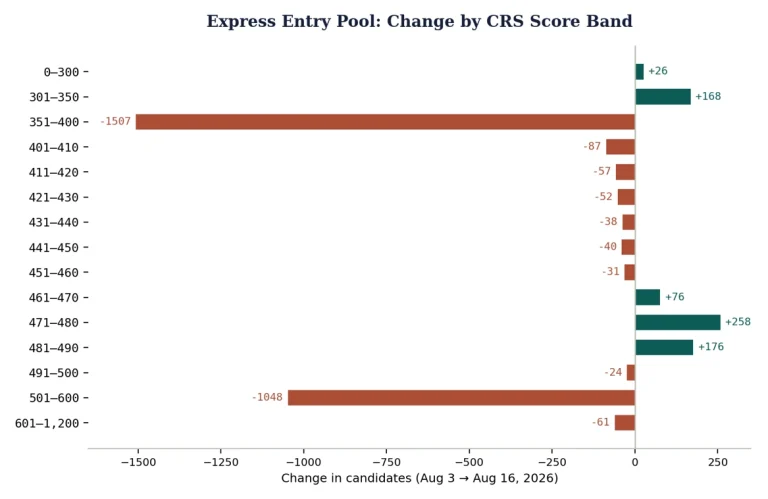
Between April 12 and April 26, the Express Entry pool increased by just 897 profiles, reaching a total of 234,452 candidates.

On paper, this looks like a slowdown — and it is. But when we break it down, the real movement is happening at the top.

The 501–600 CRS range continues to grow, adding another 250 profiles in just two weeks. This development is important because this range is now the real battleground for most skilled immigration candidates.

We are also seeing more movement in the 601–1200 CRS category, which is almost entirely made up of Provincial Nominee Program (PNP) candidates.

From our perspective, this trend clearly signals one thing:
More candidates are actively securing provincial nominations to remain competitive.

Why 500+ CRS Is No Longer “Safe” in Express Entry 2026

A few months ago, many applicants assumed that crossing the 500 CRS mark meant they were in a strong position.

That assumption is no longer holding up.

The recent Canadian Experience Class draw on April 28 issued only 2,000 invitations, with a CRS cut-off of 514. What stood out to us was not just the score — but the consistency of high cut-offs across multiple draws.

Even more concerning for candidates is the tie-break date going back more than seven months. That usually tells us one thing: there are far more eligible candidates waiting than available invitations.

In simple terms, the system is becoming more crowded at the top.

Why the Express Entry Mid-Tier Pool Is Shrinking (421–460 CRS Analysis)

One of the more interesting patterns in the latest data is the decline in CRS ranges between 421 and 460.

These ranges collectively dropped by over 1,300 profiles.

This is not random.

From what we’ve observed, this is directly linked to category-based draws, especially:

  • French-language proficiency draws
  • Trades occupation selections

These draws are quietly pulling candidates out of the mid-range pool and reshaping the distribution.

This is something many applicants don’t fully notice — but it is changing the structure of the Express Entry system over time.

Hidden Reality of Express Entry 2026: More Candidates, Not Enough ITAs

Another important point often overlooked is this:

Even after more than 6,300 ITAs were issued in mid-April draws, the pool still grew.

That tells us something basic but critical:

New candidates are entering faster than invitations are being issued.

This is why CRS scores are not dropping in the way many applicants expect.

Why CRS scores are rising in 2026 and the key factors behind growing Express Entry competition and higher cut-offs

Based on current patterns, there are four clear reasons behind rising competition:

1. Smaller, more controlled draws

CEC draw sizes have reduced, which directly increases CRS cut-offs.

2. Stronger candidates entering the system

More applicants now have:

  • Canadian work experience
  • High language scores
  • Advanced education
  • Spousal points or additional qualifications

3. Category-based immigration strategy

Canada is no longer relying only on general draws. Priority is now given to:

  • French-speaking candidates
  • Healthcare professionals
  • Skilled trades workers
  • STEM occupations
  • Provincial nominees

4. Provincial nomination demand

We are seeing a clear increase in candidates targeting PNP streams because the 600-point boost almost guarantees selection.

For those who are looking to qualify for canada PR in 2026 through category-based selection, you can go through our detailed guide on the latest Senior Managers Draw category

What We Are Advising Clients on Express Entry CRS Strategy in 2026

At Trenity Consultants, our guidance has become much more strategic compared to previous years.

A CRS score alone is no longer the full picture.

We are actively advising candidates through our Canada PR consultation services to

  • Reassess CRS improvement potential (language, education, spouse points)
  • Explore French language as a serious immigration strategy
  • Consider provincial nomination pathways early, not as a backup
  • Track category-based eligibility instead of waiting for general draws

Many candidates are surprised when we show them how small improvements can completely change their ranking position in the pool.

Final Thought on Canada Express Entry 2026 Trends and Rising CRS Competition

Canada’s Express Entry system in 2026 is no longer just about entering the pool—it is about positioning yourself correctly inside it.

Even though overall pool growth has slowed, competition at the top is becoming sharper and more selective. CRS scores above 500 are no longer automatically safe, and category-based selection is now shaping outcomes more than ever.

For anyone planning Canada PR or Express Entry immigration this year, the real question is no longer “Am I eligible?” but rather “How competitive is my profile compared to today’s pool?”

That is precisely where immigration consultants for Canada PR can make a difference through proper strategy and profile planning.

At Trenity Consultants, we continue to track these shifts closely as Canada PR consultants helping applicants stay ahead of the changes — not behind them.

FAQs - Frequently asked questions on Canada Express Entry 2026 Trends

Is a CRS score above 500 still enough for Express Entry in 2026?

Not always. It’s still a strong score, but in recent draws we’re seeing that crossing 500 doesn’t automatically guarantee an invitation anymore, especially with more competition building up at the top.

Why are CRS cut-offs still high even when pool growth is slowing?

Because the growth that matters is happening in the upper ranges. Many candidates are now sitting in higher CRS brackets, while new strong profiles keep entering the system faster than invitations are being issued.

What is driving the competition in Express Entry 2026 right now?

It’s a combination of factors. Draw sizes are more controlled, candidate profiles are stronger overall, and Canada is relying more on targeted selection through category-based draws and provincial nominations.

How are category-based draws changing the system?

The reality is, while it isn’t an instant or automatic process, it is quite structured and manageable when guided by the best Greece visa consultants in Abu Dhabi, UAE, and if you follow the right steps.

Is Provincial Nomination still the strongest advantage?

Yes, in most cases it is. A provincial nomination adds 600 CRS points, which typically places a candidate at the very top of the selection range.

What should Canada Express Entry applicants in 2026 focus on in 2026?

It’s no longer just about having a decent CRS score. Canada Express Entry applicants in 2026 are now focusing on improving language results, exploring French as an advantage, maximizing every CRS factor, and looking at provincial pathways much earlier in the process.

Are mid-range CRS scores like 421–460 still relevant?

They are, but the space is getting tighter. With category-based draws pulling candidates out and higher scores becoming more common, this range is not as stable as it used to be.

What is the key takeaway for Canada Express Entry applicants in 2026?

Being eligible is only the starting point. What really matters now is how your profile compares to others in the pool and whether it aligns with where Canada is actively selecting candidates.

Share:

Greece Tech Talent Visa 2026 for Skilled Professionals—Trenity Consultants Abu Dhabi, UAE

Your Path to Working in Greece: Greece Tech Talent Visa 2026 Explained

Greece Tech and Talent Visa 2026 - apply with the best best Greece visa consultants in Abu Dhabi, UAE - Trenity Consultants

Greece Tech Talent Visa 2026: What It Really Means for Skilled Professionals

If you’ve been thinking about working in Europe, Greece probably wasn’t your first option before.

But that’s changing fast.

With the Greece Tech Talent Visa 2026, the country is opening its doors to skilled professionals—especially in tech, IT, and innovation. And lately, we’ve been seeing more people explore how to move to Greece as software engineers or IT professionals, not just for the experience but for long-term opportunities.

Curious about the Greece Tech and Talent Visa? Find out if you’re eligible and how to apply for a Greece visa from Abu Dhabi, UAE, with Trenity Consultants.

Furthermore, read our detailed guide on hiring skilled Indian workers in Greece in 2026

What makes the Greece Tech Talent Visa different?

Most traditional immigration routes focus heavily on degrees and strict criteria. This one feels more practical. The Greece tech talent visa for skilled workers focuses on what you can actually bring to the table—your experience, your skills, and your ability to contribute to a growing tech ecosystem.

If you’ve worked in software development, IT systems, cloud infrastructure, AI, data, or automation or even startup environments—you’re already aligned with what Greece is currently looking for.

The process itself is also becoming more structured and easier to follow. It’s not “instant,” but it’s definitely more predictable than before. 

Want to check if you qualify for the Greece Tech Talent Visa? Get in touch with the best immigration consultants for Greece in Abu Dhabi today and explore your options from the UAE.

Who Is the Greece Tech Talent Visa 2026 Really For?

From our experience as one of the best Greece visa consultants in Abu Dhabi, UAE, this visa is most relevant for three key profiles of applicants looking to apply for a visa from Abu Dhabi to Greece:

  • Tech Professionals

Individuals already working in IT, software development, or related tech fields who are looking to expand their careers in the European market through the Greece Tech Talent pathway.

  • Skilled Professionals

If you have strong work experience and are seeking more stable, long-term opportunities in Europe, this route is increasingly becoming a practical option for professionals applying from the UAE.

  • Founders & Entrepreneurs

Greece is gradually opening up opportunities for innovators and startup founders. If you have a scalable business idea or entrepreneurial background, this visa can support your move beyond just relocation—towards building something in Europe.

For those exploring broader Europe migration options beyond work visas, Residency by Investment programs in Europe can also be a strong pathway.

Basic Requirements for Greece Tech Talent Visa 2026

While exact criteria may vary, applicants generally need:

  • Proof of professional experience or business activity
  • Financial stability and income evidence
  • Valid health insurance
  • Background verification documents
  • Detailed business proposal ready for assessment (Additional for Founders)

How to Apply: Your Step-by-Step Guide to apply for the Greece Tech and Talent Visa 2026

Understanding the process can make your journey smoother.

1. Prepare Your Documents

Gather employment records, financial documents, and supporting paperwork.

2. Secure Employer Support (If Applicable)

For professionals, employer involvement can strengthen the application.

3. Submit Application

Apply through the relevant Greek consulate in your home country.

4. Entry & Residence Formalities

Upon approval, travel to Greece and complete your residence permit process.

5. For Founders

Submit your business plan through designated authorities for review.

Why Skilled Professionals Are Choosing Greece for Work Opportunities

More people are now exploring Europe, and Greece is becoming an emerging option for those looking to apply for a visa from Abu Dhabi, UAE. Here’s why it stands out:

• It is still less competitive compared to other major EU destinations like Germany or the Netherlands, making it more accessible for skilled applicants
• There is a growing demand for tech and skilled professionals, especially in IT, software, and digital roles
• It offers access to the broader European job market and long-term career opportunities in the EU
• The lifestyle in Greece is also a major attraction—better work-life balance, relaxed environment, and strong quality of life

It’s not just about relocating for work—it’s about upgrading how you live, work, and grow in Europe with the right Greece visa guidance from consultants in Abu Dhabi, UAE.

How Trenity Consultants Supports Your Greece Visa Application from Abu Dhabi, UAE

A lot of people approach Trenity Consultants, one of the best Greece visa consultants in Abu Dhabi, UAE, feeling unsure—not because the process is impossible, but because they don’t know where to start to apply for a Greece visa from Abu Dhabi.

What we do is keep it simple and clear:

• Help you assess whether the Greece Tech Talent Visa suits your profile and career background
• Guide you with the complete documentation process for your Greece visa application from the UAE
• Support you step by step through the entire process, from eligibility to submission

No false promises—just honest guidance, clarity, and structured support for your Greece visa process from Abu Dhabi, UAE.

Book your one-on-one consultation with Trenity Consultants now!

If you’ve been waiting for the “right time” to explore working in Europe, this might be one of the more practical options available right now.

The Greece Tech Talent Visa 2026 isn’t for everyone, but if your profile fits, it’s definitely worth a closer look.

Let Trenity Consultants be your bridge to the Greece Tech and Talent Visa 2026—and a world of opportunity!

FAQs - Frequently asked questions about Japan's LOTUS Program 2026

Is Greece Tech and Talent visa only for tech professionals?

Mostly, yes—but founders and some skilled professionals can also explore options depending on their profile.

Do I need a job offer?

In many cases, yes. It helps strengthen your application.

Can I apply for Greece Tech and Talent Visa as a startup founder?

Yes, if you have a strong and scalable business idea, you can apply for the Greece Tech and Talent Visa as a startup founder.

Is the Process Complicated to Apply for the Greece Tech Talent Visa 2026?

The reality is, while it isn’t an instant or automatic process, it is quite structured and manageable when guided by the best Greece visa consultants in Abu Dhabi, UAE, and if you follow the right steps.

Share:

Japan's LOTUS Program 2026 offers Indian scholars up to ₹25.6 lakh funding. Explore eligibility, application steps, and Japan student visa support with Trenity Consultants.

Japan’s LOTUS Program 2026: A Golden Opportunity for Indian Scholars

A Golden Opportunity for Indian Scholars - 1,000 funded research spots for Indian scholars | Japan’s LOTUS Program 2026

Japan’s LOTUS Program 2026: A Golden Opportunity for Indian Scholars

Dreaming of taking your research career global? If you’re a Master’s, PhD, or postdoc researcher in India, Japan’s brand-new LOTUS Program 2026 could be your ticket to world-class labs, top mentors, and up to ₹25.6 lakh in annual funding. And with Trenity Consultants by your side, the process doesn’t have to be overwhelming!

If you’re excited to apply for a Japan student visa, Trenity Consultants can help you build a strong, error-free application as per Japan immigration standards. As a leading immigration and study abroad consultant in the UAE & GCC, Trenity simplifies your Japan student visa journey from start to finish.

What is the Japan’s LOTUS Program 2026?

Picture this: you, working alongside some of Japan’s brightest minds, in universities renowned for cutting-edge research. That’s the promise of the LOTUS Program 2026, launched by the Japan Science and Technology Agency. This fully funded initiative aims to build strong research bridges between India and Japan and is open exclusively to Indian students and researchers enrolled in a recognized Master’s, PhD, or postdoctoral program.

Highlights if Japan's LOTUS Program

  • 1,000 funded research spots for Indian scholars.
  • Fully covered research stays at leading Japanese institutions.
  • Monthly stipend (~240,000 yen) for living costs.
  • Extra support for research materials and travel within Japan.
  • Research focus areas include AI, biotechnology, energy, materials science, semiconductors, and quantum tech.

LOTUS Basic vs. LOTUS Aspire: Choose Your Path

The program offers flexibility to suit your research goals:

  • LOTUS Basic: Short-term placements (up to 12 months)
  • LOTUS Aspire: Long-term research (up to 36 months, with annual funding up to ₹25.6 lakh)

Whichever you choose, you’ll get mentorship both from your Indian institute and a Japanese host—so you’re never on your own.

Who is eligible to apply?

If you’re

  • Under 40 years old
  • Enrolled as a Master’s, PhD, or postdoc researcher at an Indian institution
  • Able to team up with a Principal Investigator at a Japanese university or research center
  • Passionate about high-impact STEM fields

If you’re the kind of candidate Japan’s LOTUS program is looking for!

Connect with experienced immigration consultants near you who can turn your eligibility into a strong, successful application—and help you secure your Japan student visa smoothly, without unnecessary delays or complications.

How to Apply: Your Step-by-Step Guide to apply for Japan's LOTUS program

Here’s how you can make it happen:

  • Ensure you’re affiliated with a recognized Indian institute (Master’s, PhD, or postdoc).
  • Find a Japanese Principal Investigator (PI) whose research interests align with yours.
  • Collaborate on a research proposal with your Japanese mentor—especially in priority fields.
  • Submit your application via the JST portal through your Japanese PI.
  • Choose your program track (Basic or Aspire) and get your application in before June 9, 2026.

Wait for the good news! If selected, you’ll soon be off to Japan.

Don’t navigate the process alone. From finding the right mentor to handling documentation and visa approvals, working with experienced immigration consultants for Japan visa applications can significantly improve your chances.

Why Indian Aspirants Should Consider Applying for the LOTUS Program 2026 in Japan?

The LOTUS Program 2026 offers researchers from India a valuable chance to collaborate on joint research initiatives in Japan. The program strengthens international academic connections and helps participants build a solid, globally recognized research profile.

Here are some of its key benefits:

  • World-class facilities: Access to Japan’s top labs and resources.
  • Prestigious collaborations: Work with universities like the University of Tokyo and Kyoto University.
  • Global research network: Build connections that last a lifetime.
  • Flexible duration: Go for a year or commit to a longer, deeper research journey.
  • Financial peace of mind: All major expenses are covered, so you can focus on your research, not your budget.
  • Boost your CV: International experience is a giant plus, whether you’re headed for academia or industry.

Connect with trusted immigration consultants near you for Japan visa support and start your LOTUS Program journey with confidence today.

Ready to Get Started? Trenity Consultants Can Help!

International research programs can feel daunting, but you don’t have to navigate them alone. At Trenity Consultants, we help you every step of the way—from finding the right Japanese mentor to perfecting your application. Our experienced advisors can make your journey to Japan smoother and more successful.

Don’t miss this chance to transform your research career!

Reach out to Trenity Consultants, your trusted immigration consultants for the Japan Student visa, today, for a free eligibility check and personalized support with your LOTUS Program application.

Book your one-on-one consultation with Trenity Consultants now!

Let Trenity Consultants be your bridge to Japan’s LOTUS Program 2026—and a world of opportunity!

FAQs - Frequently asked questions about Japan's LOTUS Program 2026

Do I need to speak Japanese?

Nope! The program mostly runs in English. Learning some basic Japanese will help with day-to-day life, but it’s not a requirement.

Can I apply directly?

No, you must apply through a Japanese PI who will be your co-supervisor.

What research fields are eligible?

AI, biotechnology, energy, advanced materials, semiconductors, quantum tech, and related high-impact fields.

When is the deadline?

June 9, 2026. Start early so you have plenty of time to prepare a strong application!

Share:

Canada’s April 2026 Immigration Updates explained clearly. Learn about passport fee increases, super visa changes, PR fees, and new immigration rules affecting you.

Canada’s April 2026 Immigration Updates: 9 Critical Changes You Must Know Today

Canada’s April 2026 Immigration Updates by Trenity Consultants

Canada’s April 2026 Immigration Updates: 9 Critical Changes You Must Know Today

If you’ve been following Canada’s immigration landscape, April 2026 has been a highly active period. Immigration, Refugees and Citizenship Canada (IRCC) introduced several updates that impact applicants, families, employers, and permanent residents alike.

Some of these changes may seem small at first glance, but they can significantly affect your immigration journey depending on your current stage.

At Trenity Consultants, we’ve simplified everything for you. Below is a clear breakdown of Canada’s April 2026 immigration updates and what they mean for you.

Canada's April 2026 Immigration Updates: What's Changing and Who It Affects

If you’re planning to move to Canada or already in the middle of an application, April 2026 is a month worth paying close attention to. Canada’s April 2026 immigration updates touch everything from citizenship costs to how provinces select their nominees.

1. Canada Passport Fees Increased After 13 Years

For the first time since 2013, Canada has increased passport fees.

New Passport Costs (Effective March 31, 2026):

  • 10-year adult passport: $163.50 (previously $160)
  • 5-year adult passport: $122.50 (previously $120)

Although the increase is modest, it applies to:

  • Applications inside Canada
  • Applications from abroad
  • All travel document types

Why the Increase?

IRCC states the hike is due to:

  • Inflation
  • Rising production costs for secure travel documents

Important: Passport fees will now be indexed to the Consumer Price Index (CPI), meaning annual increases are expected going forward.

2. New 30-Day Passport Processing Guarantee

Starting April 1, 2026, Canada introduced a major improvement: a 30-business-day processing guarantee.

How It Works:

  • The countdown starts only when your application is complete
  • If IRCC fails to process it within 30 business days:
    • You receive a full refund automatically

Important Tip:

The word “complete” is critical. Missing documents, incorrect forms, or improper photos will delay your timeline.

Always double-check:

    • Application forms
    • Supporting documents
    • Payment
    • Photo specifications

3. Citizenship Fees Slightly Increased

For permanent residents applying for citizenship, there’s a small cost change.

Updated Fees:

  • Right of Citizenship Fee: $123.00 (up from $119.75)
  • Processing fee: $530 (unchanged)

What This Means:

  • Annual fee adjustments are now legislated
  • Expect small yearly increases instead of large jumps

Plan your application budget accordingly.

4. Super Visa Becomes More Flexible for Families

This is one of the most impactful updates in April 2026.

The Super Visa allows parents and grandparents to

  • Stay in Canada for up to 5 years per visit
  • Hold a visa valid for up to 10 years

New Improvements:

Flexible Income Requirement

Sponsors can now use the following:

  • Income from the last 2 tax years (instead of just one)

Combined Income Option

If the sponsor falls slightly short:

  • The visiting parent/grandparent’s income can help meet requirements

Why This Matters:

  • Helps families with fluctuating income
  • Makes reunification easier
  • Expands eligibility significantly

5. Provinces Gain More Power in Immigration Decisions

Effective March 30, 2026, provinces now have greater authority in the Provincial Nominee Program (PNP).

Key Changes:

Provincial governments now assess:

  • Applicant’s intent to settle in the province
  • Ability to establish economically

What Changed?

Previously:

  • Federal officers could override decisions

Now:

  • Provinces have the final say
  • Federal officers must consult provinces before rejecting nominations

What This Means for You:

  • Stronger focus on genuine settlement plans
  • Generic answers will no longer work

Be specific about:

  • Why you chose the province
  • Your job prospects
  • Community ties

6. Settlement Services Now Have a Time Limit

Canada has introduced limits on how long immigrants can access settlement support.

New Rules:

  • Access period: 6 years after PR status (starting April 2026)
  • Reduced to 5 years starting April 2027

Services Affected:

  • Language training
  • Job assistance
  • Integration programs

Why This Change?

The government aims to:

  • Encourage faster integration
  • Align with Budget 2025 priorities

If you’re already a PR, check how much time you have left.

7. Rural Employers Get More Hiring Flexibility

To address labor shortages, Canada has expanded hiring capacity in rural areas.

Temporary Foreign Worker Program Update (2026–2027):

  • Workforce cap increased from 10% to 20%
  • Applies to low-wage stream employers

Who Benefits?

  • Rural businesses
  • Foreign workers seeking opportunities outside major cities

This opens doors for:

  • Faster hiring
  • More job opportunities in smaller communities

8. Saskatchewan Introduces New Immigration Fees

The Saskatchewan Immigrant Nominee Program (SINP) now includes application fees.

New Costs (Effective April 1, 2026):

  • Application fee: $500
  • Review request: $250

Important Note:

  • Applications submitted before April 1 are exempt

If you’re applying now, factor this into your budget.

9. Permanent Residence Fee Increase Coming Soon

Another important update is scheduled for late April.

Upcoming Change (April 30, 2026):

  • Right of Permanent Residence Fee:
    • $600 (up from $575)

Pro Tip:

Submitting your application before April 30 can save you money.

What These Immigration Changes Mean for You

Overall, Canada’s April 2026 immigration updates reflect three key trends:

  1. Faster Processing
    • Passport guarantee introduced
    • Efficiency improvements
  1. More Provincial Control
    • Provinces now drive nomination decisions
  1. Stronger Economic Alignment
    • Focus on labor shortages
    • Better integration timelines

Conclusion: Stay Ahead of Canada’s Immigration Changes

Canada’s April 2026 immigration updates may seem incremental, but they carry real implications. From fee increases to stricter provincial assessments, the system is becoming more precise and efficiency-driven.

The key takeaway?

  • Attention to detail is more important than ever.

Whether it’s submitting complete applications, planning finances, or preparing strong settlement plans—small mistakes can lead to delays.

If you’re unsure how these updates affect your situation, professional guidance from Trenity Consultants, the experienced immigration consultants for Canada in Abu Dhabi, UAE, can make all the difference.

Need Help With Your Immigration Plan?

Connect with Trenity Consultants, ICCRC-certified immigration consultants in the UAE and GCC, today for expert guidance tailored to the latest Canadian immigration policies and updates.

FAQs About Canada’s April 2026 Immigration Updates

Why did Canada increase passport fees in 2026?

The increase is due to inflation and higher production costs. Fees will now adjust annually based on CPI.

Can I still qualify for a Super Visa with lower income?

Yes, you can now use income from two years or combine income with your parents.

What happens if my passport is delayed beyond 30 days?

You will automatically receive a full refund—provided your application was complete.

Are settlement services still free in Canada?

Yes, but they are now limited to 5–6 years after becoming a permanent resident.

Do provinces now fully control immigration nominations?

They have significantly more authority, especially in assessing settlement intent.

Should I apply for PR before April 30, 2026?

Yes, applying earlier helps you avoid the fee increase.

Share: