





Our Presence
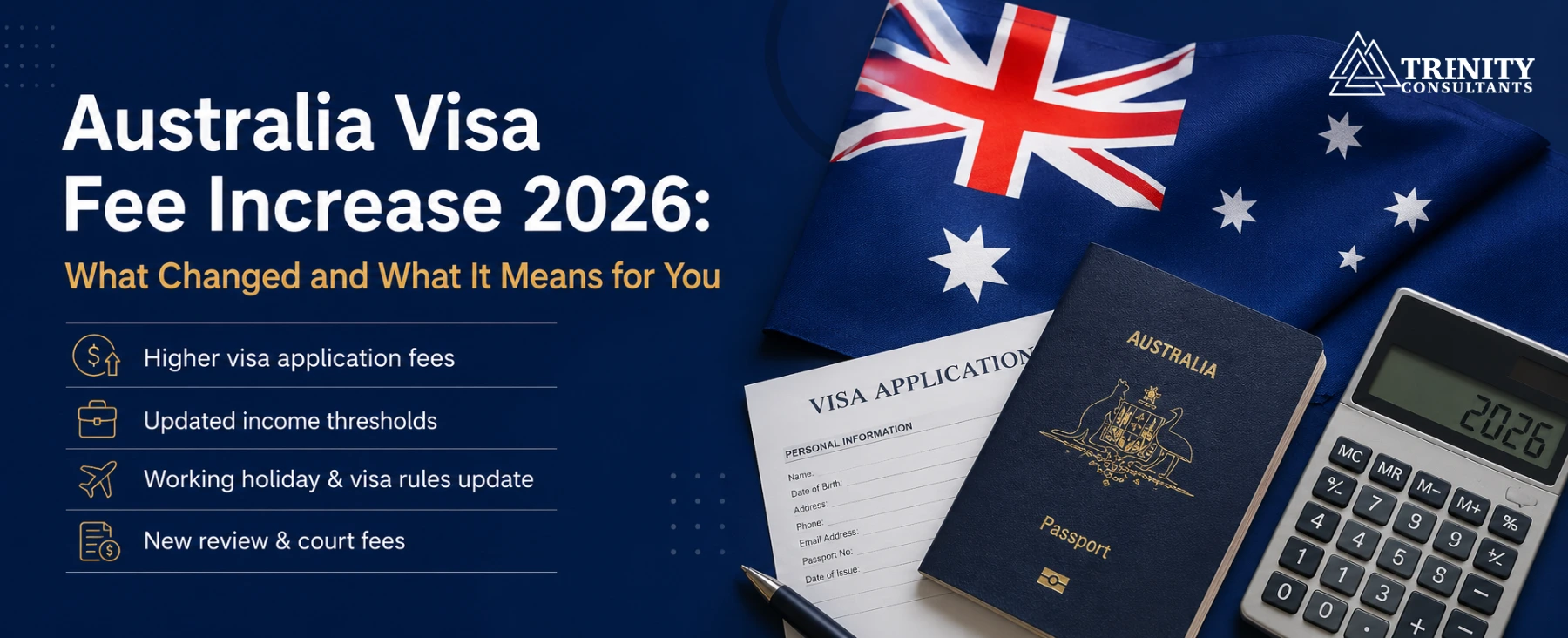
If you’re planning to apply for an Australian visa this year, you’ve probably already heard the news—the Australia visa fee increase for 2026 is now in effect, and for many applicants, it’s a bigger jump than usual.
From 1 July 2026, the Australian Government rolled out a wide set of changes covering Australia PR visa fees, skilled migration visas, student visas, employer-sponsored visas, and working holiday visas. Some of these changes are routine annual adjustments, while others represent significant increases that applicants need to plan for. Some of these changes are routine annual adjustments. Others are not — and they’re catching a lot of applicants off guard.
At Trenity Consultants, we’ve broken down exactly what’s changed below, so you know what to expect before you apply.
Most years, Australian visa fees creep up by 3–5%, roughly in line with inflation. This year, many subclasses jumped by around 25% in a single step — a far steeper rise than applicants are used to.
A smaller, CPI-only increase (around 2.6%) applied to a handful of categories, including:
Everyone else—including Australia PR applicants, skilled migrants, partner visa applicants, and Working Holiday visa applicants—is now facing noticeably higher visa application charges.
For anyone working toward permanent residency, the Australia PR visa fees 2026 update is one of the most important pieces of this announcement. Here’s a snapshot of how some of the most commonly used subclasses have moved:
| Visa Subclass | Old Fee | New Fee (From 1 July 2026) |
|---|---|---|
| Visitor (Subclass 600) | AUD $200 | AUD $250 |
| Student (Subclass 500) | AUD $2,000 | AUD $2,500 |
| Student (ELICOS / Non-award) | AUD $2,000 | AUD $2,050 |
| Temporary Graduate (Subclass 485) | AUD $4,600 | AUD $5,750 |
| Skilled Independent (Subclass 189) | AUD $4,910 | AUD $6,135 |
| Skills in Demand (Subclass 482) | AUD $3,210 | AUD $4,015 |
| Employer Nomination Scheme (Subclass 186) | AUD $4,910 | AUD $6,140 |
| Partner (820/801 or 309/100) | AUD $9,365 | AUD $11,710 |
| Working Holiday (417) / Work and Holiday (462) – First Application | — | AUD $840 |
| Working Holiday (417) / Work and Holiday (462) – Repeat Application | — | AUD $1,000 |
| Resident Return (Subclass 155/157) | AUD $490 | AUD $1,475 |
| New Zealand Family Relationship (Subclass 461) | AUD $445 | AUD $1,330 |
One thing worth understanding about the tie-break date: when two applicants in the same occupation have identical points scores, the one who submitted their EOI earlier gets the invitation. In this round, that cutoff was 24 April 2026. It is a detail that catches people off guard — and it is exactly why we always advise clients not to delay their EOI submission once they are ready.
NOTE: These are indicative base charges for a primary applicant only. Partners, adult dependants, and children included in the same application attract an additional applicant charge on top. Fees can also vary by location and stream, so it’s worth confirming your exact charge on the Visa Pricing Estimator before you apply – or asking your immigration consultant to do it for you.
One detail catches many applicants out each year: the fee you pay is determined by the date your application is received—not by when you started or finished preparing it. If your application is applied before 1 July 2026, the previous fee applies, even if the decision is made months later. Applications submitted on or after 1 July 2026 are subject to the new fees, regardless of how long they have been in preparation.
Since most application charges are non-refundable, even if an application is refused or withdrawn, lodging an incomplete or poorly prepared application under the new fee structure could prove to be a costly mistake.
It’s not just visas. Australian citizenship application fees have gone up too, broadly in line with CPI. If citizenship is next on your pathway after a permanent visa, it’s worth factoring this into your overall budget.
If you’re an employer sponsoring overseas talent, or an applicant applying through an employer-sponsored pathway, this is one of the most important changes to be aware of. From 1 July 2026, the minimum income threshold for employer-sponsored skilled visa applications has increased. The Core Skills Income Threshold (CSIT)—previously known as the Temporary Skilled Migration Income Threshold (TSMIT)—is now around AUD 79,400–79,500 per year. As reported figures vary slightly between sources, it’s advisable to confirm the current threshold with the department before lodging a nomination.
This threshold affects:
If you’re sponsoring someone, double-check that the nominated position actually meets the new threshold before you apply. Getting this wrong doesn’t just cost money—it can affect visa eligibility altogether, which is exactly the kind of detail Australia skilled migration consultants are trained to catch before it becomes a problem.
The Fair Work High Income Threshold has increased from AUD 183,100 to AUD 190,100 per year.
This change is particularly relevant for applicants seeking to rely on the high-income age exemption under the Employer Nomination Scheme (Subclass 186). From 1 July 2026, applicants must demonstrate earnings above the new threshold to be eligible for the exemption. If you’re planning to apply under this pathway, it’s important to review your salary against the updated requirement before lodging your application.
There’s good news and a word of caution here, depending on your situation.
The age requirement timing has changed. For both the Working Holiday Visa (Subclass 417) and the Work and Holiday Visa (Subclass 462), you now need to meet the age requirement at the time you apply, rather than at some later assessment point. If you’re close to the age cutoff, don’t wait — apply early, or you risk becoming ineligible partway through processing.
The age limit has been raised for some applicants. The maximum age for Subclass 417 Working Holiday applicants has increased from 30 to 35 for passport holders from:
This follows updated reciprocal arrangements between Australia and these countries. If you hold a passport from elsewhere, the existing age limits still apply unless a separate bilateral arrangement covers you.
If your application is refused, challenging the decision has become more expensive.
From 1 July 2026, the fees for lodging an application with the Administrative Review Tribunal (ART) are:
The filing fee for judicial review applications in the Federal Circuit and Family Court of Australia has also increased to AUD 4,180, although reduced fees remain available for eligible applicants.
The Department of Home Affairs has also introduced a cap on importing visa applications into ImmiAccount — you can now only import a given application up to three times. After that, further imports are blocked unless the Department manually resets the limit.
If you manage applications across multiple team members or clients, it’s worth switching to the Assign or Share functions in ImmiAccount instead of repeated imports. The Department says this change is about improving privacy and reducing fraudulent activity.
With so many moving parts, timing really does matter here. A few practical steps:
Whether you’re applying for Australia PR, an employer-sponsored visa, or a temporary visa, understanding the new Australia visa fees can help you avoid unnecessary costs and delays. Between the fee rise, the new income thresholds, and the tighter working holiday timing rules, it’s easy to get caught out by a detail that costs you money — or worse, your eligibility.
That’s where a bit of Australia visa process help from immigration consultants goes a long way. As the best immigration consultants for Australia PR & visa processes, Trenity Consultants, we help individuals, families, and employers get the numbers right the first time, so you’re not the one discovering a costly mistake after you’ve already paid a non-refundable fee.
If you’re weighing up your options under the new rules, get in touch with our team for Australia migration cost 2026 expert guidance tailored to your situation – before you apply, not after.
Most people who come to us don’t arrive with a completed file and a clear plan. They arrive with questions. Do I even qualify? Are my points enough? Where do I start?
That is completely normal — and it is exactly what our free consultation is for.
At Trenity Consultants, we work with skilled professionals across the UAE and GCC who are at different stages of their Australia PR journey. Some are just starting to explore the idea. Others have an EOI sitting in SkillSelect and are not sure why invitations haven’t come through. A few have received an invitation and need help making sure their application is airtight before the 60-day clock runs out. Wherever you are in the process, our job is simple: look at your profile honestly, tell you where you stand, and map out the clearest path forward.
Choose your nearest office and visit your local country page for personalized immigration guidance.
Share:









Sign up for a Newsletter