




H-1B Visa 2026: Is America's Skilled Worker Route Becoming Too Expensive?
A few years ago, saying “I got my H-1B” meant you’d made it. Now the same sentence gets a follow-up question: can you even afford it?
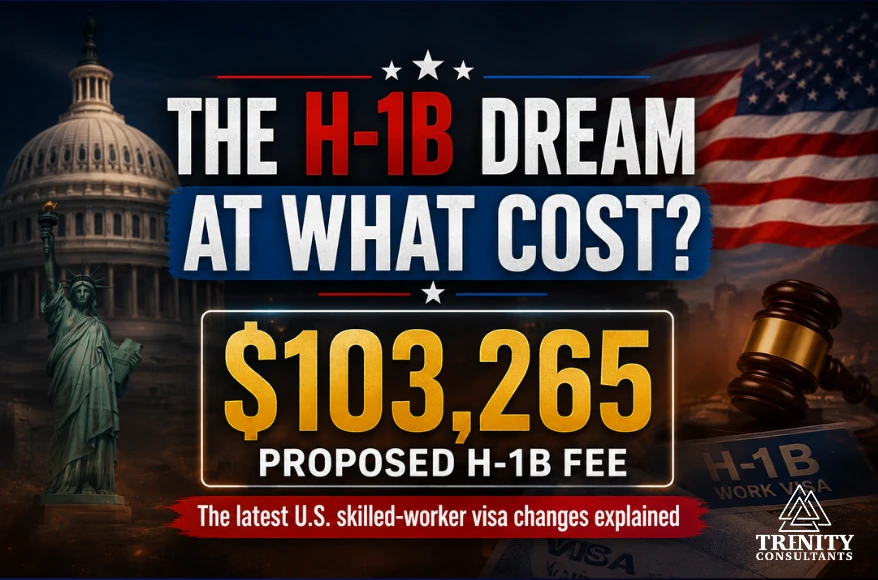
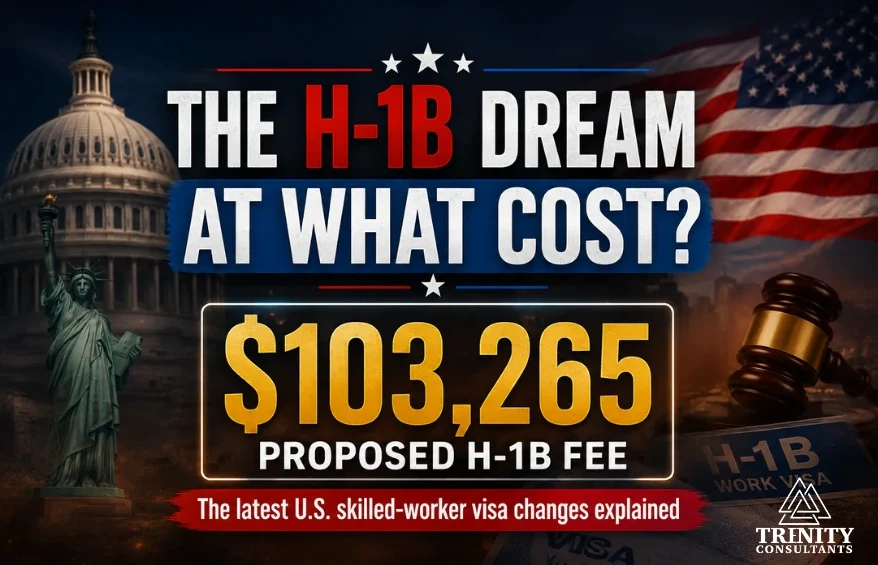
That’s not exaggeration. In August 2026, the U.S. government proposed adding $103,265 to the cost of certain H-1B petitions. That’s not the only change either. The 60-day grace period workers count on after losing a job could go away too. H-4 spouse work authorization is also under review.
So what does this mean if you’re hoping to move to the U.S. on an H-1B visa in 2026? Let’s break it down.
If you’re in Abu Dhabi or anywhere else in the Gulf and considering a move to the U.S., Trenity Consultants, trusted immigration consultants for the USA, can help you understand whether the H-1B route fits your qualifications, occupation and career plans — and how the latest H-1B visa changes could affect your options. We assess your profile, explain the relevant pathway and guide you through the process, so you can make an informed decision instead of relying on changing headlines or guesswork.
Looking for a trusted consultancy to know more about Skilled pathways?
Trenity Consultants provides professional guidance on immigration pathways, Express Entry, skilled migration, PNP options, eligibility assessments, documentation, and application support for clients across Abu Dhabi, Dubai, Sharjah, Bahrain, Qatar, Kuwait, Oman, Riyadh, and Jeddah. Trenity supports applicants through the immigration process, from initial profile assessment and pathway selection through documentation and application submission.
What's Actually Happening Right Now
Here’s the plain version.
On August 25, 2026, the Department of Homeland Security (DHS) published a proposal that would establish a $103,265 fee for H-1B cap-subject petitions, including petitions eligible for the advanced-degree exemption. The proposed fee would be paid at the time of filing and would be in addition to other applicable fees.
It’s a huge number. It’s also, right now, just a proposal.
The fee is not currently a universal requirement for every H-1B applicant. The proposal is going through the federal rulemaking process, with public comments due by September 24, 2026.
And based on how the previous attempt at a massive H-1B fee played out, legal challenges are likely to remain part of the story.
Earlier in 2026, a different $100,000 H-1B fee imposed through a presidential proclamation was blocked by a federal court. The new $103,265 proposal takes a different legal route by going through formal rulemaking. That distinction matters, because the outcome of the current proposal is not yet known.
What the $103,265 Fee Would Actually Cover
A few details matter more than the scary number.
It applies to cap-subject petitions. These are H-1B petitions subject to the annual cap, including petitions eligible for the advanced-degree exemption.
It would be paid by the employer at filing. The proposed fee would be in addition to other applicable H-1B fees.
It is not a fee that every H-1B worker or every H-1B petition automatically faces. Extensions, amendments, transfers and other types of petitions need to be assessed under the specific rules applicable to them.
Certain organizations and petitions may also fall outside the annual H-1B cap, so applicants and employers should not assume that the proposed fee applies universally.
Public comments are due on September 24, 2026. After that, DHS will consider the comments and determine whether to finalize, modify or withdraw the proposal.
Still, even as a proposal, it changes how companies think. Sponsoring someone already costs money in legal fees and compliance work. A possible six-figure additional charge could make employers much more selective about which foreign professionals they are willing to sponsor.
The Quieter Change That Might Hit Harder
The fee gets the headlines. But a second proposal could affect people already in the system even more.
DHS has been advancing a proposal to remove the 60-day grace period available to certain nonimmigrant workers after their employment ends. The proposal was sent to the Office of Management and Budget for review in August, but it has not yet become a final rule.
If you’ve never needed it, this might sound small. It isn’t.
Under the current framework, eligible H-1B workers who lose their employment can generally have up to 60 days — or until the end of their authorized stay, whichever is earlier — to find a new qualifying employer, change status or take another permitted step.
If that grace period is removed, a layoff could become much more time-sensitive.
If you’re on H-1B today, use this as a nudge to get organized. Know your exact status dates. Keep your paperwork current. Have a rough plan for what you’d do if your job ended tomorrow.
Importantly, the 60-day grace period has not been eliminated as of August 31, 2026.
Don't Forget the H-4 Spouses
H-1B workers rarely move alone. The family side of this story gets less attention than it should.
H-4 status covers qualifying spouses and children of H-1B holders. Certain H-4 spouses have historically been eligible for employment authorization under specific conditions.
DHS has proposed removing H-4 dependent spouses as a class from the category eligible to request employment authorization under the H-4 EAD rules. However, the proposal has not yet become a final rule, and existing H-4 work authorization should not be treated as automatically cancelled.
If you’re planning a move as a couple, your spouse’s career deserves a place in that planning too.
So, Is the H-1B Actually Getting Too Expensive?
This is where it helps to slow down instead of reacting to headlines.
The H-1B visa USA route hasn’t gone anywhere. USCIS continues to administer the H-1B program. Nobody is currently paying $103,265 as a universal H-1B fee, and the 60-day grace period still exists today.
What’s changed is the uncertainty sitting around the whole thing.
A few years ago, the big question was whether you’d win the lottery. Now it comes with extra questions.
Will my employer still sponsor me if the fee jumps this high?
Will I have enough time to find something new if I lose my job?
Is my partner’s work authorization safe?
None of that means the H-1B is finished. It means the H-1B visa 2026 landscape requires more planning than it used to.
People with strong qualifications, genuine specialty occupations and employers committed to sponsorship can still pursue the route. What’s shifting is the level of financial and regulatory uncertainty surrounding the process.
What the H-1B Visa Changes 2026 Could Mean for Employers
The proposed fee could have an impact beyond individual applicants.
U.S. employers considering international recruitment may need to think more carefully about:
- The cost of H-1B sponsorship
- The type of position being offered
- Salary and wage requirements
- Compliance obligations
- Whether the role genuinely qualifies as a specialty occupation
- The potential cost of sponsoring a new cap-subject worker
- Alternative immigration options where appropriate
A six-figure proposed fee could make some employers more selective about international hiring, particularly where the role can be filled through the domestic labor market.
For highly specialized roles, however, employers may still consider international talent an important part of their workforce strategy.
What You Should Do Right Now
A few things help regardless of how these proposals turn out.
- Check whether something is proposed or already final before you act on it. This space moves fast, and today’s headline can change by next month.
- Talk to your employer early about how they feel about potential H-1B visa fee changes, especially before a new cap cycle opens.
- Know your exact status timeline. That includes your I-94, petition details and what you would do if your employment situation changed suddenly.
- Look beyond the H-1B too. Depending on your background, qualifications and career goals, another U.S. visa category might fit you better.
- Consider other countries. If your priority is long-term skilled migration rather than the U.S. specifically, Canada, Australia and selected European destinations may also be worth evaluating.
And get advice from someone who knows your situation, not a forum thread full of guesses.
Is H-1B Still a Good Option for Skilled Professionals in 2026?
For qualified professionals, the H-1B remains an important US work visa 2026 pathway.
The latest developments do not mean the program is closed. They do, however, highlight why candidates should assess their options carefully.
A strong candidate should look at more than just whether they qualify for an H-1B. Their occupation, education, professional experience, employer, salary, immigration history and long-term plans can all influence which pathway makes the most sense.
For some professionals, another U.S. employment-based route may be more suitable. For others, the H-1B could still be the right option.
The key is to make that decision based on your individual circumstances rather than a single news headline.
Final Word
The H-1B Visa 2026 landscape isn’t the simple path it used to be. But harder and more expensive aren’t the same as closed.
The proposed $103,265 H-1B fee, the possible end of the 60-day grace period and the uncertainty around H-4 spouse work authorization are all real developments worth taking seriously.
They’re also, at different stages, unfinished policy proposals.
The smart move isn’t panic, and it isn’t ignoring them either.
It’s knowing exactly where things stand, understanding what applies to you and planning from there.
Book a Free Consultation
Frequently Asked Questions
Is the $103,265 H-1B fee already in effect?
Who would have to pay the $103,265 fee if it's finalized?
Does this fee affect people who already hold an H-1B?
Has the H-1B 60-day grace period already been removed?
What happens if someone loses their job on H-1B today?
Are H-4 spouse work permits getting cancelled?
With all these proposals, is the H-1B still a realistic option in 2026?
Should applications wait until these rules are finalized?
Thinking About Canada Instead?
If you’re reconsidering your U.S. plans, it may be worth comparing more than one immigration pathway.
Canada, Australia and selected European countries offer different skilled migration and work opportunities, depending on your qualifications, occupation, experience and long-term goals.
Rather than choosing a destination based only on the latest immigration headline, compare your options and understand which pathway fits your profile.
Immigration rules change often. Always confirm current requirements with the Government of Canada or a licensed consultant before applying.
Planning Your Next Move?
Trenity Consultants can help you assess your potential immigration options for the USA, Canada, Australia, Europe and other destinations based on your qualifications and career goals.
Book a free consultation with Trenity Consultants to understand whether the H-1B, Canadian PR or another pathway could be right for you.
Need Immigration Assistance? Connect With Trenity Consultants Near You
Choose your nearest office and visit your local country page for personalized immigration guidance.
Share:
Categories






- Australia Immigration Updates (17)
- Canada Express Entry Draw (24)
- Canada Immigration Updates (81)
- Citizenship By Investment (17)
- Digital Nomad Visa (2)
- Europe Immigration Update (5)
- Europe Work Permit (25)
- Germany Immigration (1)
- Greece Tech Talent Visa (1)
- Immigration Consultants (173)
- Japan Immigration Update (1)
- Residency By Investment (1)
- Romania Update (1)
- Schengen News (17)
- Study Abroad Updates (22)
- TOEFL for Canada PR (1)
- Ukraine (1)
- Videos (0)