





Our Presence
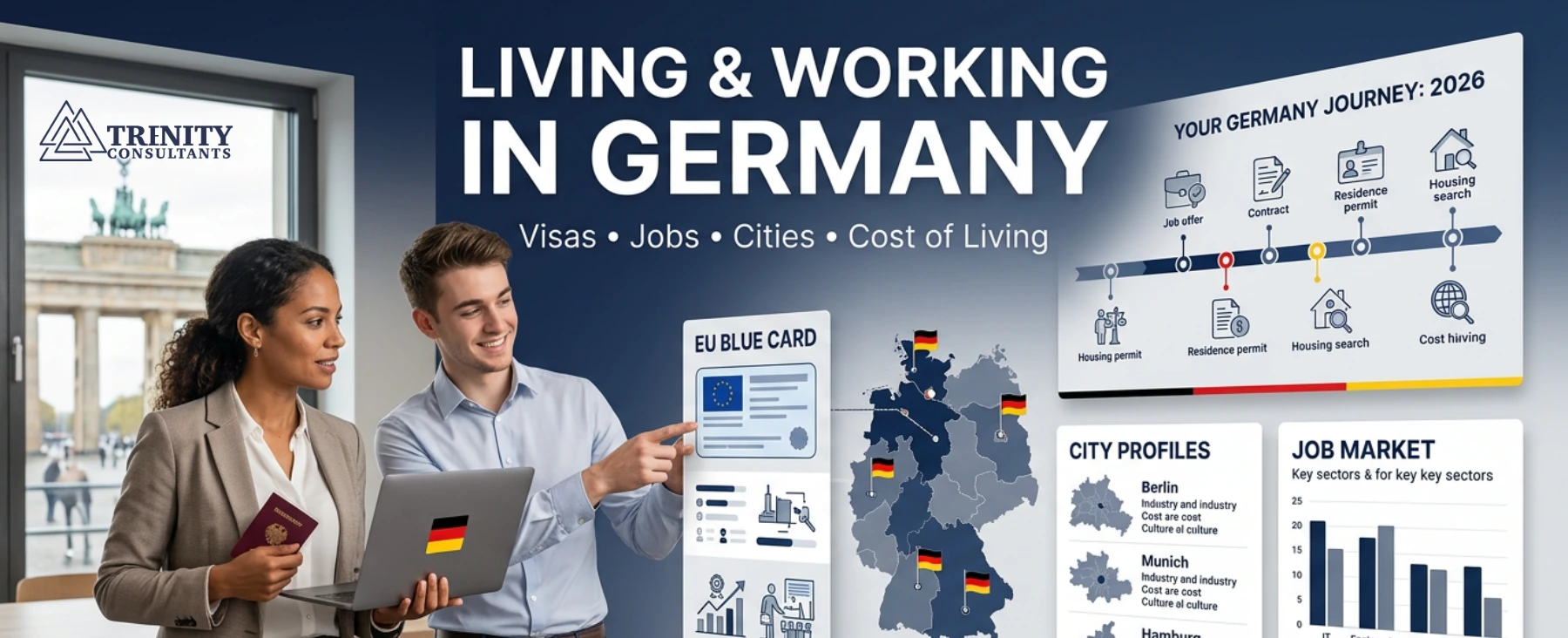
Living and working in Germany is a goal for thousands of skilled professionals every year. If you’re weighing up living and working in Germany, you’re looking at a country with over 770,000 unread job vacancies, a five-day working week written into law, and one of the fastest permanent residency timelines anywhere in the EU. The catch is that the system runs on paperwork, deadlines and a points table – which is exactly where most applications quietly stall.
This guide walks through what actually matters: which visa fits your situation, what jobs are paying right now, where to live, what it costs, and how the permanent residency clock starts ticking the day you land. Trenity Consultants put this guide together from the current 2026 rules, not last year’s numbers, so treat it as your working reference rather than a general overview.
In this guide, you’ll learn everything about living and working in Germany, including Germany work visas, the EU Blue Card, the Opportunity Card, in-demand jobs, average salaries, cost of living, permanent residency, and how to apply from the UAE or other GCC countries.
Are you applying from Abu Dhabi or anywhere else in the Gulf? Trenity Consultants also works as a dedicated Germany work permit & visa consultant in Abu Dhabi, handling the same EU Blue Card and Skilled Worker Visa process for UAE-based professionals from document collection through to consulate submission.
| Job Vacancies | 770,000+ |
| Unemployment Rate | ~6% |
| Skilled Workers Invited Annually | ~90,000 |
| EU Blue Card PR Timeline | 21 months (with B1 German) |
| Standard PR Timeline (Skilled Worker Visa) | 5 years (4 years with B1 German) |
| Path to Citizenship | 5 years' residence; dual citizenship generally allowed |
| Minimum Paid Leave | 20+ days/year |
| Standard Work Week | 5 days (~38–40 hours) |
| Minimum Wage | ~€12.82/hour (2026) |
| Official Language | German (English widely used in IT, finance, multinationals) |
| Currency | Euro (EUR) |
| Top Hubs for Foreign Talent | Berlin, Munich, Frankfurt, Hamburg, Stuttgart |
Want to check where you stand? Sign up for a free eligibility check with Trenity Consultants.
Germany isn’t quietly hoping skilled workers show up it’s actively rewriting policy to get them there faster. A few things stand out if you’re comparing it against other migration destinations:
Not sure which of these actually applies to your profession? That’s usually the first thing an immigration consultant checks before you spend weeks on a visa route that was never going to fit.
If you’re planning on living and working in Germany, understanding the current job market is the first step toward finding suitable employment. Demand isn’t spread evenly. IT and engineering are pulling ahead in both volume and salary, but healthcare and skilled trades aren’t far behind.
| Sector | Average Salary (EUR/Year) | Demand | Sample Roles |
|---|---|---|---|
| IT & Software | €55,000–€90,000 | Very High | Cloud Engineer, Backend Developer, AI/ML Engineer |
| Engineering | €55,000–€85,000 | Very High | Mechanical, Automotive, Electrical Engineer |
| Finance & Banking | €60,000–€100,000 | High | Risk Analyst, Compliance Officer, FinTech Specialist |
| Healthcare | €45,000–€90,000 | High | Registered Nurse, Specialist Doctor, Medical Technician |
| Skilled Trades | €40,000–€55,000 | High | Electrician, HVAC Technician, Plumber |
| Research & Academia | €50,000–€70,000 | Moderate | Postdoctoral Researcher, Research Associate, Lecturer |
English gets you further in tech and finance than most people expect, particularly with the larger multinational employers. But German at a working level – B1 is the usual benchmark – still provides more opportunities, especially outside the biggest cities, and it’s practically required once you’re applying for permanent residency.
Choosing the right visa is one of the most important parts of living and working in Germany successfully. Three routes cover most skilled migrants. Which one fits depends mainly on whether you already have a job offer.
| Visa Type | Best For | Validity | PR Timeline |
|---|---|---|---|
| EU Blue Card | Degree + job offer with a qualifying salary (€45,934–€50,700) | Up to 4 years | 21 months (B1 German) / 27 months (A1 German) |
| Skilled Worker Visa | Recognised qualification + German job offer | Up to 4 years | 5 years (4 years with B1 German) |
| Opportunity Card | Skilled job seekers with at least 6 points | Up to 12 months (job search) | Can transition to the EU Blue Card or Skilled Worker Visa pathway |
The default choice for degree-holders with a job offer that clears the salary threshold, and the fastest of the three routes to permanent residency.
The lower threshold (~$45,934) applies to shortage occupations, recent graduates and qualifying IT specialists — worth checking before you assume you don’t qualify.
This route is designed for vocational and academic qualifications that fall outside the Blue Card’s scope. A broader net, but a longer road to residency. Qualification recognition through Germany’s ZAB or Anabin database is usually the slowest part of this route — start it early, not after you’ve accepted an offer.
No job offers yet? This points-based route lets you enter Germany and search on the ground for up to 12 months.
You’ll need to show financial self-sufficiency for the job-search period, roughly €1,091 a month, before the card is issued.
Based in the UAE? All three routes above are filed the same way whether you’re applying from home or from the Gulf. If you’re arranging a German work permit from Abu Dhabi, UAE, Trenity’s local desk handles document attestation and consulate submission on the ground – see the full Germany Work Permit & Visa Consultant in Abu Dhabi service page for details.
| City | Key Industries | Average Rent (1-Bedroom Apartment) | Job Market |
|---|---|---|---|
| Berlin | Startups, IT, Technology, Creative Industries, Digital Economy | €900–€1,200/month | Very Strong – Growing demand for tech, software, and international talent |
| Munich | Automotive, Engineering, Technology, Manufacturing, Finance | €1,200–€1,800/month | Excellent – One of Germany’s strongest employment markets |
| Frankfurt | Banking, Finance, Insurance, Consulting, Logistics | €1,100–€1,400/month | Strong – Major financial hub with international employers |
| Hamburg | Logistics, Aviation, Media, Trade, Maritime Industries | €1,000–€1,300/month | Strong – High demand in logistics, engineering, and skilled sectors |
| Stuttgart | Automotive, Manufacturing, Engineering, Research & Development | €1,100–€1,400/month | Strong – Home to leading automotive companies and suppliers |
The cost of housing, transport, and daily expenses plays a major role when living and working in Germany. Munich and Frankfurt sit at the top of the price scale; Berlin, despite being the capital, remains comparatively affordable. Here’s a realistic monthly spread for a single adult in a mid-sized German city.
| Expense | Estimated Cost |
|---|---|
| Rent (1-Bedroom Apartment, City Centre) | €800–€1,200/month |
| Utilities (Electricity, Heating, Water) | €150–€250/month |
| Groceries | €200–€300/month |
| Public Transport Pass | €60–€100/month |
| Mobile & Internet | €30–€50/month |
| Dining Out (Per Meal) | €12–€20 |
| Leisure & Entertainment | €100–€200/month |
Against Switzerland, Germany looks noticeably cheaper for a comparable salary. Against the UK, it’s roughly on par, sometimes a shade lower outside London-equivalent cities” while still paying competitively in IT, engineering and finance.
1. Register your address (Anmeldung) at the local Bürgeramt within two weeks of arrival.
2. Register with a statutory health insurer (Krankenkasse) – most employers will ask for this before payroll starts.
3. Open a bank account; Deutsche Bank, Sparkasse, Commerzbank and N26 are the common starting points.
4. Apply for your residence permit or EU Blue Card at the local Ausländerbehörde.
5. Get a German SIM and set up transport and banking apps.
6. If you have children, apply for school places early -international schools fill up fast.
| Stage | Requirement | Timeline |
|---|---|---|
| EU Blue Card Holder | Recognised degree qualification and meeting the required salary threshold | 21 months (with B1 German) / 27 months (with A1 German) |
| Skilled Worker Visa Holder | Continuous employment, required residence period, and pension contributions | 5 years (4 years with B1 German) |
| Opportunity Card Holder | Convert to a suitable work residence permit after securing employment | Up to 12 months job search + standard PR timeline |
| German Citizenship | B1 German language skills, integration requirements, and legal residence | 5 years (dual citizenship generally permitted) |
Beyond the technical qualification on your CV, German employers consistently rank a specific set of soft and hard skills higher than most applicants expect:
– Digital and programming literacy -even outside pure tech roles
– German language, B1 minimum -for client-facing or people-management roles especially
– Cross-cultural communication and comfort working in mixed-nationality teams
– Project management fluency -Agile and Scrum show up constantly in job listings
– Adaptability -Germany’s Mittelstand (mid-sized company) sector moves fast and expects flexibility
Living and working in Germany offers excellent career opportunities, competitive salaries, and a clear pathway to permanent residency for skilled professionals. The rules above are the ones that hold true today – but salary thresholds, points tables and processing times shift every year, and most refusals come down to a document filed the wrong way or a qualification that was never formally recognised. This is the exact gap that experienced immigration consultants for Germany are here to close.
Trenity Consultants works through your profile against the current EU Blue Card, Skilled Worker Visa and Opportunity Card rules, flags qualification-recognition issues before they cost you months, and keeps your application moving instead of sitting in a queue. As a Germany immigration consultant, that’s the whole job – fewer surprises, fewer resubmissions, faster decisions.
UAE-based professionals can work with our local team directly – see Germany Work Permit & Visa Consultant in Abu Dhabi for the full UAE-specific process.
Book a free consultation with Trenity Consultants today!
Every country on this list has different rules, timelines, and paperwork. Getting the details right the first time is usually the difference between a permit approved in a few months and one stuck in review for twice as long.
Trenity Consultants works with applicants across Abu Dhabi, Dubai, Sharjah, Bahrain, Qatar, Kuwait, Oman, Riyadh & Jeddah to identify which route to European employment actually fits their qualifications, and then manages document preparation and submission from start to finish.
Book a free eligibility check with Trenity Consultants and find out which country gives you the fastest, most realistic path to work in Europe.
Choose your nearest office and visit your local country page for personalized immigration guidance.
Share:









Sign up for a Newsletter