






Our Presence
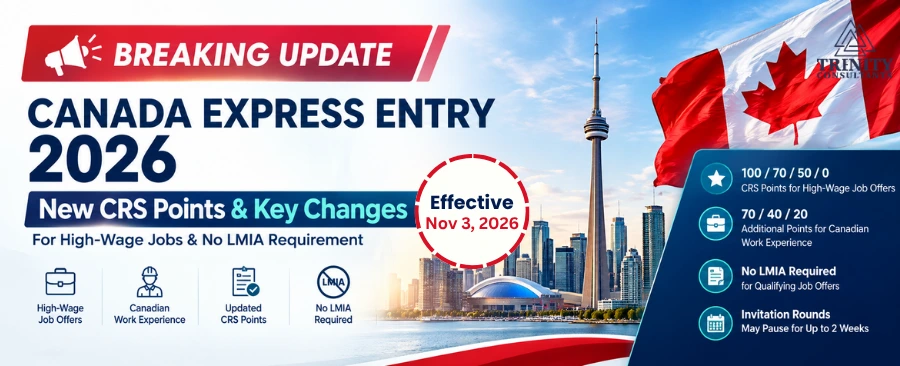
On October 16, 2026, Immigration Minister Lena Metlege Diab announced a major change to Canada’s Express Entry scoring system, following the removal of job offer points in March 2025. From November 3, 2026, eligible candidates can earn new CRS points for a qualifying job offer or for Canadian work experience in a high-wage occupation. Qualifying job offers will also no longer require a Labour Market Impact Assessment (LMIA) for specified Express Entry purposes.
IRCC says the objective is to give greater weight to factors associated with stronger economic outcomes and help Canada attract and retain skilled workers who can contribute to its labour market.
If you are working in Abu Dhabi, Dubai, Sharjah, Bahrain, Qatar, Kuwait, Oman, Riyadh, or Jeddah and considering Canada PR, the important question is whether a Canadian job offer could improve your CRS score. It may, but only if the offer and occupation meet the applicable requirements.
Whether you’re just starting to look at Canada or already have an invitation to apply, Trenity Consultants can guide you through each stage, from checking your eligibility to submitting a complete application. Our licensed team is available at our branches across the GCC and online, and your first assessment is free.
IRCC has announced three major changes.
A new Labour Market Integration Factor (LMIF) will award CRS points for a qualifying job offer in an eligible high-wage occupation or eligible Canadian work experience in such an occupation. Candidates cannot combine both routes under this factor; IRCC will assess the applicable options and award the higher score.
Qualifying job offers will no longer need an LMIA to receive the new CRS points or to meet specified job-offer requirements under the Federal Skilled Worker Program (FSWP) and Federal Skilled Trades Program (FSTP), subject to the applicable rules and policy conditions.
Removing the LMIA requirement does not mean every Canadian job offer qualifies. The offer must still meet the relevant program requirements and be genuine.
IRCC will temporarily pause invitation rounds while it recalculates the scores of existing candidates under the new system. The recalculation may take up to two weeks.
IRCC compares the median wage of an occupation in Canada with the median wage of the overall Canadian workforce. To qualify for the new high-wage factor, an occupation must meet at least 1.3 times the national median wage.
The occupation is assessed using its National Occupational Classification (NOC) code and the applicable wage data, not simply the applicant’s personal salary.
For example, earning a high salary in the GCC does not automatically make your occupation eligible. The duties performed in a role matter more than the job title alone. Applicants should compare their job duties with the official NOC descriptions before drawing conclusions.
| Occupation's Median Wage Compared with the National Median | CRS Points |
|---|---|
| At least 2 times the national median wage | 100 |
| At least 1.5 times, but less than 2 times | 70 |
| At least 1.3 times, but less than 1.5 times | 50 |
| Below 1.3 times the national median | 0 |
These points apply only when the job offer and the applicant satisfy the applicable requirements.
Candidates with qualifying Canadian work experience may receive their usual CRS points based on the duration of that experience, plus additional points if the experience meets the new high-wage occupation requirements.
| Qualifying High-Wage Canadian Work Experience | Additional Points |
|---|---|
| At least 12 months at the 2-times median-wage level | 70 |
| At least 12 months at the 1.5-times level, where the higher tier does not apply | 40 |
| At least 12 months at the 1.3-times level, where the higher tiers do not apply | 20 |
The minimum qualifying period for these additional points is generally 12 months, or 1,560 hours, of eligible Canadian work experience in a qualifying high-wage occupation.
The duration-based Canadian work experience points are separate from the additional high-wage points. The maximum score under the new factor is 150 points without an accompanying spouse or partner and 140 points with an accompanying spouse or partner.
If you are applying from the GCC without a qualifying Canadian job offer, you will not receive the additional CRS points associated with the job-offer route.
However, your international work experience may still contribute to your Express Entry profile under the applicable eligibility and CRS assessment rules. Factors such as age, education, language proficiency, and skills transferability can also influence your overall CRS score.
Professionals based in the GCC who secure a genuine Canadian job offer in an eligible high-wage occupation may be able to benefit from the proposed additional CRS points, depending on the applicable wage tier and eligibility requirements.
The proposed changes to the LMIA requirement for these points would not mean that every job offer qualifies. Applicants must still meet the relevant Express Entry criteria, and removing the LMIA requirement for CRS points does not guarantee a work permit or permanent residence approval.
GCC-based applicants who have previously worked in Canada may be eligible for additional points if they meet the requirements for qualifying Canadian work experience in an eligible high-wage occupation.
Work experience gained in the UAE, Saudi Arabia, Kuwait, Qatar, Bahrain, or Oman does not count as Canadian work experience for this specific bonus. Nevertheless, overseas experience may still be relevant to other parts of an applicant’s Express Entry assessment, depending on the applicable rules.
For GCC professionals planning to move to Canada, understanding how these changes affect their individual CRS profile can help them identify the most relevant immigration pathways and prepare for future Express Entry opportunities.
Changes to Canada’s Express Entry system can create new opportunities, but they can also lead to misleading claims about CRS points, job offers and immigration eligibility. If you are applying from the UAE, Saudi Arabia, Kuwait, Qatar, Bahrain or Oman, Canadian Immigration Guidance for GCC Applicants can help you understand the proposed rules and assess your options before making any decisions.
Before choosing an immigration consultant, verify their credentials and make sure you understand the services, fees and terms of your agreement. For paid Canadian immigration advice or representation, check whether the professional is authorized to provide these services. You can verify a Canadian immigration consultant through the College of Immigration and Citizenship Consultants (CICC) public register.
Not sure how the Express Entry changes could affect your profile? Connect with Trenity Consultants for a personalized assessment of your Canadian immigration options. Our team can help you understand the applicable requirements, review your profile and identify potential pathways based on your qualifications, work experience and immigration goals.
With branches across the GCC, you can connect with our team for guidance closer to home. Contact Trenity Consultants today to discuss your profile and plan your next steps towards Canada with greater clarity and confidence.
The Express Entry 2026 changes may create new opportunities for some skilled professionals, but the right strategy depends on your occupation, qualifications, work experience, language scores and eligibility.
At Trenity Consultants, our team can help you review your profile, understand the applicable Express Entry requirements and identify the factors that may influence your Canadian permanent residence plans.
Whether you are applying from the GCC, considering a Canadian job offer or already have eligible Canadian work experience, a personalised assessment can help you understand your options before making important decisions.
Book a CRS assessment with Trenity Consultants’ highly professional and skilled immigration consultants for Canada.
Disclaimer: Immigration eligibility and CRS scores depend on individual circumstances and the rules in force when an application is assessed. An assessment does not guarantee an invitation to apply or permanent residence.
Choose your nearest office and visit your local country page for personalized immigration guidance.
Share:










Sign up for a Newsletter