
Chancenkarte Requirements (2026) - The Opportunity Card for foreign professionals

Germany Opportunity Card: Application Steps and Required Documents

Germany Opportunity Card (Chancenkarte) application and document checklist 2026 by Trenity Consultants

Germany Opportunity Card: Application Steps and Required Documents

A missing document, unclear qualification evidence or an incomplete financial plan can delay your Germany Opportunity Card application. Preparing these details before booking an appointment can save time and help you understand what the German authorities expect.

The Germany Opportunity Card, also known as the Chancenkarte, gives eligible applicants from outside the EU a way to travel to Germany and search for qualified employment without securing a job offer first.

Whether you live in the UAE, another GCC country, or elsewhere, the application starts with the same essentials: understanding which route applies to you, gathering the right evidence, and following the procedure for your country of residence.

Speak with Trenity Consultants, Germany immigration consultants, to discuss your profile, understand the application requirements and prepare for your next steps.

Germany Opportunity Card (Chancenkarte): Key Facts 2026

Germany Opportunity Card: Key Facts

Understand the main requirements at a glance

DetailWhat to know
PurposeSearch for qualified employment in Germany
Job offerNot required before applying
Initial validityUp to 12 months
Eligibility routesRecognised qualification or points-based route
Points routeAt least 6 points, plus the other eligibility requirements
Language requirementGerman A1 or English B2 for the points-based route
Financial requirement for 2026Generally €1,091 net per month
Work while searchingSecondary employment of up to 20 hours per week
ApplicationThrough the official application process for your place of residence

Check the official Germany Opportunity Card guidance and the requirements of the German mission responsible for your application.

Before You Apply: Which Route Fits Your Qualification?

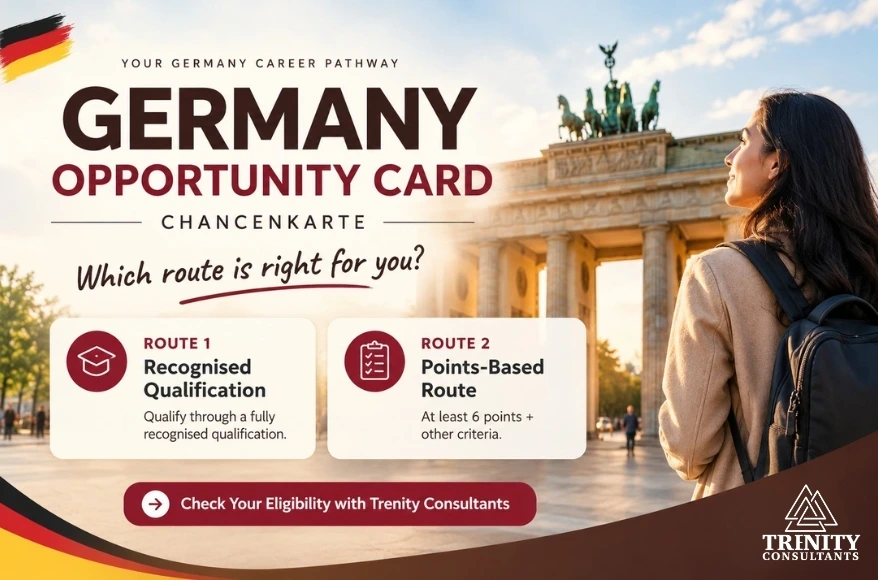
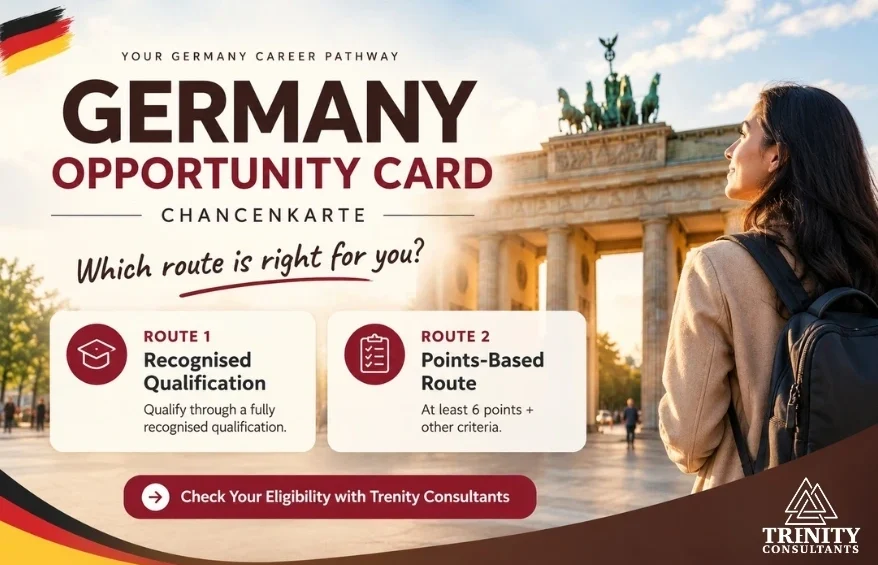
There are two ways to qualify for the Opportunity Card/Chancenkarte.

1. Recognized qualification:

If you hold a German qualification or a foreign academic or vocational qualification fully recognized in Germany, you may qualify without collecting points. For a foreign university degree, ANABIN information or a Statement of Comparability from the Central Office for Foreign Education (ZAB) may be relevant. Vocational qualifications follow their own recognition requirements.

2. Points-based route:

If your qualification meets the requirements in the country where you obtained it but is not fully recognized in Germany, you may qualify by meeting the basic conditions and scoring at least six points. You generally need a university degree or a vocational qualification involving at least two years of training, along with German at A1 level or English at B2 level.

Points can be awarded for factors such as professional experience, language ability, age, partial recognition of qualifications, and previous lawful residence in Germany.

The official Opportunity Card self-check is a useful starting point. Keep evidence for the answers you give; a self-check result does not replace the supporting documents required for your application.

Germany Opportunity Card Documents Checklist 2026

Start collecting your documents early, particularly if you need qualification recognition, translations, or certificates from previous employers.

Germany Opportunity Card Documents Checklist

Prepare your documents before submitting your application

DocumentWhat to check
PassportValidity, required copies and available pages
Visa applicationCompleted and signed as instructed
PhotographsMeet the applicable biometric photo requirements
Qualification documentsDegree or vocational certificate and supporting records
ANABIN or ZAB evidenceRelevant evidence for your qualification route, where required
Language certificateAccepted test and required level, if applicable
CVClear education and employment history
Work-experience certificatesJob titles, duties and dates should be consistent with your CV
Financial evidenceBlocked account or other accepted proof, as applicable
Job-search planTarget roles, employers, location and career goals
Cover or motivation letterWhy you want to work in Germany and how you plan to find employment
Accommodation evidenceDocuments required by the German mission handling your application
Medical insurance evidenceCoverage accepted for the intended stay
Previous visas or residence permitsCopies where requested

**This is a preparation checklist, not a substitute for the official list issued by your German mission. Documents in languages other than English or German may need translation.

Applying from the UAE? Pay attention to these details.

The German Consulate General in Dubai’s Opportunity Card checklist contains additional instructions for applicants it serves.

In particular:

  • Residence documents: Prepare copies of your UAE residence permit and Emirates ID as specified in the checklist. Confirm that you fall within the consulate’s jurisdiction before applying.

  • Payment: The published checklist states that the visa fee must be paid in cash in AED and that exact change is required.

  • Insurance: Travel insurance alone is not sufficient. The checklist calls for incoming medical insurance or acceptable public or private insurance evidence as specified by the consulate.

  • Accommodation: Proof of accommodation in Germany for at least the first month is listed.

  • Job-search evidence: Prepare a plan identifying potential employers and your intended employment direction. Evidence of correspondence with employers can also be relevant.

Applicants living outside the UAE should follow the checklist issued by the German mission responsible for their place of residence.

How to Apply for the Germany Opportunity Card

The application is easier to organize when you tackle it in a practical order.

  1. Identify your eligibility route. Establish whether you qualify through a recognized qualification or the points system. Gather evidence for your qualification, language level, and professional experience.

  2. Check your qualification records. Review the relevant ANABIN information or find out whether you need a ZAB Statement of Comparability or vocational qualification evidence. Do not treat a submitted recognition request as proof that recognition has been granted.

  3. Complete the self-check and prepare your job-search plan. Identify the roles you want to pursue, the regions where you intend to look, and potential employers. Make sure your CV supports the experience you describe.

  4. Arrange your financial evidence and insurance. For 2026, the general guidance uses €1,091 net per month as the financial benchmark. Confirm the accepted evidence and any additional requirements for your application.

  5. Submit through the official process. Use the German Consular Services Portal and follow the instructions from the German mission responsible for your residence. Prepare the required forms, photographs, copies, and originals in the requested format.

  6. Attend your appointment and prepare for follow-up. Bring the documents requested by the mission and pay the applicable fee using its accepted method. Incomplete applications can require another appointment, and additional documents or an interview may be requested.

Once your visa is issued, check its validity dates and conditions before finalizing travel arrangements.

Proof of Funds: How Much Should You Prepare?

For 2026, the official German government guidance lists €1,091 net per month as the financial benchmark for the Opportunity Card.

For a full 12-month stay, that works out to €13,092. Additional return-flight funds may also be required under the relevant mission’s instructions.

The official guidance identifies a German blocked account or a declaration of commitment as ways to demonstrate financial support. The Dubai consulate’s checklist describes these options for applicants it serves.

Germany Opportunity Card: Expenses to Budget For

Plan for application costs and your initial stay in Germany

ExpenseWhat to budget for
Living expensesThe required amount for your intended stay
Visa feeGenerally €75 for a German national visa; confirm the current fee and payment method
Qualification recognitionAny applicable assessment or documentation charges
Language testingTest fees if you need an accepted language certificate
Translation and document preparationCosts based on the documents you need to submit
InsuranceSuitable coverage for your intended stay
Travel and accommodationFlights, initial accommodation and arrival expenses

Remember your proof of funds

For 2026, the general financial benchmark is €1,091 net per month. For 12 months, that amounts to €13,092. Additional funds for a return flight may also be required. Check the latest official Opportunity Card guidance and your responsible German mission's requirements.

Your total budget will depend on your circumstances and how much preparation your application requires. Check the current financial requirements before opening an account or arranging sponsorship.

Common Application Mistakes That Are Easy to Overlook

Small inconsistencies can create unnecessary questions during an application. Pay particular attention to these areas:

  • Qualification evidence that does not match the claim: Check the university and degree information in ANABIN rather than assuming that one entry settles every recognition question.

  • Experience that is difficult to verify: Make sure employment dates, job titles, and duties are consistent across your CV and work-experience certificates.

  • A weak job-search plan: Naming a broad industry is less useful than explaining the roles you intend to pursue, the employers you have researched, and where you plan to look.

  • Insufficient financial preparation: Calculate the amount for your intended stay and account for any additional funds required by the mission.

  • Incorrect insurance: For UAE applicants, the Dubai consulate specifically states that travel insurance alone is insufficient.

  • A checklist taken from another country: Requirements published by one German mission should not automatically be treated as the checklist for another.

The Dubai consulate also warns that submitting a complete set of documents does not guarantee that a visa will be granted.

What Can You Do With the Opportunity Card?

The Opportunity Card is designed to help eligible applicants search for qualified work in Germany. During the job search, holders can undertake secondary employment totalling up to 20 hours per week. Job trials of up to two weeks per employer are also permitted when they meet the official conditions.

Finding a suitable job does not automatically convert the card into a long-term work residence permit. You will need to follow the appropriate process for the employment or residence category that applies to your circumstances.

Germany Opportunity Card to permanent residency

The Germany Opportunity Card can be a starting point for building a long-term future in Germany, but it does not lead to permanent residency automatically.

  • Find a qualifying job: The Opportunity Card allows you to search for employment in Germany for up to 12 months.

  • Switch to a work residence permit: Once you secure suitable employment, you may apply for an appropriate residence permit through the local foreigners authority (Ausländerbehörde).

  • Explore the EU Blue Card: In 2026, the general salary threshold is €50,700 per year, or €45,934.20 for eligible recent graduates and certain shortage occupations, subject to the applicable conditions.

  • Consider a skilled-worker permit: If you do not meet the EU Blue Card requirements, a skilled-worker residence permit may be another option, depending on your qualifications and job.

  • Work towards permanent residency: Eligible EU Blue Card holders may qualify for a settlement permit after 27 months with A1 German or 21 months with B1 German, subject to other requirements.

  • Meet settlement requirements: The route and waiting period depend on your residence permit, employment history, pension contributions, language ability and other legal conditions.

  • Understand the citizenship process: German citizenship is a separate application with its own eligibility requirements.

Explore our Living and Working in Germany guide to learn more about residence options and the pathway towards long-term settlement.

How Trenity Consultants Can Help

The Opportunity Card is designed to help eligible applicants search for qualified work in Germany. During the job search, holders can undertake secondary employment totalling up to 20 hours per week. Job trials of up to two weeks per employer are also permitted when they meet the official conditions.

Finding a suitable job does not automatically convert the card into a long-term work residence permit. You will need to follow the appropriate process for the employment or residence category that applies to your circumstances.

Book a Free Consultation

Book a free consultation today and get expert guidance tailored to your profile.

Frequently Asked Questions

Can I apply for the Germany Opportunity Card/Chancenkarte without a job offer?

Yes. The card is intended for eligible applicants who want to search for qualified employment in Germany before securing a job offer.

Can I apply from a country other than the UAE?

Yes, if you meet the requirements and follow the application procedure for your place of residence. Check the German mission responsible for your application because local document and submission instructions can differ.

How long can I stay in Germany on the Opportunity Card?

The initial job-search Opportunity Card can be issued for up to 12 months. The period granted depends on the applicable requirements and the validity stated on your visa.

Can I work while looking for a job?

Yes. Secondary employment of up to 20 hours per week is permitted. Job trials of up to two weeks per employer are also allowed under the official conditions.

Does the Opportunity Card guarantee employment?

No. It allows eligible applicants to search for work; finding a job depends on their qualifications, experience, language skills, employer requirements and the labour market.

Need Immigration Assistance? Connect With Trenity Consultants Near You

Choose your nearest office and visit your local country page for personalized immigration guidance.

🇦🇪
Abu Dhabi
United Arab Emirates
Immigration Consultants in Abu Dhabi
Visit Page
🇦🇪
Dubai
United Arab Emirates
Immigration Consultants in Dubai
Visit Page
🇦🇪
Sharjah
United Arab Emirates
Immigration Consultants in Sharjah
Visit Page
🇰🇼
Kuwait
Kuwait
Immigration Consultants in Kuwait
Visit Page
🇧🇭
Bahrain
Bahrain
Immigration Consultants in Bahrain
Visit Page
🇶🇦
Qatar
Qatar
Immigration Consultants in Qatar
Visit Page
🇴🇲
Oman
Oman
Immigration Consultants in Oman
Visit Page
🇸🇦
Riyadh
Saudi Arabia
Immigration Consultants in Riyadh
Visit Page
🇸🇦
Jeddah
Saudi Arabia
Immigration Consultants in Jeddah
Visit Page

Share:

770,000 jobs open in Germany — 2026 guide to visas, salaries and permanent residency | Trenity Consultants

Complete 2026 Guide to Germany Work Visa, Jobs & Permanent Residency

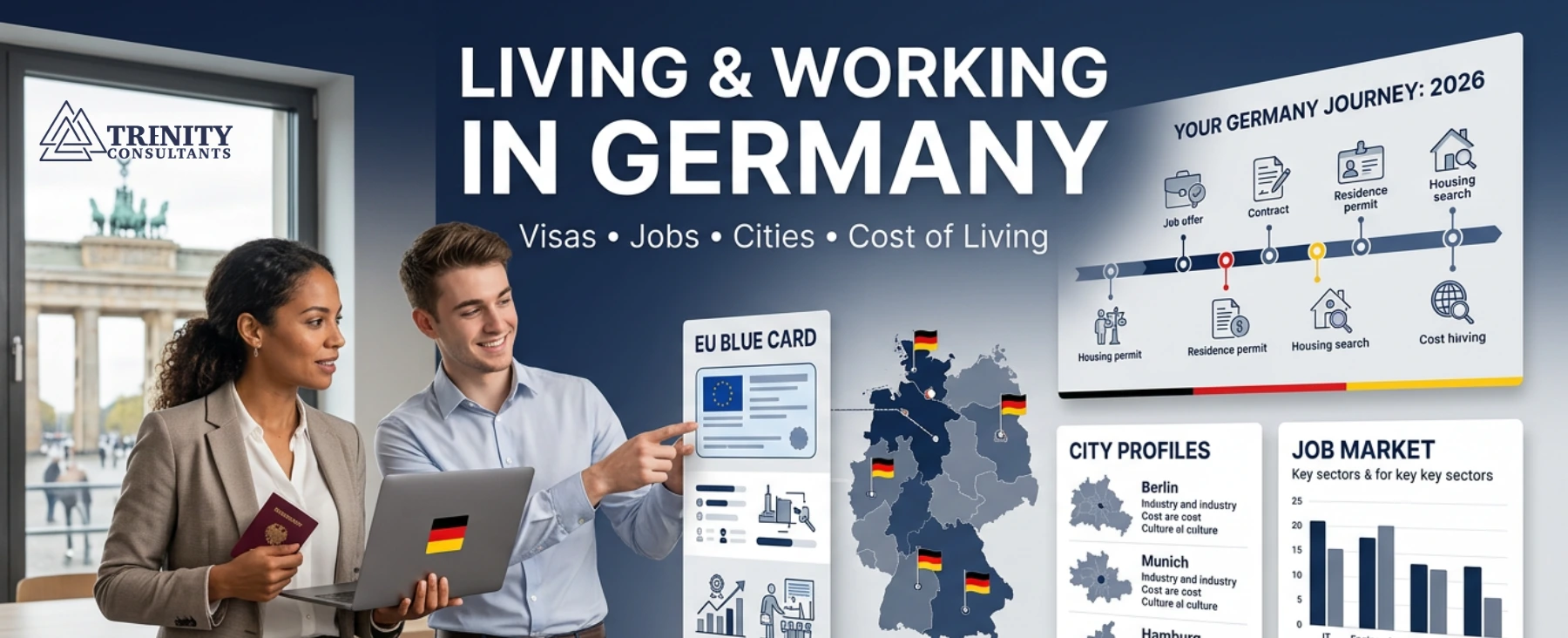
Living and working in Germany 2026 guide — visas, jobs, cities and cost of living | Trenity Consultants

Living and working in Germany: Complete 2026 Guide to Germany Work Visa, Jobs & Permanent Residency

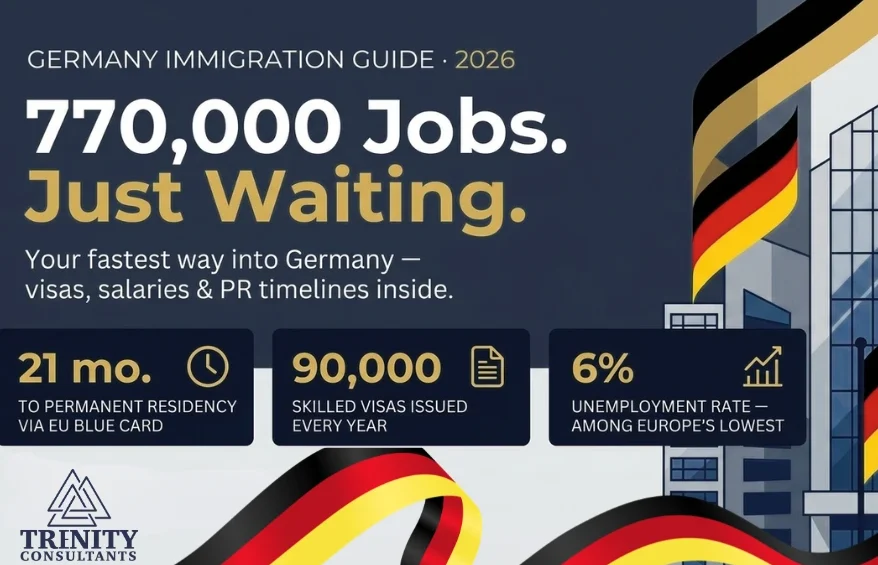
Living and working in Germany is a goal for thousands of skilled professionals every year. If you’re weighing up living and working in Germany, you’re looking at a country with over 770,000 unread job vacancies, a five-day working week written into law, and one of the fastest permanent residency timelines anywhere in the EU. The catch is that the system runs on paperwork, deadlines and a points table – which is exactly where most applications quietly stall.

This guide walks through what actually matters: which visa fits your situation, what jobs are paying right now, where to live, what it costs, and how the permanent residency clock starts ticking the day you land. Trenity Consultants put this guide together from the current 2026 rules, not last year’s numbers, so treat it as your working reference rather than a general overview.

In this guide, you’ll learn everything about living and working in Germany, including Germany work visas, the EU Blue Card, the Opportunity Card, in-demand jobs, average salaries, cost of living, permanent residency, and how to apply from the UAE or other GCC countries.

Are you applying from Abu Dhabi or anywhere else in the Gulf? Trenity Consultants also works as a dedicated Germany work permit & visa consultant in Abu Dhabi, handling the same EU Blue Card and Skilled Worker Visa process for UAE-based professionals from document collection through to consulate submission.

Germany at a Glance 2026

Job Vacancies 770,000+
Unemployment Rate ~6%
Skilled Workers Invited Annually ~90,000
EU Blue Card PR Timeline 21 months (with B1 German)
Standard PR Timeline (Skilled Worker Visa) 5 years (4 years with B1 German)
Path to Citizenship 5 years' residence; dual citizenship generally allowed
Minimum Paid Leave 20+ days/year
Standard Work Week 5 days (~38–40 hours)
Minimum Wage ~€12.82/hour (2026)
Official Language German (English widely used in IT, finance, multinationals)
Currency Euro (EUR)
Top Hubs for Foreign Talent Berlin, Munich, Frankfurt, Hamburg, Stuttgart

Want to check where you stand? Sign up for a free eligibility check with Trenity Consultants.

Looking for the best consultancy for Germany work permits? Trenity Consultants provides professional guidance on work permit options for Germany, eligibility assessments, and application support for clients across Abu Dhabi, Dubai, Sharjah, Bahrain, Qatar, Kuwait, Oman, Riyadh & Jeddah.

Why Living and Working in Germany Is Attracting Skilled Professionals in 2026

Germany isn’t quietly hoping skilled workers show up it’s actively rewriting policy to get them there faster. A few things stand out if you’re comparing it against other migration destinations:

  1. Europe’s largest economy is short on workers across IT, engineering, healthcare and the skilled trades, not just one sector.
  2. The EU Blue Card offers a route to permanent residency in as little as 21 months, faster than most comparable programmes in Western Europe.
  3. The Opportunity Card lets qualified professionals enter and job-hunt on the ground, rather than applying blindly from abroad.
  4. Public universities remain free or near-free, and statutory health insurance covers most of what a family needs.
  5. Since the 2024 citizenship reform, Germany generally permits dual nationality and cut the residency requirement for citizenship from 8 years to 5.

Not sure which of these actually applies to your profession? That’s usually the first thing an immigration consultant checks before you spend weeks on a visa route that was never going to fit.

Germany's Job Market in 2026: Where the Openings Actually Are

If you’re planning on living and working in Germany, understanding the current job market is the first step toward finding suitable employment. Demand isn’t spread evenly. IT and engineering are pulling ahead in both volume and salary, but healthcare and skilled trades aren’t far behind.

In-Demand Sectors - Germany 2026

SectorAverage Salary (EUR/Year)DemandSample Roles
IT & Software€55,000–€90,000Very HighCloud Engineer, Backend Developer, AI/ML Engineer
Engineering€55,000–€85,000Very HighMechanical, Automotive, Electrical Engineer
Finance & Banking€60,000–€100,000HighRisk Analyst, Compliance Officer, FinTech Specialist
Healthcare€45,000–€90,000HighRegistered Nurse, Specialist Doctor, Medical Technician
Skilled Trades€40,000–€55,000HighElectrician, HVAC Technician, Plumber
Research & Academia€50,000–€70,000ModeratePostdoctoral Researcher, Research Associate, Lecturer

English gets you further in tech and finance than most people expect, particularly with the larger multinational employers. But German at a working level – B1 is the usual benchmark – still provides more opportunities, especially outside the biggest cities, and it’s practically required once you’re applying for permanent residency.

Visa Routes for Non-EU Professionals

Choosing the right visa is one of the most important parts of living and working in Germany successfully. Three routes cover most skilled migrants. Which one fits depends mainly on whether you already have a job offer.

Visa Routes Comparison

Visa TypeBest ForValidityPR Timeline
EU Blue Card Degree + job offer with a qualifying salary (€45,934–€50,700) Up to 4 years 21 months (B1 German) / 27 months (A1 German)
Skilled Worker Visa Recognised qualification + German job offer Up to 4 years 5 years (4 years with B1 German)
Opportunity Card Skilled job seekers with at least 6 points Up to 12 months (job search) Can transition to the EU Blue Card or Skilled Worker Visa pathway

1. EU Blue Card

The default choice for degree-holders with a job offer that clears the salary threshold, and the fastest of the three routes to permanent residency.

The lower threshold (~$45,934) applies to shortage occupations, recent graduates and qualifying IT specialists — worth checking before you assume you don’t qualify.

2. Skilled Worker Visa

This route is designed for vocational and academic qualifications that fall outside the Blue Card’s scope. A broader net, but a longer road to residency. Qualification recognition through Germany’s ZAB or Anabin database is usually the slowest part of this route — start it early, not after you’ve accepted an offer.

3. Opportunity Card

No job offers yet? This points-based route lets you enter Germany and search on the ground for up to 12 months.

You’ll need to show financial self-sufficiency for the job-search period, roughly €1,091 a month, before the card is issued.

Based in the UAE? All three routes above are filed the same way whether you’re applying from home or from the Gulf. If you’re arranging a German work permit from Abu Dhabi, UAE, Trenity’s local desk handles document attestation and consulate submission on the ground – see the full Germany Work Permit & Visa Consultant in Abu Dhabi service page for details.

Best German Cities to Live and Work

CityKey IndustriesAverage Rent (1-Bedroom Apartment)Job Market
BerlinStartups, IT, Technology, Creative Industries, Digital Economy€900–€1,200/monthVery Strong – Growing demand for tech, software, and international talent
MunichAutomotive, Engineering, Technology, Manufacturing, Finance€1,200–€1,800/monthExcellent – One of Germany’s strongest employment markets
FrankfurtBanking, Finance, Insurance, Consulting, Logistics€1,100–€1,400/monthStrong – Major financial hub with international employers
HamburgLogistics, Aviation, Media, Trade, Maritime Industries€1,000–€1,300/monthStrong – High demand in logistics, engineering, and skilled sectors
StuttgartAutomotive, Manufacturing, Engineering, Research & Development€1,100–€1,400/monthStrong – Home to leading automotive companies and suppliers

Cost of Living: What to Actually Budget For

The cost of housing, transport, and daily expenses plays a major role when living and working in Germany. Munich and Frankfurt sit at the top of the price scale; Berlin, despite being the capital, remains comparatively affordable. Here’s a realistic monthly spread for a single adult in a mid-sized German city.

ExpenseEstimated Cost
Rent (1-Bedroom Apartment, City Centre)€800–€1,200/month
Utilities (Electricity, Heating, Water)€150–€250/month
Groceries€200–€300/month
Public Transport Pass€60–€100/month
Mobile & Internet€30–€50/month
Dining Out (Per Meal)€12–€20
Leisure & Entertainment€100–€200/month

Against Switzerland, Germany looks noticeably cheaper for a comparable salary. Against the UK, it’s roughly on par, sometimes a shade lower outside London-equivalent cities” while still paying competitively in IT, engineering and finance.

1. Register your address (Anmeldung) at the local Bürgeramt within two weeks of arrival.
2. Register with a statutory health insurer (Krankenkasse) – most employers will ask for this before payroll starts.
3. Open a bank account; Deutsche Bank, Sparkasse, Commerzbank and N26 are the common starting points.
4. Apply for your residence permit or EU Blue Card at the local Ausländerbehörde.
5. Get a German SIM and set up transport and banking apps.
6. If you have children, apply for school places early -international schools fill up fast.

Path to Permanent Residency and Citizenship

Residency Timeline by Route

StageRequirementTimeline
EU Blue Card HolderRecognised degree qualification and meeting the required salary threshold21 months (with B1 German) / 27 months (with A1 German)
Skilled Worker Visa HolderContinuous employment, required residence period, and pension contributions5 years (4 years with B1 German)
Opportunity Card HolderConvert to a suitable work residence permit after securing employmentUp to 12 months job search + standard PR timeline
German CitizenshipB1 German language skills, integration requirements, and legal residence5 years (dual citizenship generally permitted)

Skills and Language: What Employers Actually Screen For

Beyond the technical qualification on your CV, German employers consistently rank a specific set of soft and hard skills higher than most applicants expect:

– Digital and programming literacy -even outside pure tech roles
– German language, B1 minimum -for client-facing or people-management roles especially
– Cross-cultural communication and comfort working in mixed-nationality teams
– Project management fluency -Agile and Scrum show up constantly in job listings
– Adaptability -Germany’s Mittelstand (mid-sized company) sector moves fast and expects flexibility

Why Work With an Immigration Consultants for Germany

Living and working in Germany offers excellent career opportunities, competitive salaries, and a clear pathway to permanent residency for skilled professionals. The rules above are the ones that hold true today – but salary thresholds, points tables and processing times shift every year, and most refusals come down to a document filed the wrong way or a qualification that was never formally recognised. This is the exact gap that experienced immigration consultants for Germany are here to close.

Trenity Consultants works through your profile against the current EU Blue Card, Skilled Worker Visa and Opportunity Card rules, flags qualification-recognition issues before they cost you months, and keeps your application moving instead of sitting in a queue. As a Germany immigration consultant, that’s the whole job – fewer surprises, fewer resubmissions, faster decisions.

UAE-based professionals can work with our local team directly – see Germany Work Permit & Visa Consultant in Abu Dhabi for the full UAE-specific process.

Book a free consultation with Trenity Consultants today!

Book a Free Consultation

Book a free consultation today and get expert guidance tailored to your profile.

Frequently Asked Questions

Is Germany good for expats and skilled migrants?

Generally, yes. Low unemployment, over 770,000 open vacancies, accessible statutory healthcare, and one of Europe's fastest EU Blue Card routes to permanent residency make it a strong option for skilled professionals, though the paperwork-heavy system takes some getting used to.

Do I need to speak German to work in Germany?

Not always -English is common in IT, multinational firms and finance, especially in Berlin, Munich and Frankfurt. But German at B1 level is generally required for permanent residency and citizenship, and it opens up far more roles outside the biggest hubs.

How much money do I need to move to Germany?

Plan for roughly €2,500–€6,000 in initial costs—visa fees, flights, a rental deposit, and first month's expenses. The Opportunity Card also requires proof of about €1,091/month in self-sufficiency during the job search.

What is the EU Blue Card salary threshold in 2026?

From January 2026, the general threshold sits around €50,700/year, dropping to roughly €45,934 for shortage occupations, recent graduates, and qualifying IT specialists.

Can I move to Germany without a job offer?

Yes – the Opportunity Card (Chancenkarte) lets qualified professionals scoring 6+ points enter Germany and job-hunt for up to 12 months before converting to a Skilled Worker Visa or EU Blue Card.

How can immigration consultants for Germany help my application?

They check your eligibility against current thresholds, guide you through qualification recognition, prepare documentation to the standard German authorities expect, and reduce the chance of delays or refusals -which is where most self-filed applications lose time.

Can I apply for a German work permit from Abu Dhabi or elsewhere in the UAE?

Yes. UAE-based applicants follow the same EU Blue Card, Skilled Worker Visa or Opportunity Card routes, usually submitting documents at the German Consulate in Dubai or Abu Dhabi. Trenity Consultants runs a dedicated [Germany Work Permit & Visa Consultant in Abu Dhabi] (https://trenityconsultants.com/germany-work-permit/) service to handle attestation, document prep and consulate submission locally.

How to Change my Photo from Admin Dashboard?

Far far away, behind the word mountains, far from the countries Vokalia and Consonantia, there live the blind texts. Separated they live in Bookmarksgrove right at the coast

Ready to Start Your Germany Move?

Trenity Consultants can check your eligibility across the EU Blue Card, Skilled Worker Visa and Opportunity Card in one free session. Based in the UAE? Talk to our [Germany Work Permit & Visa Consultant in Abu Dhabi](https://trenityconsultants.com/germany-work-permit/) team directly.

Ready to Start Your Application?

Every country on this list has different rules, timelines, and paperwork. Getting the details right the first time is usually the difference between a permit approved in a few months and one stuck in review for twice as long.

Trenity Consultants works with applicants across Abu Dhabi, Dubai, Sharjah, Bahrain, Qatar, Kuwait, Oman, Riyadh & Jeddah to identify which route to European employment actually fits their qualifications, and then manages document preparation and submission from start to finish.

Book a free eligibility check with Trenity Consultants and find out which country gives you the fastest, most realistic path to work in Europe.

Need Immigration Assistance? Connect With Trenity Consultants Near You

Choose your nearest office and visit your local country page for personalized immigration guidance.

🇦🇪
Abu Dhabi
United Arab Emirates
Immigration Consultants in Abu Dhabi
Visit Page
🇦🇪
Dubai
United Arab Emirates
Immigration Consultants in Dubai
Visit Page
🇦🇪
Sharjah
United Arab Emirates
Immigration Consultants in Sharjah
Visit Page
🇰🇼
Kuwait
Kuwait
Immigration Consultants in Kuwait
Visit Page
🇧🇭
Bahrain
Bahrain
Immigration Consultants in Bahrain
Visit Page
🇶🇦
Qatar
Qatar
Immigration Consultants in Qatar
Visit Page
🇴🇲
Oman
Oman
Immigration Consultants in Oman
Visit Page
🇸🇦
Riyadh
Saudi Arabia
Immigration Consultants in Riyadh
Visit Page
🇸🇦
Jeddah
Saudi Arabia
Immigration Consultants in Jeddah
Visit Page

Share: