





Our Presence
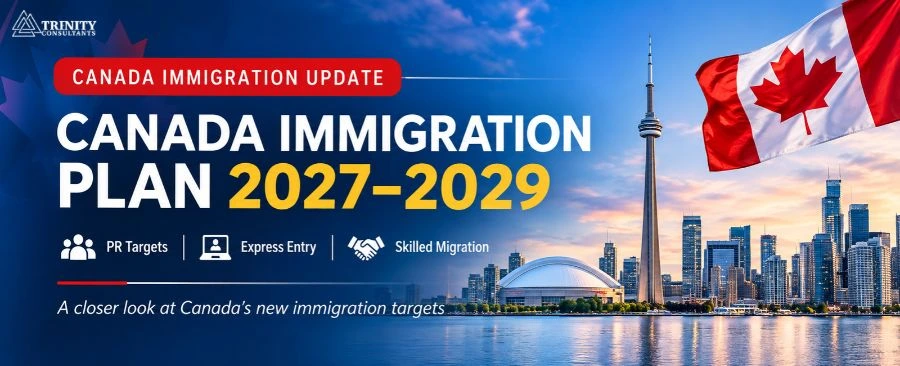
Canada has kept its annual permanent residence target at 380,000 for 2027, 2028 and 2029. But the latest Immigration Levels Plan brings some important changes to how those places are distributed. Federal High Skilled admissions, which include the main Express Entry programs, are set at 100,000 a year. The Provincial Nominee Program and Atlantic Immigration Program receive higher allocations than previously projected. Canada has also announced additional permanent residence spaces for certain people who are already living in the country.
For skilled professionals in Abu Dhabi and across the GCC, the figures are worth understanding before making plans to move to Canada. While national targets do not determine individual eligibility, they offer useful insight into available immigration pathways. Canada’s skilled immigration consultants in Abu Dhabi can help applicants understand Express Entry, explore suitable provincial programmes and assess their profiles against current requirements.
Immigration, Refugees and Citizenship Canada (IRCC) publishes an Immigration Levels Plan each year. It sets out the number of permanent residents Canada intends to admit over the following three years, alongside targets for new temporary worker and international student arrivals.
The plan divides permanent residence admissions into broad categories: economic immigration, family sponsorship, refugees and protected individuals, and humanitarian and other admissions. Within the economic category, it also sets targets for programs such as Express Entry, provincial nomination and regional immigration pathways.
These figures are planning targets, not individual application quotas. They do not guarantee that a particular program will issue more invitations or that an applicant will receive permanent residency. The figures for 2028 and 2029 are also subject to review in future annual plans.
The official IRCC 2027–2029 Immigration Levels Plan provides the detailed breakdown.
Canada plans to admit 380,000 permanent residents in each of the three years covered by the plan. That is a combined target of 1.14 million admissions between 2027 and 2029. For 2027, the overall planning range is 352,500 to 422,000.
The economic category accounts for 244,700 admissions a year, or 64.4% of the total. This remains the largest part of Canada’s immigration program, reflecting the government’s focus on attracting people who can contribute to the workforce and meet regional economic needs.
The annual category targets are:
| Immigration Category | Annual Target | Share of Total |
|---|---|---|
| Economic Class | 244,700 | 64.4% |
| Family Class | 81,000 | 21.3% |
| Refugees and Protected Persons | 49,300 | 13.0% |
| Humanitarian and Other | 5,000 | 1.3% |
| Total Permanent Resident Admissions | 380,000 | 100% |
These are admissions across the relevant programs, including people already in Canada who are transitioning to permanent residence. They should not be read as places reserved exclusively for overseas applicants.
The plan also sets annual targets of 370,000 new temporary resident arrivals for 2027, 2028 and 2029. This includes 220,000 workers and 150,000 international students.
The worker allocation is divided between 170,000 arrivals under the International Mobility Program and 50,000 under the Temporary Foreign Worker Program.
These figures relate to new arrivals under the specified worker and student programs. They do not include visitor visa or eTA arrivals, permit extensions or every person who already holds temporary status in Canada. The distinction matters: the target is not a count of Canada’s entire temporary resident population.
The Federal High Skilled category has an annual target of 100,000 admissions throughout 2027–2029. It includes the Federal Skilled Worker Program (FSWP), Canadian Experience Class (CEC) and Federal Skilled Trades Program (FSTP), all managed through the Express Entry system.
Compared with the previous plan’s projection for 2027, the allocation has been reduced. At the same time, provincial and regional programs have received higher targets.
| Immigration Category | Previous 2027 Projection | New 2027 Target |
|---|---|---|
| Federal High Skilled | 111,000 | 100,000 |
| Provincial Nominee Program (PNP) | 92,500 | 95,000 |
| Atlantic Immigration Program (AIP) | 4,000 | 6,000 |
The comparison shows a shift in the planned distribution of economic admissions. It does not mean that Express Entry is closing or that every provincial program will become easier to access.
There is another important distinction. The 100,000 Federal High Skilled figure represents planned permanent resident admissions, not the number of invitations to apply. Express Entry draw sizes, CRS cut-offs and category-based selection priorities are separate decisions made by IRCC.
For someone applying from outside Canada, the Federal Skilled Worker Program is often the most relevant Express Entry route to investigate. It assesses factors such as skilled work experience, education, language ability and other selection criteria. The Canadian Experience Class, by contrast, requires qualifying skilled work experience in Canada. The Federal Skilled Trades Program is intended for eligible applicants with experience in qualifying trades.
A lower admissions target is a reason to assess your profile carefully, not a reason to assume that applying is no longer worthwhile.
The Provincial Nominee Program (PNP) has an annual target of 95,000 admissions from 2027 to 2029. This is higher than the previous projection of 92,500 for 2027.
Provincial nomination allows participating provinces and territories to select candidates whose experience and skills match local workforce requirements. That makes the program particularly relevant to applicants whose occupations are in demand in specific regions.
The requirements are not the same across Canada. One stream may focus on a particular occupation, while another may require a job offer, a connection to the province or a specific level of language ability. Some nomination streams are linked to Express Entry; others operate separately.
A higher national PNP target does not mean every province will increase its intake by the same amount. Each province has its own allocation, application windows and selection priorities. Candidates should look at the individual stream requirements rather than relying on the national figure alone.
Express Entry and provincial nomination are not the only economic pathways included in the plan. Canada is also maintaining or increasing allocations for regional programs.
The Atlantic Immigration Program has a target of 6,000 admissions a year. It is designed for eligible skilled workers and international graduates who have a job offer from a designated employer in one of Canada’s four Atlantic provinces.
The Rural Community Immigration Program has targets of 5,500 in 2027, 6,000 in 2028 and 6,500 in 2029. Its focus is on helping participating communities attract workers to meet local labour needs. Eligibility depends on the community, the occupation and the relevant program requirements.
French-language ability also remains part of Canada’s immigration priorities. The target for French-speaking permanent resident admissions outside Quebec rises from 9.5% in 2027 to 10.5% in 2028 and 12% in 2029. Candidates with strong French-language skills may therefore have additional options worth investigating.
These programs are not interchangeable. A candidate needs to meet the requirements of the pathway, including any employer, occupation, language or location conditions.
Alongside the regular Immigration Levels Plan, the government has announced additional permanent residence processing space for up to 200,000 people already living in Canada. The measure is time-limited and covers two broad groups.
The workers’ cohort provides up to 100,000 spaces for eligible workers already in Canada and their families. It is intended to support regional labour needs, with provinces and territories involved in identifying eligible candidates. The measure is not a general invitation for every temporary worker to apply. It covers people who meet specific conditions, including certain workers eligible through provincial nomination or those with applications under selected programs.
A further allocation of up to 100,000 spaces is intended for specific humanitarian and family-related cases already in the Canadian system. These include certain applicants under the Hong Kong and Ukraine pathways, some family sponsorship applications and people whose humanitarian and compassionate applications have already been approved in principle.
This distinction is important for anyone applying from overseas. The measure does not create a new permanent residence route for people living in Abu Dhabi, the UAE or elsewhere outside Canada. It is designed to address applications and groups already in the country.
IRCC has published further details on its time-limited measures for people already in Canada. The government is also continuing earlier initiatives announced in Budget 2025 to transition up to 33,000 work permit holders and up to 115,000 protected persons in Canada and their dependants during 2026 and 2027. These are separate measures.
For professionals living in Abu Dhabi, Dubai, Sharjah, Jeddah, Riyadh, Qatar, Kuwait, Bahrain and Oman, the main takeaway is that Canada’s economic immigration programs remain significant, but the routes are not all moving in the same direction.
Federal High Skilled admissions have been reduced compared with the previous 2027 projection, while PNP and Atlantic Immigration Program targets have increased. That makes it sensible to look beyond one immigration route when assessing your options.
Your place of residence does not, by itself, determine whether you qualify for Canadian permanent residence. The more relevant questions concern your occupation, work history, education, language results and whether you meet the criteria of a particular program.
For example, a professional with several years of skilled work experience outside Canada may wish to assess eligibility under the Federal Skilled Worker Program. Someone with experience in a trade may need to look at the Federal Skilled Trades requirements. A candidate whose occupation matches a provincial labour need may discover a suitable PNP stream worth researching.
Education credentials may also need an educational credential assessment, while language test results can affect both program eligibility and Express Entry ranking. The details matter; two applicants with similar job titles may have very different options once their actual duties, qualifications and experience are assessed.
Those exploring Canada immigration options with Trenity Consultants can begin by reviewing their profile and identifying which pathways are relevant. It is more useful to establish where you may qualify than to choose a program simply because its national allocation has increased.
Before committing to an immigration route, take time to understand the requirements and how your own background measures up.
Start with your work experience. The occupation classification, length of employment and duties performed can all matter. Job titles alone may not establish that your experience meets a program’s requirements.
Review your education and find out whether an educational credential assessment is needed. Be aware of the language requirements of the programs you’re applying for and how your scores impact your eligibility and CRS points.
If Express Entry appears suitable, calculate your CRS score and review the current selection categories. It is also worth researching provincial streams that match your occupation and experience. Some require a job offer or a connection to the province; others have different selection criteria.
Keep your supporting documents organised. Employment reference letters, educational records, identity documents and language test results can take time to arrange. Check the latest instructions on the official IRCC website before submitting an application, as program requirements and intake arrangements can change.
For a starting point, you can also use Trenity’s immigration eligibility check.
The immigration plan provides useful context, but it cannot tell an applicant which route is suitable. That depends on individual circumstances, including qualifications, occupation, work experience, language ability and the requirements in force when an application is made.
Trenity Consultants assists individuals exploring international immigration options, including Canadian skilled migration. For professionals based in Abu Dhabi and across the GCC, reviewing the available routes can help clarify whether the Federal Skilled Worker Program, Express Entry or a provincial nomination pathway deserves further consideration.
If Canada is part of your plans, begin with an assessment of your profile rather than assumptions based on annual immigration targets.
Speak to Trenity Consultants to explore your Canada skilled migration options.
This article is for general information and reflects the published 2027–2029 Immigration Levels Plan as of 9 November 2026. Immigration targets, program criteria and application procedures may change. Applicants should consult current official IRCC guidance before making immigration decisions.
Choose your nearest office and visit your local country page for personalized immigration guidance.
Share:










Sign up for a Newsletter