





Our Presence
Employment and Social Development Canada quietly updated its website on August 18, 2026. No press conference, no big announcement — just a change buried in the program requirements page for the Temporary Foreign Worker Program. But if you’re a small employer who’s been told you don’t qualify under the old low-wage cap math, this is worth ten minutes of your time.
At Trenity Consultants, we’ve already had clients asking what this change means for Canadian employers and foreign workers. So, let’s walk through what changed, who may benefit, and — just as important — what this doesn’t do.
Trenity Consultants provides professional guidance on Canada immigration pathways, Express Entry, skilled migration, PNP options, eligibility assessments, documentation, and application support for clients across Abu Dhabi, Dubai, Sharjah, Bahrain, Qatar, Kuwait, Oman, Riyadh and Jeddah. Trenity supports applicants through the Canada immigration process, from initial profile assessment and pathway selection through documentation and application submission
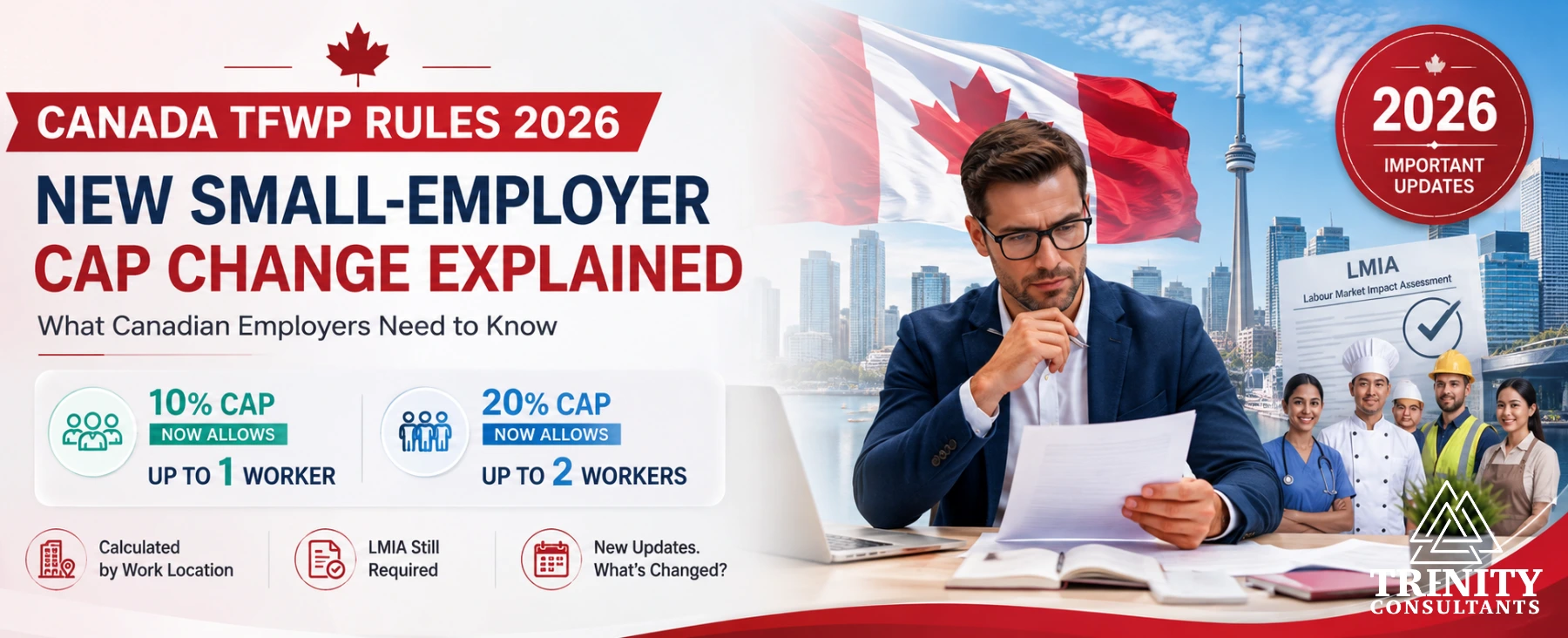
The standard TFWP low-wage cap is 10% of an employer’s workforce at a given location. Simple enough, until you apply it to a small team. Six employees, times 10%, gives you 0.6 of a worker. Service Canada doesn’t round up, so a business with a genuine labour gap ended up with zero approvals — not because the case was weak, but because the arithmetic worked against them.
A handful of sectors get more room: construction, food manufacturing, hospitals, nursing and residential care, and specified in-home caregiver roles sit under a 20% cap rather than 10%. Same rounding problem applied there too.
This means ESDC has changed how the Temporary Foreign Worker Program (TFWP) low-wage LMIA cap is calculated for certain small employers/locations.
In simpler terms: previously, an employer with fewer than 10 employees could effectively have a very restrictive cap. Under the adjustment, eligible small locations can calculate the cap as if they have 10 employees, even if their actual workforce is smaller. That can turn a previous zero-worker allowance into one worker, and in some cases two, depending on the applicable cap percentage and calculation.
Under the new calculation, a location subject to the standard 10% cap can bring on one low-wage temporary foreign worker. A location under the sector-specific 20% cap can bring on two. Not a large number in absolute terms — but for a business that was previously locked out entirely, going from zero to one is the whole ballgame.
Here’s the detail a lot of the coverage on this has glossed over: before August 18, the small-workforce exception only kicked in if a company’s entire headcount was under 10. A restaurant group running six branches with 40 total staff didn’t qualify, even if any single branch had just 6 or 7 people on the floor. The update moves the calculation from company-wide to location-specific, which is the actual shift that matters here. Multi-site employers — restaurant groups, dental and medical clinics, retail chains, care facilities — stand to gain the most, not just standalone small shops.
Say a dental clinic has 6 staff at one location and belongs to a larger group with several other branches. Before this update, that clinic’s application would have been assessed against the whole company’s headcount and likely rejected outright. Now it’s assessed on its own footing, and it can bring on one low-wage temporary foreign worker under the 10% cap.
Not sure whether your situation actually fits the small-employer cap, or whether the job offer you’ve got checks out under LMIA rules? As a trusted Canada immigration consultants in Abu Dhabi, Trenity can take a quick look and tell you where you stand — no cost, no obligation.
The workforce number used for the cap hasn’t changed — just where it’s applied. It still includes full-time and part-time staff (part-timers count as 0.5 each), Canadians, permanent residents, existing temporary foreign workers, and employees on approved leave who are expected to return. Vacant positions tied to a pending application count too, along with anyone who already has an approved LMIA but hasn’t started yet.
Separately from the cap update, ESDC raised the hourly wage thresholds that decide whether a role even falls under the low-wage stream in the first place. The new figures apply to LMIA applications received on or after July 17, 2026, and they’re set at 120% of the median hourly wage for each province and territory.
| Province | New Threshold | Effective Date |
|---|---|---|
| Ontario | $36.92/hour | July 17, 2026 |
| Alberta | $37.50/hour | July 17, 2026 |
| British Columbia | $38.40/hour | July 17, 2026 |
Every jurisdiction moved up this year, not just these three — so if you’re offering a wage that was previously classified as high-wage, it’s worth checking whether it still clears the bar. A position offered below the applicable threshold falls into the low-wage stream, which is where the cap rules discussed above come into play. Nothing about the small-employer cap change alters this threshold — the two updates are separate, and both matter for figuring out whether a position even qualifies.
There’s another update, this one relevant to workers already in Canada rather than to employers. On August 21, 2026, IRCC extended what’s called concurrent processing — the option to submit a work permit application before your employer’s LMIA has actually been decided.
It only applies in a fairly narrow set of circumstances: your current work permit has to be expiring in two weeks or less, your employer needs to have already filed a complete LMIA application with enough lead time for a decision to have been realistically possible, and no LMIA decision can have been made yet. If all of those lines up, IRCC will now hold your application for 90 days from the date you submit it — up from 60 — giving you that window to add proof of the LMIA once it comes through.
Worth being clear: this isn’t an LMIA exemption. It’s extra runway. If the job offer isn’t genuine, or the LMIA never lands, the extra 30 days doesn’t rescue the application — it just gets refused as incomplete once the window closes.
The caps themselves are unchanged — still 10% and 20%. An LMIA is still required for most TFWP-based work permits, and the small-employer calculation doesn’t turn an LMIA-required role into an LMIA-exempt one. Employers still carry their usual obligations around recruitment, wages, housing, and transportation. Rural employers in participating provinces still get a separate 15% cap, running from April 2026 through March 2027, which has nothing to do with the updates above. And critically, none of this guarantees a work permit for anyone — the employer’s LMIA and the worker’s individual eligibility both still have to hold up on their own.
Depends entirely on the program. TFWP roles are generally LMIA-based — the employer needs a positive or neutral Labour Market Impact Assessment before the worker can apply for the matching permit. The International Mobility Program runs on different rules and covers various LMIA-exempt categories. The first question to answer isn’t “do I need an LMIA,” it’s “which program am I actually under” — everything else follows from that.
If you run a small operation under 10 staff at a single site, or manage several small branches under a bigger company, this is worth a second look — especially if you were told “no” under the old rules and never checked back. The same goes for employers in construction, food manufacturing, healthcare, and eligible caregiving roles, where the 20% threshold now opens the door to two hires instead of none. And workers already in Canada with a pending LMIA should know about the extended grace period — it could be the difference between maintaining status and getting caught on a deadline.
Rule changes like this are where working with experienced Canada immigration consultants earns its keep. The cap math itself isn’t complicated. What trips people up is everything around it — whether the LMIA is structured properly, whether the offered wage clears the current threshold for that province, whether the specific work location genuinely qualifies under the new calculation.
If you’re comparing options and trying to find the best consultancy for Canada immigration and work permit support, a few things are worth checking before you commit: do they work with licensed RCICs rather than general advisors, can they point you to the current rule rather than something recycled from last year, do they look at your specific occupation, employer, and location instead of handing out a generic answer, and are they upfront about what a rule change does and doesn’t guarantee — because a firm promising a guaranteed approval is a red flag, not a selling point.
Trenity Consultants works across TFWP applications, LMIA-based work permits, and longer-term immigration pathways, and can tell you quickly whether a specific employer or worker profile fits under the current rules.
Neither of these August changes throw the TFWP wide open. What they do is fix a couple of narrow, specific bottlenecks — one for small and multi-location employers who were getting rounded down to zero, and one for workers stuck in an LMIA processing gap through no fault of their own. Whether either applies to you comes down to your work location’s headcount, your sector, your offered wage against the current threshold, and, for workers, your own eligibility for the permit category in question.
As a Canada work permit consultancy, Trenity Consultants can walk through your specific situation and tell you where you actually stand under the current TFWP and LMIA framework.
Book a consultation with Trenity Consultants to go over your options.
Immigration rules change often. Always confirm current requirements with the Government of Canada or a licensed consultant before applying.
Choose your nearest office and visit your local country page for personalized immigration guidance.
Share:










Sign up for a Newsletter