


U.S. H-1B skilled-worker pathway

H-1B Visa 2026: Is America’s Skilled Worker Route Becoming Too Expensive?

H-1B Visa 2026 - Skilled Worker Pathyway Canada

H-1B Visa 2026: Is America's Skilled Worker Route Becoming Too Expensive?

A few years ago, saying “I got my H-1B” meant you’d made it. Now the same sentence gets a follow-up question: can you even afford it?

That’s not exaggeration. In August 2026, the U.S. government proposed adding $103,265 to the cost of certain H-1B petitions. That’s not the only change either. The 60-day grace period workers count on after losing a job could go away too. H-4 spouse work authorization is also under review.

So what does this mean if you’re hoping to move to the U.S. on an H-1B visa in 2026? Let’s break it down.

If you’re in Abu Dhabi or anywhere else in the Gulf and considering a move to the U.S., Trenity Consultants, trusted immigration consultants for the USA, can help you understand whether the H-1B route fits your qualifications, occupation and career plans — and how the latest H-1B visa changes could affect your options. We assess your profile, explain the relevant pathway and guide you through the process, so you can make an informed decision instead of relying on changing headlines or guesswork.

Looking for a trusted consultancy to know more about Skilled pathways?

Trenity Consultants provides professional guidance on  immigration pathways, Express Entry, skilled migration, PNP options, eligibility assessments, documentation, and application support for clients across Abu Dhabi, Dubai, Sharjah, Bahrain, Qatar, Kuwait, Oman, Riyadh, and Jeddah. Trenity supports applicants through the immigration process, from initial profile assessment and pathway selection through documentation and application submission.

Check your eligibility now!

What's Actually Happening Right Now

Here’s the plain version.

On August 25, 2026, the Department of Homeland Security (DHS) published a proposal that would establish a $103,265 fee for H-1B cap-subject petitions, including petitions eligible for the advanced-degree exemption. The proposed fee would be paid at the time of filing and would be in addition to other applicable fees.

It’s a huge number. It’s also, right now, just a proposal.

The fee is not currently a universal requirement for every H-1B applicant. The proposal is going through the federal rulemaking process, with public comments due by September 24, 2026.

And based on how the previous attempt at a massive H-1B fee played out, legal challenges are likely to remain part of the story.

Earlier in 2026, a different $100,000 H-1B fee imposed through a presidential proclamation was blocked by a federal court. The new $103,265 proposal takes a different legal route by going through formal rulemaking. That distinction matters, because the outcome of the current proposal is not yet known.

What the $103,265 Fee Would Actually Cover

A few details matter more than the scary number.

It applies to cap-subject petitions. These are H-1B petitions subject to the annual cap, including petitions eligible for the advanced-degree exemption.

It would be paid by the employer at filing. The proposed fee would be in addition to other applicable H-1B fees.

It is not a fee that every H-1B worker or every H-1B petition automatically faces. Extensions, amendments, transfers and other types of petitions need to be assessed under the specific rules applicable to them.

Certain organizations and petitions may also fall outside the annual H-1B cap, so applicants and employers should not assume that the proposed fee applies universally.

Public comments are due on September 24, 2026. After that, DHS will consider the comments and determine whether to finalize, modify or withdraw the proposal.

Still, even as a proposal, it changes how companies think. Sponsoring someone already costs money in legal fees and compliance work. A possible six-figure additional charge could make employers much more selective about which foreign professionals they are willing to sponsor.

The Quieter Change That Might Hit Harder

The fee gets the headlines. But a second proposal could affect people already in the system even more.

DHS has been advancing a proposal to remove the 60-day grace period available to certain nonimmigrant workers after their employment ends. The proposal was sent to the Office of Management and Budget for review in August, but it has not yet become a final rule.

If you’ve never needed it, this might sound small. It isn’t.

Under the current framework, eligible H-1B workers who lose their employment can generally have up to 60 days — or until the end of their authorized stay, whichever is earlier — to find a new qualifying employer, change status or take another permitted step.

If that grace period is removed, a layoff could become much more time-sensitive.

If you’re on H-1B today, use this as a nudge to get organized. Know your exact status dates. Keep your paperwork current. Have a rough plan for what you’d do if your job ended tomorrow.

Importantly, the 60-day grace period has not been eliminated as of August 31, 2026.

Don't Forget the H-4 Spouses

H-1B workers rarely move alone. The family side of this story gets less attention than it should.

H-4 status covers qualifying spouses and children of H-1B holders. Certain H-4 spouses have historically been eligible for employment authorization under specific conditions.

DHS has proposed removing H-4 dependent spouses as a class from the category eligible to request employment authorization under the H-4 EAD rules. However, the proposal has not yet become a final rule, and existing H-4 work authorization should not be treated as automatically cancelled.

If you’re planning a move as a couple, your spouse’s career deserves a place in that planning too.

So, Is the H-1B Actually Getting Too Expensive?

This is where it helps to slow down instead of reacting to headlines.

The H-1B visa USA route hasn’t gone anywhere. USCIS continues to administer the H-1B program. Nobody is currently paying $103,265 as a universal H-1B fee, and the 60-day grace period still exists today.

What’s changed is the uncertainty sitting around the whole thing.

A few years ago, the big question was whether you’d win the lottery. Now it comes with extra questions.

Will my employer still sponsor me if the fee jumps this high?

Will I have enough time to find something new if I lose my job?

Is my partner’s work authorization safe?

None of that means the H-1B is finished. It means the H-1B visa 2026 landscape requires more planning than it used to.

People with strong qualifications, genuine specialty occupations and employers committed to sponsorship can still pursue the route. What’s shifting is the level of financial and regulatory uncertainty surrounding the process.

What the H-1B Visa Changes 2026 Could Mean for Employers

The proposed fee could have an impact beyond individual applicants.

U.S. employers considering international recruitment may need to think more carefully about:

  • The cost of H-1B sponsorship
  • The type of position being offered
  • Salary and wage requirements
  • Compliance obligations
  • Whether the role genuinely qualifies as a specialty occupation
  • The potential cost of sponsoring a new cap-subject worker
  • Alternative immigration options where appropriate

A six-figure proposed fee could make some employers more selective about international hiring, particularly where the role can be filled through the domestic labor market.

For highly specialized roles, however, employers may still consider international talent an important part of their workforce strategy.

What You Should Do Right Now

A few things help regardless of how these proposals turn out.

  • Check whether something is proposed or already final before you act on it. This space moves fast, and today’s headline can change by next month.
  • Talk to your employer early about how they feel about potential H-1B visa fee changes, especially before a new cap cycle opens.
  • Know your exact status timeline. That includes your I-94, petition details and what you would do if your employment situation changed suddenly.
  • Look beyond the H-1B too. Depending on your background, qualifications and career goals, another U.S. visa category might fit you better.
  • Consider other countries. If your priority is long-term skilled migration rather than the U.S. specifically, Canada, Australia and selected European destinations may also be worth evaluating.

And get advice from someone who knows your situation, not a forum thread full of guesses.

Is H-1B Still a Good Option for Skilled Professionals in 2026?

For qualified professionals, the H-1B remains an important US work visa 2026 pathway.

The latest developments do not mean the program is closed. They do, however, highlight why candidates should assess their options carefully.

A strong candidate should look at more than just whether they qualify for an H-1B. Their occupation, education, professional experience, employer, salary, immigration history and long-term plans can all influence which pathway makes the most sense.

For some professionals, another U.S. employment-based route may be more suitable. For others, the H-1B could still be the right option.

The key is to make that decision based on your individual circumstances rather than a single news headline.

Final Word

The H-1B Visa 2026 landscape isn’t the simple path it used to be. But harder and more expensive aren’t the same as closed.

The proposed $103,265 H-1B fee, the possible end of the 60-day grace period and the uncertainty around H-4 spouse work authorization are all real developments worth taking seriously.

They’re also, at different stages, unfinished policy proposals.

The smart move isn’t panic, and it isn’t ignoring them either.

It’s knowing exactly where things stand, understanding what applies to you and planning from there.

Book a Free Consultation

Book a free consultation today and get expert guidance tailored to your profile.

Frequently Asked Questions

Is the $103,265 H-1B fee already in effect?

It isn't. DHS published this as a proposed rule on August 25, 2026, and proposed rules go through public comments and agency review before they can apply to anyone. So, for now, nobody is being charged this amount.

Who would have to pay the $103,265 fee if it's finalized?

The employer, not the applicant, and only on petitions filed under the annual H-1B cap. That covers the regular lottery cases and the advanced-degree exemption. Transfers, extensions, and amendments to an existing H-1B stay untouched.

Does this fee affect people who already hold an H-1B?

It doesn't. Existing H-1B holders, and anyone whose petition was already filed this year, fall outside this proposal entirely. If it does get finalized, it would only apply from a future cap cycle onwards.

Has the H-1B 60-day grace period already been removed?

Not yet, and that's an important distinction. DHS has a separate proposal to eliminate it, which has cleared review at the Office of Management and Budget, but the full rule text still hasn't been published. Until those changes, the 60-day grace period continues to apply.

What happens if someone loses their job on H-1B today?

The current rules still give you up to 60 days, or until your authorized stay ends, whichever comes first, to find a new employer or another lawful option. That protection hasn't disappeared. What might change is exactly what workers should be preparing for.

Are H-4 spouse work permits getting cancelled?

Not automatically, and not right now. The administration is looking at tightening eligibility for future H-4 work authorization, but that's different from pulling existing permits. Anyone holding an H-4 EAD should just keep an eye on how this develops.

With all these proposals, is the H-1B still a realistic option in 2026?

For plenty of people, yes. USCIS hasn't stopped running the program, and candidates with genuine specialty roles and committed employers are still getting through. The difference now is how much planning it takes — thinking through your employer's appetite for cost, your own status timeline, and whether a different visa category might fit you just as well.

Should applications wait until these rules are finalized?

There's no single answer here. It comes down to your occupation, your employer's timeline, and how much risk you're comfortable carrying. That's a conversation better had with someone who knows your specific case, not something to decide off a headline.

Thinking About Canada Instead?

If you’re reconsidering your U.S. plans, it may be worth comparing more than one immigration pathway.

Canada, Australia and selected European countries offer different skilled migration and work opportunities, depending on your qualifications, occupation, experience and long-term goals.

Rather than choosing a destination based only on the latest immigration headline, compare your options and understand which pathway fits your profile.

Immigration rules change often. Always confirm current requirements with the Government of Canada or a licensed consultant before applying.

Planning Your Next Move?

Trenity Consultants can help you assess your potential immigration options for the USA, Canada, Australia, Europe and other destinations based on your qualifications and career goals.

Book a free consultation with Trenity Consultants to understand whether the H-1B, Canadian PR or another pathway could be right for you.

Need Immigration Assistance? Connect With Trenity Consultants Near You

Choose your nearest office and visit your local country page for personalized immigration guidance.

🇦🇪
Abu Dhabi
United Arab Emirates
Immigration Consultants in Abu Dhabi
Visit Page
🇦🇪
Dubai
United Arab Emirates
Immigration Consultants in Dubai
Visit Page
🇦🇪
Sharjah
United Arab Emirates
Immigration Consultants in Sharjah
Visit Page
🇰🇼
Kuwait
Kuwait
Immigration Consultants in Kuwait
Visit Page
🇧🇭
Bahrain
Bahrain
Immigration Consultants in Bahrain
Visit Page
🇶🇦
Qatar
Qatar
Immigration Consultants in Qatar
Visit Page
🇴🇲
Oman
Oman
Immigration Consultants in Oman
Visit Page
🇸🇦
Riyadh
Saudi Arabia
Immigration Consultants in Riyadh
Visit Page
🇸🇦
Jeddah
Saudi Arabia
Immigration Consultants in Jeddah
Visit Page

Share:

Canada's TFWP rules changed on Aug 18, 2026. See how the new small-employer cap works, who qualifies, and what it means for your work permit.

Canada TFWP Rules 2026: What the New Small-Employer Cap Change Means

TFWP-based work permits, TFWP-based work permits

Canada TFWP Rules 2026: What the New Small-Employer Cap Change Means

Employment and Social Development Canada quietly updated its website on August 18, 2026. No press conference, no big announcement — just a change buried in the program requirements page for the Temporary Foreign Worker Program. But if you’re a small employer who’s been told you don’t qualify under the old low-wage cap math, this is worth ten minutes of your time.

At Trenity Consultants, we’ve already had clients asking what this change means for Canadian employers and foreign workers. So, let’s walk through what changed, who may benefit, and — just as important — what this doesn’t do.

If you’re in Abu Dhabi or anywhere else in the Gulf, Trenity Consultants, the best immigration consultants for Canada, can look into whether a Canadian employer’s job offer actually holds up under TFWP or LMIA rules and where you stand on eligibility for the work permit that applies to you. We handle the checks and the paperwork so foreign workers aren’t left guessing.

Looking for a trusted consultancy for Canada immigration?

Trenity Consultants provides professional guidance on Canada immigration pathways, Express Entry, skilled migration, PNP options, eligibility assessments, documentation, and application support for clients across Abu Dhabi, Dubai, Sharjah, Bahrain, Qatar, Kuwait, Oman, Riyadh and Jeddah. Trenity supports applicants through the Canada immigration process, from initial profile assessment and pathway selection through documentation and application submission

Why This Needed Fixing in the First Place

The standard TFWP low-wage cap is 10% of an employer’s workforce at a given location. Simple enough, until you apply it to a small team. Six employees, times 10%, gives you 0.6 of a worker. Service Canada doesn’t round up, so a business with a genuine labour gap ended up with zero approvals — not because the case was weak, but because the arithmetic worked against them.

A handful of sectors get more room: construction, food manufacturing, hospitals, nursing and residential care, and specified in-home caregiver roles sit under a 20% cap rather than 10%. Same rounding problem applied there too.

What Actually Changed on August 18

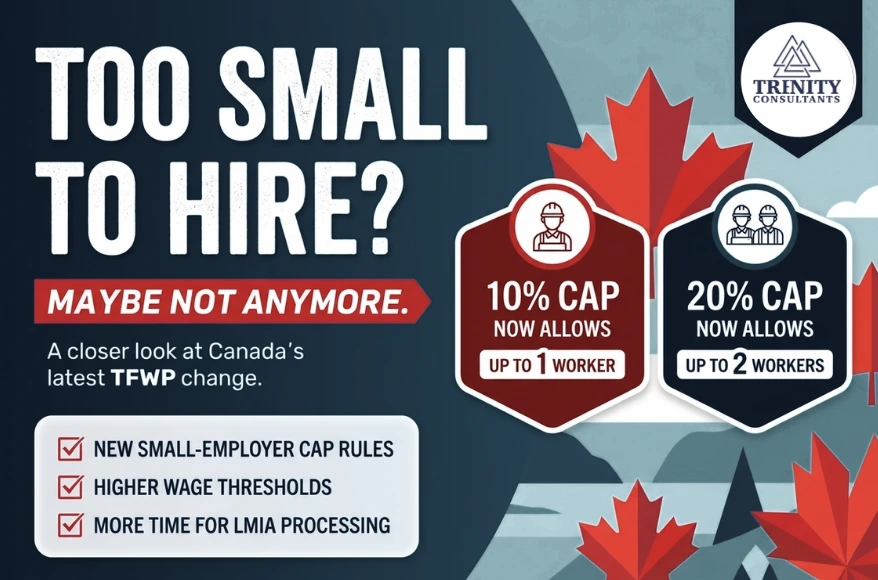
This means ESDC has changed how the Temporary Foreign Worker Program (TFWP) low-wage LMIA cap is calculated for certain small employers/locations.

In simpler terms: previously, an employer with fewer than 10 employees could effectively have a very restrictive cap. Under the adjustment, eligible small locations can calculate the cap as if they have 10 employees, even if their actual workforce is smaller. That can turn a previous zero-worker allowance into one worker, and in some cases two, depending on the applicable cap percentage and calculation.

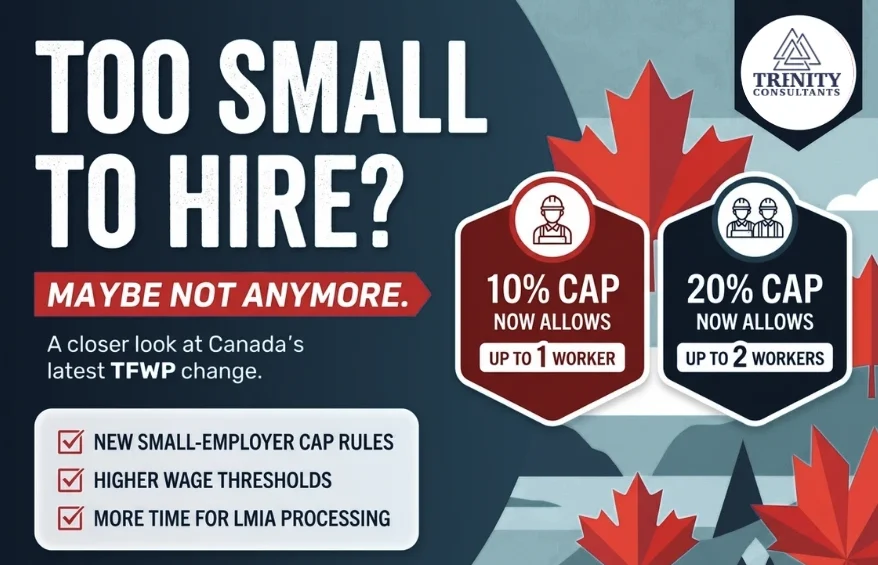
Under the new calculation, a location subject to the standard 10% cap can bring on one low-wage temporary foreign worker. A location under the sector-specific 20% cap can bring on two. Not a large number in absolute terms — but for a business that was previously locked out entirely, going from zero to one is the whole ballgame.

Here’s the detail a lot of the coverage on this has glossed over: before August 18, the small-workforce exception only kicked in if a company’s entire headcount was under 10. A restaurant group running six branches with 40 total staff didn’t qualify, even if any single branch had just 6 or 7 people on the floor. The update moves the calculation from company-wide to location-specific, which is the actual shift that matters here. Multi-site employers — restaurant groups, dental and medical clinics, retail chains, care facilities — stand to gain the most, not just standalone small shops.

Say a dental clinic has 6 staff at one location and belongs to a larger group with several other branches. Before this update, that clinic’s application would have been assessed against the whole company’s headcount and likely rejected outright. Now it’s assessed on its own footing, and it can bring on one low-wage temporary foreign worker under the 10% cap.

Not sure whether your situation actually fits the small-employer cap, or whether the job offer you’ve got checks out under LMIA rules? As a trusted Canada immigration consultants in Abu Dhabi, Trenity can take a quick look and tell you where you stand — no cost, no obligation.

What Counts Toward the Headcount

The workforce number used for the cap hasn’t changed — just where it’s applied. It still includes full-time and part-time staff (part-timers count as 0.5 each), Canadians, permanent residents, existing temporary foreign workers, and employees on approved leave who are expected to return. Vacant positions tied to a pending application count too, along with anyone who already has an approved LMIA but hasn’t started yet.

The Wage Threshold Also Moved This Year

Separately from the cap update, ESDC raised the hourly wage thresholds that decide whether a role even falls under the low-wage stream in the first place. The new figures apply to LMIA applications received on or after July 17, 2026, and they’re set at 120% of the median hourly wage for each province and territory.

ProvinceNew ThresholdEffective Date
Ontario$36.92/hourJuly 17, 2026
Alberta$37.50/hourJuly 17, 2026
British Columbia$38.40/hourJuly 17, 2026

Every jurisdiction moved up this year, not just these three — so if you’re offering a wage that was previously classified as high-wage, it’s worth checking whether it still clears the bar. A position offered below the applicable threshold falls into the low-wage stream, which is where the cap rules discussed above come into play. Nothing about the small-employer cap change alters this threshold — the two updates are separate, and both matter for figuring out whether a position even qualifies.

A Second Change: More Room on LMIA Timing

There’s another update, this one relevant to workers already in Canada rather than to employers. On August 21, 2026, IRCC extended what’s called concurrent processing — the option to submit a work permit application before your employer’s LMIA has actually been decided.

It only applies in a fairly narrow set of circumstances: your current work permit has to be expiring in two weeks or less, your employer needs to have already filed a complete LMIA application with enough lead time for a decision to have been realistically possible, and no LMIA decision can have been made yet. If all of those lines up, IRCC will now hold your application for 90 days from the date you submit it — up from 60 — giving you that window to add proof of the LMIA once it comes through.

Worth being clear: this isn’t an LMIA exemption. It’s extra runway. If the job offer isn’t genuine, or the LMIA never lands, the extra 30 days doesn’t rescue the application — it just gets refused as incomplete once the window closes.

What Hasn't Moved

The caps themselves are unchanged — still 10% and 20%. An LMIA is still required for most TFWP-based work permits, and the small-employer calculation doesn’t turn an LMIA-required role into an LMIA-exempt one. Employers still carry their usual obligations around recruitment, wages, housing, and transportation. Rural employers in participating provinces still get a separate 15% cap, running from April 2026 through March 2027, which has nothing to do with the updates above. And critically, none of this guarantees a work permit for anyone — the employer’s LMIA and the worker’s individual eligibility both still have to hold up on their own.

What Hasn't Moved

Depends entirely on the program. TFWP roles are generally LMIA-based — the employer needs a positive or neutral Labour Market Impact Assessment before the worker can apply for the matching permit. The International Mobility Program runs on different rules and covers various LMIA-exempt categories. The first question to answer isn’t “do I need an LMIA,” it’s “which program am I actually under” — everything else follows from that.

Who Should Actually Care About This

If you run a small operation under 10 staff at a single site, or manage several small branches under a bigger company, this is worth a second look — especially if you were told “no” under the old rules and never checked back. The same goes for employers in construction, food manufacturing, healthcare, and eligible caregiving roles, where the 20% threshold now opens the door to two hires instead of none. And workers already in Canada with a pending LMIA should know about the extended grace period — it could be the difference between maintaining status and getting caught on a deadline.

Finding the Right Consultancy for This

Rule changes like this are where working with experienced Canada immigration consultants earns its keep. The cap math itself isn’t complicated. What trips people up is everything around it — whether the LMIA is structured properly, whether the offered wage clears the current threshold for that province, whether the specific work location genuinely qualifies under the new calculation.

If you’re comparing options and trying to find the best consultancy for Canada immigration and work permit support, a few things are worth checking before you commit: do they work with licensed RCICs rather than general advisors, can they point you to the current rule rather than something recycled from last year, do they look at your specific occupation, employer, and location instead of handing out a generic answer, and are they upfront about what a rule change does and doesn’t guarantee — because a firm promising a guaranteed approval is a red flag, not a selling point.

Trenity Consultants works across TFWP applications, LMIA-based work permits, and longer-term immigration pathways, and can tell you quickly whether a specific employer or worker profile fits under the current rules.

Book a Free Consultation

Book a free consultation today and get expert guidance tailored to your profile.

Frequently Asked Questions

My company has 50 employees across several locations. Can one small branch still qualify?

Yes — the calculation now runs per work location, not against your company's total headcount. A branch with fewer than 10 staff qualifies on its own, regardless of how big the parent company is.

Does the wage threshold change affect the TFWP cap directly?

No, they're separate mechanisms. The wage threshold decides whether a position is low-wage or high-wage in the first place. The cap only applies once a role is already classified as low wage.

Can I apply for a work permit extension before my employer's LMIA comes through?

Only under specific conditions — your current permit needs to be expiring within two weeks, and your employer needs to have already filed a complete LMIA application. If that's the case, IRCC will hold your application for 90 days while the LMIA is finalized.

Does a higher cap mean my LMIA gets approved faster?

No. The cap only determines how many low-wage positions you're eligible to apply for at that location. LMIA processing speed and approval odds depend on separate factors — recruitment efforts, wage compliance, and local labour market conditions.

Bottom Line

Neither of these August changes throw the TFWP wide open. What they do is fix a couple of narrow, specific bottlenecks — one for small and multi-location employers who were getting rounded down to zero, and one for workers stuck in an LMIA processing gap through no fault of their own. Whether either applies to you comes down to your work location’s headcount, your sector, your offered wage against the current threshold, and, for workers, your own eligibility for the permit category in question.

As a Canada work permit consultancy, Trenity Consultants can walk through your specific situation and tell you where you actually stand under the current TFWP and LMIA framework.

Book a consultation with Trenity Consultants to go over your options.

Immigration rules change often. Always confirm current requirements with the Government of Canada or a licensed consultant before applying.

Need Immigration Assistance? Connect With Trenity Consultants Near You

Choose your nearest office and visit your local country page for personalized immigration guidance.

🇦🇪
Abu Dhabi
United Arab Emirates
Immigration Consultants in Abu Dhabi
Visit Page
🇦🇪
Dubai
United Arab Emirates
Immigration Consultants in Dubai
Visit Page
🇦🇪
Sharjah
United Arab Emirates
Immigration Consultants in Sharjah
Visit Page
🇰🇼
Kuwait
Kuwait
Immigration Consultants in Kuwait
Visit Page
🇧🇭
Bahrain
Bahrain
Immigration Consultants in Bahrain
Visit Page
🇶🇦
Qatar
Qatar
Immigration Consultants in Qatar
Visit Page
🇴🇲
Oman
Oman
Immigration Consultants in Oman
Visit Page
🇸🇦
Riyadh
Saudi Arabia
Immigration Consultants in Riyadh
Visit Page
🇸🇦
Jeddah
Saudi Arabia
Immigration Consultants in Jeddah
Visit Page

Share:

Express Entry CRS Score 2026: What the Latest Pool Data Means for You

Express Entry CRS Score 2026: What the Latest Pool Data Means for You

Express Entry CRS Score 2026: What the Latest Pool Data Means for You

Express Entry CRS Score 2026: What the Latest Pool Data Means for You

Canada’s candidate pool shrank by over 2,200 people in two weeks — but the number of high scorers grew. Here’s what moved, why, and what to do about it depending on where your score sits.

If you’re tracking your Express Entry CRS score in 2026, the pool just shifted in a way that’s easy to misread from the headline alone.

Between August 3 and August 16, the Express Entry pool contracted by 2,241 candidates — but that drop wasn’t evenly spread. It hit two specific score bands hard, while the very top of the pool grew. That combination changes what your Express Entry CRS score in 2026 is worth right now, more than the total pool size does on its own.

If you’re based in Abu Dhabi or elsewhere in the Gulf, Trenity Consultants can help you assess your Canada Express Entry profile, identify the most suitable pathway, and understand how category-based selection may apply to your situation. From CRS assessment and document preparation to profile submission, our team supports UAE-based professionals throughout the application process.

Quick stats – Express Entry CRS Score 2026

MetricLatest Data
Total Pool Change−2,241 candidates
Pool Size229,100 → 226,859
Candidates Scoring 501+19,096
ITAs Issued8,807
Invitation Rounds4

Want to check where you stand? Sign up for a free eligibility check with Trenity Consultants.

Looking for a trusted consultancy for Canada immigration?

Trenity Consultants provides professional guidance on Canada immigration pathways, Express Entry, skilled migration, PNP options, eligibility assessments, documentation, and application support for clients across Abu Dhabi, Dubai, Sharjah, Bahrain, Qatar, Kuwait, Oman, Riyadh and Jeddah. Trenity supports applicants through the Canada immigration process, from initial profile assessment and pathway selection through documentation and application submission

How Your Express Entry CRS Score 2026 Ranking Shifted

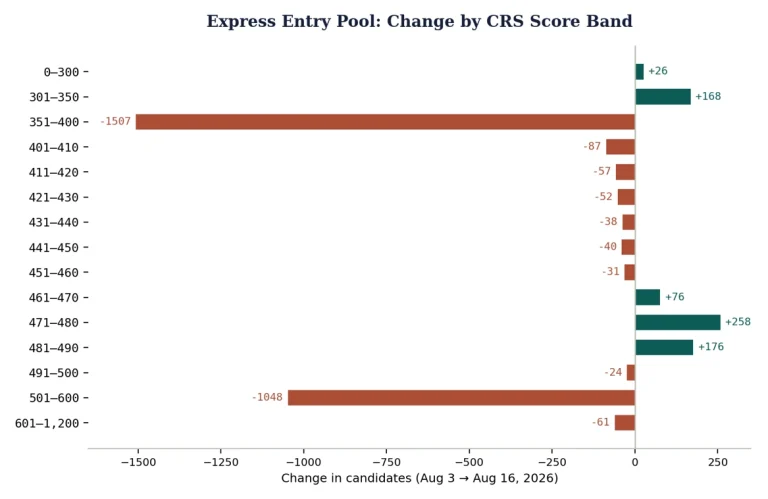
Two bands account for almost all of the contraction. The 351–400 range lost 1,507 candidates, and the 501–600 range lost 1,048 — together, that’s more than 100% of the net decline, offset slightly by growth elsewhere.

Meanwhile, three bands actually gained candidates: 471–480 (+258), 481–490 (+176), and 301–350 (+168). The middle-upper range held its ground or grew even as the pool shrank overall.

(Chart: change in candidates by CRS band, Aug 3 → Aug 16, 2026 — blue/grey diverging bar chart)

Why Percentile Matters More Than Pool Size

A shrinking pool sounds like better odds — but what decides whether you get invited is where your score ranks relative to everyone else, not the raw headcount. This is why percentile position is the number worth watching.

CRS RangeCandidatesCumulativePercentile
0–3007,7097,7090.0%–3.4%
301–35017,26924,9783.4%–11.0%
351–40048,60073,57811.0%–32.4%
401–45060,631134,20932.4%–59.2%
451–50073,554207,76359.2%–91.6%
501–60018,657226,42091.6%–99.8%
601–1,200439226,85999.8%–100%

In plain terms: a candidate above 500 is already ahead of roughly 92% of the pool. A candidate around 470 is somewhere near the 73rd–80th percentile — solidly mid-pack, but in the single most crowded stretch of scores, where thousands of profiles sit within 10 points of each other. Small point gains here move you across percentile lines faster than at either extreme.

Not sure exactly where your profile ranks in this pool? As a trusted Canada immigration consultants in Abu Dhabi, Trenity can run a quick comparison of your CRS score against the current data — no cost, no obligation.

What Drove the Shift: Four Rounds, One Notable First

The pool movement lines up directly with four invitation rounds Canada ran in this window, together issuing 8,807 ITAs.

DateRound TypeITAsLowest CRS
Aug 4Provincial Nominee Program768507
Aug 5Canadian Experience Class3,000516
Aug 6French-Language Proficiency5,000391
Aug 7Transport Occupations300470
Total8,807

The French-language round explains most of the 351–400 band’s drop on its own — 5,000 ITAs at a cutoff of 391 pulled candidates directly out of that range in a single round. It remains the lowest-cutoff category running right now, and by a wide margin.

The Transport Occupations round is worth flagging separately: it was the first selection under the category’s revamped occupation list, reintroduced in February 2026. It’s a new lever worth watching if your background touches logistics, aviation, rail, or marine transport occupations.

Not yet reflected in this data: a further Provincial Nominee round on August 17 issued 442 ITAs at a cutoff of 760. Since it landed after the August 16 snapshot, expect the next pool update to show an additional dip at the very top of the score range.

What Your Express Entry CRS Score 2026 Means, By Range

  • Below 400 — Category-based rounds are your realistic route in. French-language proficiency cleared at 391 this round — 100+ points below CEC. If you qualify for a category (language, healthcare, trades, education, or transport), that’s where your energy belongs.
  • 400–490 — This is the densest part of the pool — roughly 55,000 candidates sit in this exact stretch. Small gains compound fast here. A stronger language retest or an added year of skilled work experience can move you several percentile points at once.
  • Above 500 — You’re ahead of ~92% of the pool, but this band grew, not shrank, over the last two weeks. Don’t assume a score that cleared a cutoff months ago still will — recheck recent CEC and general draw trends before relying on it.

If you’re exploring immigration to Canada from Abu Dhabi, timing your application to match category-based draws can make a real difference in how fast you clear the pool. Trenity’s team tracks every round so you don’t have to.

The Bigger Picture

Express Entry remains Canada’s core system for skilled worker permanent residence, drawing from three streams — the Canadian Experience Class, the Federal Skilled Worker Program, and the Federal Skilled Trades Program. Since the system launched, IRCC has issued 113,865 ITAs, with Canadian Experience Class candidates receiving the largest share at 42.4%.

Category-based selection continues to run well below general and CEC cutoffs — this year, healthcare and social services rounds have cleared between 467 and 475, against 507–518 for CEC. If your profile fits any of the ten active categories, it’s often the fastest realistic path into an ITA.

Ready to move forward with your Express Entry profile?

As a leading Canada consultancy in Abu Dhabi, Trenity Consultants has helped candidates across every CRS range build a realistic path to an ITA — from category-based routes for lower scores to provincial nomination strategy for those closer to the cutoff.

If you’re looking for the best agency for Canada immigration in Abu Dhabi, book a free CRS assessment with our team today and get a clear, honest read on where you stand.

Figures sourced from IRCC’s Express Entry pool data as published August 16–17, 2026. Analysis and recommendations by Trenity Consultants. This article is for general informational purposes and does not constitute immigration advice for any individual case.

Book a Free Consultation

Book a free consultation today and get expert guidance tailored to your profile.

Frequently Asked Questions

What is a good Express Entry CRS score in 2026?

It depends on which round you're aiming for. Above 500 currently puts you ahead of about 92% of the pool, which is competitive for most general and CEC draws. But plenty of people get through with less — scores in the 460–490 range often qualify through category-based rounds that run 50 to 100 points lower.

Why did the pool shrink between August 3 and August 16?

Four invitation rounds ran in that window and pulled 8,807 candidates out at once — a Provincial Nominee round, a Canadian Experience Class round, a French-language round, and a new Transport Occupations round.

If the pool got smaller, why did the number of high scorers go up?

Because those rounds mostly targeted the 351–400 and 501–600 bands, not the very top. So even as the overall pool shrank, more candidates kept crossing the 500-point line through profile updates and new entries.

What's the lowest score that's gotten someone an invitation this year?

391, through the French-language proficiency category. That's usually the lowest-scoring route available in Express Entry — well under the 500+ cutoffs you'll see in general and CEC rounds.

How do I raise my CRS score?

Three levers move the needle fastest: a stronger language test result, an extra year of skilled work experience, or a provincial nomination — which adds 600 points on its own. Even a modest language jump can shift you several percentile points.

How often does this data get updated?

IRCC republishes pool composition roughly every two weeks, timed around its invitation rounds. Cutoffs and candidate distribution can move noticeably between each update, so it's worth checking again before assuming an older number still holds.

Category-based draw or general round — which should I go for?

Both, if you can. If you qualify for an active category — language, healthcare, trades, education, transport — it's worth applying alongside your general profile, since category cutoffs consistently run lower and can get you an ITA faster.

I'm based in Abu Dhabi — does any of this apply differently to me?

Not really, since Express Entry works the same way regardless of where you're applying from. What does help is having someone track the draws and category shifts on your behalf. That's the core of what Trenity does for people pursuing immigration to Canada from Abu Dhabi — reviewing where your CRS score actually sits and flagging routes you might be missing.

Who can help me navigate Canada immigration in Abu Dhabi?

Trenity Consultants works with candidates across the UAE at every CRS range, from category-based strategies for lower scores to provincial nomination planning closer to the cutoff. We're often described as one of the more established names for Canada consultancy in Abu Dhabi, largely because we stay on top of every draw and update the pool goes through — not just the headline numbers.

Canada Express Entry: Find the Right Pathway for Your CRS Score

Every score band in the Express Entry pool moves differently, and knowing which route actually fits your profile — general draws, CEC, or a category-based round — is usually the difference between an ITA in a few months and a profile stuck in the pool for a year or more.

Trenity Consultants works with applicants across Abu Dhabi, Dubai, Sharjah, Bahrain, Qatar, Kuwait, Oman, Riyadh & Jeddah to identify which Express Entry route actually fits their CRS score, and then manages profile strategy, documentation, and submission from start to finish.

Book a free eligibility check with Trenity Consultants and find out which pathway gives you the fastest, most realistic route to Canadian permanent residence

Need Immigration Assistance? Connect With Trenity Consultants Near You

Choose your nearest office and visit your local country page for personalized immigration guidance.

🇦🇪
Abu Dhabi
United Arab Emirates
Immigration Consultants in Abu Dhabi
Visit Page
🇦🇪
Dubai
United Arab Emirates
Immigration Consultants in Dubai
Visit Page
🇦🇪
Sharjah
United Arab Emirates
Immigration Consultants in Sharjah
Visit Page
🇰🇼
Kuwait
Kuwait
Immigration Consultants in Kuwait
Visit Page
🇧🇭
Bahrain
Bahrain
Immigration Consultants in Bahrain
Visit Page
🇶🇦
Qatar
Qatar
Immigration Consultants in Qatar
Visit Page
🇴🇲
Oman
Oman
Immigration Consultants in Oman
Visit Page
🇸🇦
Riyadh
Saudi Arabia
Immigration Consultants in Riyadh
Visit Page
🇸🇦
Jeddah
Saudi Arabia
Immigration Consultants in Jeddah
Visit Page

Share:

770,000 jobs open in Germany — 2026 guide to visas, salaries and permanent residency | Trenity Consultants

Complete 2026 Guide to Germany Work Visa, Jobs & Permanent Residency

Living and working in Germany 2026 guide — visas, jobs, cities and cost of living | Trenity Consultants

Living and working in Germany: Complete 2026 Guide to Germany Work Visa, Jobs & Permanent Residency

Living and working in Germany is a goal for thousands of skilled professionals every year. If you’re weighing up living and working in Germany, you’re looking at a country with over 770,000 unread job vacancies, a five-day working week written into law, and one of the fastest permanent residency timelines anywhere in the EU. The catch is that the system runs on paperwork, deadlines and a points table – which is exactly where most applications quietly stall.

This guide walks through what actually matters: which visa fits your situation, what jobs are paying right now, where to live, what it costs, and how the permanent residency clock starts ticking the day you land. Trenity Consultants put this guide together from the current 2026 rules, not last year’s numbers, so treat it as your working reference rather than a general overview.

In this guide, you’ll learn everything about living and working in Germany, including Germany work visas, the EU Blue Card, the Opportunity Card, in-demand jobs, average salaries, cost of living, permanent residency, and how to apply from the UAE or other GCC countries.

Are you applying from Abu Dhabi or anywhere else in the Gulf? Trenity Consultants also works as a dedicated Germany work permit & visa consultant in Abu Dhabi, handling the same EU Blue Card and Skilled Worker Visa process for UAE-based professionals from document collection through to consulate submission.

Germany at a Glance 2026

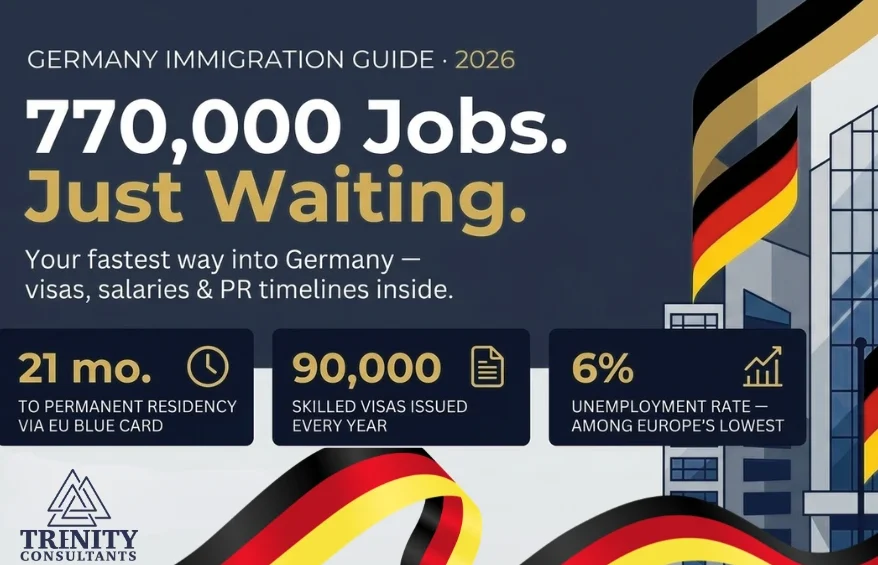
Job Vacancies 770,000+
Unemployment Rate ~6%
Skilled Workers Invited Annually ~90,000
EU Blue Card PR Timeline 21 months (with B1 German)
Standard PR Timeline (Skilled Worker Visa) 5 years (4 years with B1 German)
Path to Citizenship 5 years' residence; dual citizenship generally allowed
Minimum Paid Leave 20+ days/year
Standard Work Week 5 days (~38–40 hours)
Minimum Wage ~€12.82/hour (2026)
Official Language German (English widely used in IT, finance, multinationals)
Currency Euro (EUR)
Top Hubs for Foreign Talent Berlin, Munich, Frankfurt, Hamburg, Stuttgart

Want to check where you stand? Sign up for a free eligibility check with Trenity Consultants.

Looking for the best consultancy for Germany work permits? Trenity Consultants provides professional guidance on work permit options for Germany, eligibility assessments, and application support for clients across Abu Dhabi, Dubai, Sharjah, Bahrain, Qatar, Kuwait, Oman, Riyadh & Jeddah.

Why Living and Working in Germany Is Attracting Skilled Professionals in 2026

Germany isn’t quietly hoping skilled workers show up it’s actively rewriting policy to get them there faster. A few things stand out if you’re comparing it against other migration destinations:

  1. Europe’s largest economy is short on workers across IT, engineering, healthcare and the skilled trades, not just one sector.
  2. The EU Blue Card offers a route to permanent residency in as little as 21 months, faster than most comparable programmes in Western Europe.
  3. The Opportunity Card lets qualified professionals enter and job-hunt on the ground, rather than applying blindly from abroad.
  4. Public universities remain free or near-free, and statutory health insurance covers most of what a family needs.
  5. Since the 2024 citizenship reform, Germany generally permits dual nationality and cut the residency requirement for citizenship from 8 years to 5.

Not sure which of these actually applies to your profession? That’s usually the first thing an immigration consultant checks before you spend weeks on a visa route that was never going to fit.

Germany's Job Market in 2026: Where the Openings Actually Are

If you’re planning on living and working in Germany, understanding the current job market is the first step toward finding suitable employment. Demand isn’t spread evenly. IT and engineering are pulling ahead in both volume and salary, but healthcare and skilled trades aren’t far behind.

In-Demand Sectors - Germany 2026

SectorAverage Salary (EUR/Year)DemandSample Roles
IT & Software€55,000–€90,000Very HighCloud Engineer, Backend Developer, AI/ML Engineer
Engineering€55,000–€85,000Very HighMechanical, Automotive, Electrical Engineer
Finance & Banking€60,000–€100,000HighRisk Analyst, Compliance Officer, FinTech Specialist
Healthcare€45,000–€90,000HighRegistered Nurse, Specialist Doctor, Medical Technician
Skilled Trades€40,000–€55,000HighElectrician, HVAC Technician, Plumber
Research & Academia€50,000–€70,000ModeratePostdoctoral Researcher, Research Associate, Lecturer

English gets you further in tech and finance than most people expect, particularly with the larger multinational employers. But German at a working level – B1 is the usual benchmark – still provides more opportunities, especially outside the biggest cities, and it’s practically required once you’re applying for permanent residency.

Visa Routes for Non-EU Professionals

Choosing the right visa is one of the most important parts of living and working in Germany successfully. Three routes cover most skilled migrants. Which one fits depends mainly on whether you already have a job offer.

Visa Routes Comparison

Visa TypeBest ForValidityPR Timeline
EU Blue Card Degree + job offer with a qualifying salary (€45,934–€50,700) Up to 4 years 21 months (B1 German) / 27 months (A1 German)
Skilled Worker Visa Recognised qualification + German job offer Up to 4 years 5 years (4 years with B1 German)
Opportunity Card Skilled job seekers with at least 6 points Up to 12 months (job search) Can transition to the EU Blue Card or Skilled Worker Visa pathway

1. EU Blue Card

The default choice for degree-holders with a job offer that clears the salary threshold, and the fastest of the three routes to permanent residency.

The lower threshold (~$45,934) applies to shortage occupations, recent graduates and qualifying IT specialists — worth checking before you assume you don’t qualify.

2. Skilled Worker Visa

This route is designed for vocational and academic qualifications that fall outside the Blue Card’s scope. A broader net, but a longer road to residency. Qualification recognition through Germany’s ZAB or Anabin database is usually the slowest part of this route — start it early, not after you’ve accepted an offer.

3. Opportunity Card

No job offers yet? This points-based route lets you enter Germany and search on the ground for up to 12 months.

You’ll need to show financial self-sufficiency for the job-search period, roughly €1,091 a month, before the card is issued.

Based in the UAE? All three routes above are filed the same way whether you’re applying from home or from the Gulf. If you’re arranging a German work permit from Abu Dhabi, UAE, Trenity’s local desk handles document attestation and consulate submission on the ground – see the full Germany Work Permit & Visa Consultant in Abu Dhabi service page for details.

Best German Cities to Live and Work

CityKey IndustriesAverage Rent (1-Bedroom Apartment)Job Market
BerlinStartups, IT, Technology, Creative Industries, Digital Economy€900–€1,200/monthVery Strong – Growing demand for tech, software, and international talent
MunichAutomotive, Engineering, Technology, Manufacturing, Finance€1,200–€1,800/monthExcellent – One of Germany’s strongest employment markets
FrankfurtBanking, Finance, Insurance, Consulting, Logistics€1,100–€1,400/monthStrong – Major financial hub with international employers
HamburgLogistics, Aviation, Media, Trade, Maritime Industries€1,000–€1,300/monthStrong – High demand in logistics, engineering, and skilled sectors
StuttgartAutomotive, Manufacturing, Engineering, Research & Development€1,100–€1,400/monthStrong – Home to leading automotive companies and suppliers

Cost of Living: What to Actually Budget For

The cost of housing, transport, and daily expenses plays a major role when living and working in Germany. Munich and Frankfurt sit at the top of the price scale; Berlin, despite being the capital, remains comparatively affordable. Here’s a realistic monthly spread for a single adult in a mid-sized German city.

ExpenseEstimated Cost
Rent (1-Bedroom Apartment, City Centre)€800–€1,200/month
Utilities (Electricity, Heating, Water)€150–€250/month
Groceries€200–€300/month
Public Transport Pass€60–€100/month
Mobile & Internet€30–€50/month
Dining Out (Per Meal)€12–€20
Leisure & Entertainment€100–€200/month

Against Switzerland, Germany looks noticeably cheaper for a comparable salary. Against the UK, it’s roughly on par, sometimes a shade lower outside London-equivalent cities” while still paying competitively in IT, engineering and finance.

1. Register your address (Anmeldung) at the local Bürgeramt within two weeks of arrival.
2. Register with a statutory health insurer (Krankenkasse) – most employers will ask for this before payroll starts.
3. Open a bank account; Deutsche Bank, Sparkasse, Commerzbank and N26 are the common starting points.
4. Apply for your residence permit or EU Blue Card at the local Ausländerbehörde.
5. Get a German SIM and set up transport and banking apps.
6. If you have children, apply for school places early -international schools fill up fast.

Path to Permanent Residency and Citizenship

Residency Timeline by Route

StageRequirementTimeline
EU Blue Card HolderRecognised degree qualification and meeting the required salary threshold21 months (with B1 German) / 27 months (with A1 German)
Skilled Worker Visa HolderContinuous employment, required residence period, and pension contributions5 years (4 years with B1 German)
Opportunity Card HolderConvert to a suitable work residence permit after securing employmentUp to 12 months job search + standard PR timeline
German CitizenshipB1 German language skills, integration requirements, and legal residence5 years (dual citizenship generally permitted)

Skills and Language: What Employers Actually Screen For

Beyond the technical qualification on your CV, German employers consistently rank a specific set of soft and hard skills higher than most applicants expect:

Digital and programming literacy -even outside pure tech roles
German language, B1 minimum -for client-facing or people-management roles especially
Cross-cultural communication and comfort working in mixed-nationality teams
Project management fluency -Agile and Scrum show up constantly in job listings
Adaptability -Germany’s Mittelstand (mid-sized company) sector moves fast and expects flexibility

Why Work With an Immigration Consultants for Germany

Living and working in Germany offers excellent career opportunities, competitive salaries, and a clear pathway to permanent residency for skilled professionals. The rules above are the ones that hold true today – but salary thresholds, points tables and processing times shift every year, and most refusals come down to a document filed the wrong way or a qualification that was never formally recognised. This is the exact gap that experienced immigration consultants for Germany are here to close.

Trenity Consultants works through your profile against the current EU Blue Card, Skilled Worker Visa and Opportunity Card rules, flags qualification-recognition issues before they cost you months, and keeps your application moving instead of sitting in a queue. As a Germany immigration consultant, that’s the whole job – fewer surprises, fewer resubmissions, faster decisions.

UAE-based professionals can work with our local team directly – see Germany Work Permit & Visa Consultant in Abu Dhabi for the full UAE-specific process.

Book a free consultation with Trenity Consultants today!

Book a Free Consultation

Book a free consultation today and get expert guidance tailored to your profile.

Frequently Asked Questions

Is Germany good for expats and skilled migrants?

Generally, yes. Low unemployment, over 770,000 open vacancies, accessible statutory healthcare, and one of Europe's fastest EU Blue Card routes to permanent residency make it a strong option for skilled professionals, though the paperwork-heavy system takes some getting used to.

Do I need to speak German to work in Germany?

Not always -English is common in IT, multinational firms and finance, especially in Berlin, Munich and Frankfurt. But German at B1 level is generally required for permanent residency and citizenship, and it opens up far more roles outside the biggest hubs.

How much money do I need to move to Germany?

Plan for roughly €2,500–€6,000 in initial costs—visa fees, flights, a rental deposit, and first month's expenses. The Opportunity Card also requires proof of about €1,091/month in self-sufficiency during the job search.

What is the EU Blue Card salary threshold in 2026?

From January 2026, the general threshold sits around €50,700/year, dropping to roughly €45,934 for shortage occupations, recent graduates, and qualifying IT specialists.

Can I move to Germany without a job offer?

Yes – the Opportunity Card (Chancenkarte) lets qualified professionals scoring 6+ points enter Germany and job-hunt for up to 12 months before converting to a Skilled Worker Visa or EU Blue Card.

How can immigration consultants for Germany help my application?

They check your eligibility against current thresholds, guide you through qualification recognition, prepare documentation to the standard German authorities expect, and reduce the chance of delays or refusals -which is where most self-filed applications lose time.

Can I apply for a German work permit from Abu Dhabi or elsewhere in the UAE?

Yes. UAE-based applicants follow the same EU Blue Card, Skilled Worker Visa or Opportunity Card routes, usually submitting documents at the German Consulate in Dubai or Abu Dhabi. Trenity Consultants runs a dedicated [Germany Work Permit & Visa Consultant in Abu Dhabi] (https://trenityconsultants.com/germany-work-permit/) service to handle attestation, document prep and consulate submission locally.

How to Change my Photo from Admin Dashboard?

Far far away, behind the word mountains, far from the countries Vokalia and Consonantia, there live the blind texts. Separated they live in Bookmarksgrove right at the coast

Ready to Start Your Germany Move?

Trenity Consultants can check your eligibility across the EU Blue Card, Skilled Worker Visa and Opportunity Card in one free session. Based in the UAE? Talk to our [Germany Work Permit & Visa Consultant in Abu Dhabi](https://trenityconsultants.com/germany-work-permit/) team directly.

Ready to Start Your Application?

Every country on this list has different rules, timelines, and paperwork. Getting the details right the first time is usually the difference between a permit approved in a few months and one stuck in review for twice as long.

Trenity Consultants works with applicants across Abu Dhabi, Dubai, Sharjah, Bahrain, Qatar, Kuwait, Oman, Riyadh & Jeddah to identify which route to European employment actually fits their qualifications, and then manages document preparation and submission from start to finish.

Book a free eligibility check with Trenity Consultants and find out which country gives you the fastest, most realistic path to work in Europe.

Need Immigration Assistance? Connect With Trenity Consultants Near You

Choose your nearest office and visit your local country page for personalized immigration guidance.

🇦🇪
Abu Dhabi
United Arab Emirates
Immigration Consultants in Abu Dhabi
Visit Page
🇦🇪
Dubai
United Arab Emirates
Immigration Consultants in Dubai
Visit Page
🇦🇪
Sharjah
United Arab Emirates
Immigration Consultants in Sharjah
Visit Page
🇰🇼
Kuwait
Kuwait
Immigration Consultants in Kuwait
Visit Page
🇧🇭
Bahrain
Bahrain
Immigration Consultants in Bahrain
Visit Page
🇶🇦
Qatar
Qatar
Immigration Consultants in Qatar
Visit Page
🇴🇲
Oman
Oman
Immigration Consultants in Oman
Visit Page
🇸🇦
Riyadh
Saudi Arabia
Immigration Consultants in Riyadh
Visit Page
🇸🇦
Jeddah
Saudi Arabia
Immigration Consultants in Jeddah
Visit Page

Share:

How to Apply for a Europe Work Visa from Dubai

Europe Work Visa 2026: What Record EU Employment Data Means for Applicants

Non-EU immigrant employment rose from 59.4% in 2017 to 66.0% in 2025. That's a gain of 6.6 percentage points in eight years, larger than the improvement seen among EU-born immigrants or native-born workers.

Europe Work Visa 2026: What Record EU Employment Data Means for Applicants

If you’re planning to apply for a Europe work visa in 2026, new employment data gives you a clearer picture of where things stand. A study released in July 2026 found that immigrant employment across the EU reached 68.2% in 2025, the highest rate on record. For non-EU applicants specifically, the numbers are even more encouraging.

Non-EU immigrant employment rose from 59.4% in 2017 to 66.0% in 2025. That’s a gain of 6.6 percentage points in eight years, larger than the improvement seen among EU-born immigrants or native-born workers. In other words, employers in Europe are hiring non-EU job seekers at a faster rate than almost any other group.

Key Highlights

  • EU immigrant employment reached a record 68.2% in 2025.
  • Non-EU employment increased from 59.4% to 66.0% between 2017 and 2025.
  • Healthcare, IT, manufacturing, construction, and hospitality continue to experience strong demand for workers.
  • Czech Republic and Serbia currently have comparatively faster processing times based on recent client experience.
  • Most Europe work permits require applicants to have a valid job offer before applying.

Looking for the best Europe work permit consultancy? Trenity Consultants provides professional guidance on Europe work permit pathways, eligibility assessments, and application support for clients across Abu Dhabi, Dubai, Sharjah, Bahrain, Qatar, Kuwait, Oman, Riyadh & Jeddah.

Why Non-EU Hiring Is Rising

Researchers behind the study, from the Centre for Research and Analysis of Migration at RFBerlin, point to labour shortages as the main driver. The gaps are concentrated in healthcare, IT, construction, and hospitality. These sectors have struggled to fill roles from local labour markets alone, so employers have leaned more heavily on foreign hiring to keep up with demand.

Part of the issue comes down to demographics. Several EU countries have ageing populations and shrinking domestic workforces, which means there simply aren’t enough local workers to fill the roles opening up each year. That gap has been widening for a decade, and it’s now large enough that immigration policy has shifted from a background issue to an active tool governments use to keep their economies running.

Healthcare is the clearest example. Hospitals across the EU are short-staffed on nurses, care workers, and doctors, and several countries have simplified qualification-recognition processes specifically to bring in foreign-trained healthcare workers faster. Germany, Ireland, and the Czech Republic have all expanded fast-track routes for medical professionals in the past two years.

IT shortages are less about ageing and more about a straightforward skills gap. Software development, cybersecurity, and data roles have grown faster than European universities can produce graduates, so companies have turned to skilled migration to fill the difference. This is one of the few sectors where non-EU applicants often compete on equal terms with local candidates, since employers value technical ability more than nationality.

Construction demand is tied to specific national projects — housing shortages in several countries, along with infrastructure and green-energy building programmes, have created a sustained need for tradespeople that local labour markets can’t meet on their own.

Hospitality shortages tend to be seasonal but persistent, particularly in countries with large tourism industries. Staff turnover is high and local workers increasingly avoid the sector, which has pushed employers toward hiring from abroad even for entry-level roles.

How Europe Is Making It Easier to Hire Foreign Workers

Policy has moved in the same direction. The EU Blue Card, the bloc’s main route for skilled non-EU workers, was reformed recently to lower salary thresholds and shorten processing times in several member states, making it easier for employers to sponsor foreign hires with less bureaucracy than before. A handful of countries have gone further with their own fast-track schemes for specific shortage occupations.

Put together, the result is less a single trend than several separate pressures pointing the same direction: fewer local workers available, more roles that need filling, and governments actively adjusting policy to make foreign hiring easier rather than harder. That combination explains the employment gains in the data and why they are concentrated in the same handful of sectors.

Where the Gaps Remain

Group2017 Employment Rate2025 Employment RateChange
Non-EU immigrants59.4%66.0%+6.6 points
EU-born immigrants71.1%74.8%+3.7 points
Native-born workers67.2%71.6%+4.4 points

Germany shows both sides of this trend. Non-EU employment there reached 66.1% in 2025, but native-born employment stood at 79.6%. Demand for foreign workers is strong, but the gap hasn’t fully closed. Researchers noted that employment gaps remain widest among highly educated migrants, which suggests the challenge is less about finding a job and more about finding the right one.

Malta, the Czech Republic, and Ireland recorded the strongest non-EU employment outcomes overall. Belgium and Finland recorded the weakest. The difference, according to the study, comes down to language requirements and how flexible each country’s labour rules are for foreign hires.

What This Means If You're Looking for European Work Opportunities from Dubai or the GCC

A rising employment rate doesn’t simplify the visa process itself. You still need a job offer, the right documents, and time. What it changes is your odds of success.

Employers across Europe are actively sponsoring non-EU hires right now, especially in healthcare, IT, and construction. For anyone considering work in Europe from Dubai, Abu Dhabi, or elsewhere in the Gulf, this opportunity is a practical window worth acting on.

We’ve seen these trends reflected directly in client activity. Interest in a Europe work permit from applicants in Dubai and Riyadh has picked up over the past year, particularly for Bulgaria, Serbia, Slovakia, and Croatia. Applications from Kuwait and Qatar for EU work permit consultants have followed a similar trend, and Romania and Latvia continue to draw steady interest from applicants in construction and IT.

How to Apply for a Europe Work Visa from Dubai

The process for a European work permit from Dubai generally follows the same sequence, regardless of destination country:

  1. Identify your target country based on your sector and how quickly you need to relocate.
  2. Check your eligibility against that country’s work permit requirements.
  3. Secure a job offer from a registered employer.
  4. Prepare your documents, including degree certificates, experience letters, police clearance, and language test results where required.
  5. Submit your application through the relevant embassy or consulate in the UAE.
  6. Complete biometrics or an interview if requested.
  7. Receive your visa approval and arrange your relocation.

Processing time varies by country. Applications for the Czech Republic and Serbia have generally moved faster this year. Germany and Luxembourg tend to take longer, mostly due to higher application volume rather than stricter requirements.

Country Snapshot: Where the Demand Is

CountrySectors in DemandCommon Delay Points
Czech RepublicManufacturing, IT, skilled tradesUntranslated documents
SerbiaConstruction, hospitality, logisticsIncomplete employer paperwork
BulgariaManufacturing, agriculture, hospitalityPermit category mismatches
SlovakiaManufacturing, logisticsEmployer registration delays
CroatiaHospitality, constructionSeasonal permit quotas
RomaniaManufacturing, construction, ITDocument authentication
LatviaIT, logisticsPeak-season processing delays
LuxembourgFinancial services, techRelocation cost, qualification checks
GermanyHealthcare, engineering, ITApplication volume

This isn’t fixed. Quotas shift and employer demand changes month to month. But it’s a reasonable starting point if you’re narrowing down where to apply first.

Book a Free Consultation

Book a free consultation today and get expert guidance tailored to your profile.

Frequently Asked Questions

Is it easier to find employment in Europe right now?

The process hasn't changed, but the odds have improved for non-EU applicants. Employers are hiring people in this group faster than any other, especially in healthcare, IT, and construction.

Do I need a job offer before applying for a European work permit?

For most countries and permit categories, yes. A small number of routes allow a job-seeker visa without a confirmed offer, though these usually come with stricter financial requirements.

Which countries process an EU work permit fastest?

Based on current client applications from the UAE, the Czech Republic and Serbia have had shorter turnaround this year. Germany and Luxembourg tend to take longer due to application volume.

What documents do I need for overseas jobs in Europe?

Typically, a degree certificate, employment or experience letters, police clearance, and language test results if required. Some countries also require document authentication or certified translation before submission.

How can Europe work permit consultants in Dubai help with my application?

A consultant can match your profile to the right country, confirm eligibility, prepare your documents correctly the first time, and manage submission through the relevant embassy. This matters most for countries with strict document formatting rules, where a small error can add months to processing.

Ready to Start Your Application?

Every country on this list has different rules, timelines, and paperwork. Getting the details right the first time is usually the difference between a permit approved in a few months and one stuck in review for twice as long.

Trenity Consultants works with applicants across Abu Dhabi, Dubai, Sharjah, Bahrain, Qatar, Kuwait, Oman, Riyadh & Jeddah.

to identify which route to European employment actually fits their qualifications, then manages document preparation and submission from start to finish.

Book a free eligibility check with Trenity Consultants and find out which country gives you the fastest, most realistic path to work in Europe.

Need Immigration Assistance? Connect With Trenity Consultants Near You

Choose your nearest office and visit your local country page for personalized immigration guidance.

🇦🇪
Abu Dhabi
United Arab Emirates
Immigration Consultants in Abu Dhabi
Visit Page
🇦🇪
Dubai
United Arab Emirates
Immigration Consultants in Dubai
Visit Page
🇦🇪
Sharjah
United Arab Emirates
Immigration Consultants in Sharjah
Visit Page
🇰🇼
Kuwait
Kuwait
Immigration Consultants in Kuwait
Visit Page
🇧🇭
Bahrain
Bahrain
Immigration Consultants in Bahrain
Visit Page
🇶🇦
Qatar
Qatar
Immigration Consultants in Qatar
Visit Page
🇴🇲
Oman
Oman
Immigration Consultants in Oman
Visit Page
🇸🇦
Riyadh
Saudi Arabia
Immigration Consultants in Riyadh
Visit Page
🇸🇦
Jeddah
Saudi Arabia
Immigration Consultants in Jeddah
Visit Page

Share:

Ccountries with highest Schengen visa approval—Get to know more with Trenity Consultants!

Traveling to Europe in 2026? Here are the top easiest Schengen countries to get visa in 2026

The Easiest Schengen Countries for Quick Visa Approval - Get Fast Schengen Visa Appointments in Abu Dhabi with Trenity Consultants

Which Schengen Country Is Easiest to Get a Visa in 2026?

Getting a Schengen visa is probably one of the first things you should do if you want to go to Europe in 2026.  It can be easier to choose a country with a higher approval rate now that there are new rules and more people applying.  This guide will help you choose the best countries for your application, explain important rules, and help you avoid common mistakes so that your trip goes well.

Top 10 Schengen Countries Where Getting a Visa Is Easy

Recent statistics from 2024 show which countries are most likely to give out Schengen visas.  The average approval rate was about 52.2%, but some countries were much more welcoming than others:

  1. Lithuania: 97.2% approval rate
  2. Estonia: 98% (highest volume-adjusted)
  3. Iceland: 91%
  4. Slovakia: 89%
  5. Italy: 88%
  6. Romania: 88%
  7. Switzerland: 88%
  8. Hungary: 87%
  9. Norway: 87%
  10. Greece: 86%

Applying through one of these countries gives you the best chance of getting your Schengen visa approved. Here is a quick comparison to help you decide:

CountryApproval RateAvg. Processing TimeAppointment WaitBest For
Estonia98%5–7 daysShortFirst-time applicants
Lithuania97%7–10 daysShortIndian & Pakistani applicants
Iceland91%5–7 daysShortFast approval
Slovakia89%7–10 daysShortUAE & Gulf applicants
Italy88%10–15 daysModerateTourism-focused trips
Romania88%7–10 daysShortFirst-time applicants
Switzerland88%10–15 daysModerateBusiness travel
Hungary87%7–10 daysShortUAE & Gulf applicants
Norway87%10–15 daysShortStraightforward applications
Greece86%10–15 daysModerateTourism

Don’t “Visa Shop”: Follow the Correct Schengen Visa Process in 2026

The rules for the Schengen visa in 2026 say that you have to apply based on your real travel plans. You might want to apply in the country with the highest approval rate.  This is how it works:

  • If you’re visiting only one Schengen country, apply for your visa through that country’s embassy or its authorized visa center.

  • If your trip includes multiple Schengen countries, submit your application to the embassy of the country where you’ll spend the most time (your main destination).

  • If you’ll spend an equal amount of time in each country, apply through the embassy of the country you’ll enter first.

You could get your application turned down or have problems later if you don’t follow these embassy rules and apply to the wrong country.

Understanding how long it takes to process and why it was rejected

In 2025, nearly 12 million people applied for Schengen visas—a 1.8% increase on the year before. Processing times remain busy in 2026, especially during the summer and Christmas periods. The overall refusal rate has improved to 14.8% in 2025, down from 17.9% in 2022, which means your chances of approval are better now than they have been in years. Apply as early as possible and book your appointment well in advance to avoid delays.

How Long Does a Schengen Visa Take to Get Approved in 2026?

Most people assume getting a Schengen visa takes forever—but that is not always true. The official processing time is 15 calendar days, but in reality, it depends a lot on which country you apply through.

Countries like Slovakia, Lithuania, and Iceland tend to move much faster. Many applicants get their visa back in 5 to 10 working days when applying through these embassies.

If you apply through France, Germany, or Spain—especially from the UAE—you could wait 3 to 4 weeks just for an appointment, not to mention the additional time for the decision.

A few things that will affect how long your application takes:

  • The embassy you apply through—busy ones like France and Spain are simply slower
  • The time of year—avoid applying close to summer or Christmas if you can
  • Your documents—one missing paper can set you back weeks
  • Your nationality — some passports require extra checks, which adds time
  • The safest approach is to apply at least 4 to 6 weeks before your trip.
  • You are allowed to apply up to 6 months in advance, so there is no reason to leave it last minute.

Easiest Schengen Visa for Indian Passport Holders in 2026

A lot of our clients at Trenity come to us with the same question — which Schengen country is actually easy to get approved from if you hold an Indian passport? The honest answer is that it depends on where you apply, but some countries are consistently easier than others.

From the UAE, Lithuania and Slovakia are currently two of the best options. Appointments are easier to get, processing is faster, and approval rates are strong.

Estonia and Hungary are also worth considering—they do not get as much traffic as the bigger embassies, which means shorter queues and quicker turnaround.

Iceland technically has the highest approval rate at 91%, but appointment availability can be limited depending on where you are applying from.

The most common reasons we see Indian applications get rejected are weak bank statements, a vague travel itinerary, or nothing in the application that shows you plan to come back home. If your bank statements show at least 3 months of steady income, your flights and hotels are confirmed, and your cover letter clearly explains why you are travelling and when you are returning, your chances go up significantly.

Which Schengen Country Is Easiest to Get a Visa Appointment in 2026?

Here is something a lot of people do not realise until it is too late — the hardest part of getting a Schengen visa in 2026 is often not the approval; it is just getting an appointment.

France, Germany, Spain, and the Netherlands are notoriously difficult for appointments right now, especially if you are applying from the UAE or Gulf. Wait times of 4 to 8 weeks are common, and during peak travel season it can be even longer. If you want a faster appointment, these countries are your best bet right now:

  • Lithuania: usually 1 to 2 weeks via VFS Global
  • Slovakia: appointments generally available within 2 weeks
  • Estonia: low demand means shorter waits
  • Luxembourg:  smaller embassy, much quicker
  • Hungary: VFS in the UAE typically has slots within 2 to 3 weeks

One thing worth knowing: if you are visiting multiple Schengen countries and spending roughly equal time in each, you do not have to apply through the most popular one. You can apply through whichever country you enter first—so it is worth planning your itinerary around a country with easier appointments if you have flexibility.

How to Increase Your Schengen Visa Approval Chances

To improve your chances of approval, ensure that you provide accurate and complete documentation. Each Schengen country may have specific requirements, so always check the latest visa guidelines on their official website or consult with experts.

If you are unsure about the application process, it’s advisable to work with experienced professionals such as the Best Europe Immigration Consultants. These experts can help you navigate the complex visa application process and increase your chances of a successful application by providing expert advice on documentation, timelines, and strategies for overcoming common hurdles.

How Nationality Influences Schengen Visa Success Rates

Your nationality and the country you apply through both matters.  For example, in 2024, 97.6% of Liberians approved, but only a small number of people from Comoros and Guinea-Bissau did.  No matter where you’re from, it’s important to be well-prepared, especially if this is your first time applying.

What the EES and ETIAS Mean for Your Schengen Visa in 2026

Here is the EES section rewritten to sound human:


If you are planning to apply for a Schengen visa in 2026, there are two big changes to European border control that you genuinely need to know about before you apply.

EES — Entry/Exit System (already live)

The EES went fully live on 10 April 2026, and it changes things quite significantly. Passport stamping is done. Now, every time you cross into or out of a Schengen country, the system records your fingerprints, photo, and travel document details digitally in a central database.

What this really means is that border guards and embassies can instantly see your complete travel history—every entry, every exit, and crucially, any overstays or past rejections. Even if you overstayed by just a few days on a previous trip, that is now on permanent record, and it will come up when you apply again.

ETIAS—launching later in 2026

ETIAS is essentially Europe’s version of the US ESTA—an online travel authorization you apply for before you travel. It is due to launch in the last quarter of 2026. The key thing to understand here is that ETIAS only applies to people who currently travel to Europe without a visa, like UK, US, or Australian passport holders. If you are Indian, Pakistani, or hold most Asian passports and already go through the Schengen visa process, this does not affect you at all. Your application process stays exactly the same.

What does this mean for your application?

Be honest about your travel history—all of it. The EES means there is no way to hide a previous overstay or rejection anymore. If your record is clean, you have absolutely nothing to worry about. If it is not, be upfront in your application and clearly explain the circumstances instead of hoping it goes unnoticed.

Easiest Schengen Countries for Visa: Final Tips for First-Time Applicants

Refer to the 2025 statistics to find the which were the top Schengen countries for visa approval in summer 2025.  If you want to go to Europe soon.  Pick the country you want to apply to based on where you really want to go, apply early, and obey the rules for 2026.  If this is your first time applying, Lithuania, Estonia, and Iceland are the strongest choices in 2026.

Schengen Visa Questions Answered for 2026

Q: Which Schengen country is the easiest to get a visa in 2026?

Honestly, Lithuania and Estonia are leading the pack right now. Lithuania sits at a 97% approval rate and Estonia is even higher at 98% on a volume-adjusted basis. Iceland, Slovakia, and Romania are also solid choices. If you are applying from the UAE, India, or Pakistan specifically, Lithuania and Slovakia tend to work out best — the queues are shorter and the process is just more straightforward.

Q: Which Schengen visa is easiest to get for Indian passport holders?

From what we see with our clients, Lithuania and Slovakia are consistently the best bet for Indian passport holders in 2026. Appointments come through faster, approval rates are high, and most applications are processed within 7 to 10 days. If you are based in the UAE, Hungary and Estonia are also worth looking at — both have good VFS availability right now.

Q: How long does a Schengen visa take to process in 2026?

The official answer is 15 calendar days, but that is really the maximum — not what usually happens. If you apply through Lithuania, Slovakia, or Estonia, a lot of applicants are getting their visa back in 5 to 10 working days. The one time to be careful is summer, roughly June through August, when every embassy slows down. To be safe, give yourself at least 4 to 6 weeks before your travel date.

Q: Which Schengen country has the highest visa approval rate in 2026?

Based on the latest European Commission data, Estonia is actually at the top with a 98% approval rate, followed by Lithuania at 97% and Iceland at 91%. These numbers are based on 2025 applications so they are as current as it gets. Worth noting though — high approval rates partly reflect the type of applicants these countries receive, so strong documentation still matters regardless of where you apply.

Q: Which Schengen country is easiest to get a visa appointment in 2026?

This is honestly one of the biggest frustrations people face right now. France, Germany, Spain, and the Netherlands are a nightmare for appointments from the UAE — you are often looking at 4 to 8 weeks just to get a slot. Lithuania, Slovakia, Estonia, and Luxembourg are a completely different story. Most people get appointments within 1 to 2 weeks through VFS Global. If timing matters to you, this alone is a good reason to plan your trip around one of these countries.

Q: Is it hard to get a Schengen visa from the UAE in 2026?

It really does not have to be. The overall Schengen refusal rate has actually dropped to 14.8% — the best it has been since before the pandemic. If you apply through Lithuania, Slovakia, or Hungary from the UAE, have your documents in order, and give yourself enough time, your chances are genuinely good. Most rejections we see come down to weak bank statements or a travel plan that does not quite add up — both of which are completely avoidable with the right preparation.

Q: What is the EES and does it affect my Schengen visa application in 2026?

The EES — Entry/Exit System — went fully live on 10 April 2026. In simple terms, it means passport stamping is finished. Every time you cross into or out of a Schengen country, your fingerprints, photo, and travel details are now recorded digitally. It does not change the visa application process itself, but it does mean that if you have ever overstayed a Schengen visa — even by a few days — that is now permanently on record and embassies can see it. If your travel history is clean, you have nothing to worry about.

Q: What is ETIAS and do I need it in 2026?

ETIAS is a new online travel authorisation that is launching in the last quarter of 2026 — think of it like the US ESTA. Here is the important part though: it only applies to people who currently travel to Europe without a visa, like UK, US, and Australian passport holders. If you are Indian, Pakistani, Bangladeshi, or hold most Asian passports and already apply for a Schengen visa, ETIAS has nothing to do with you. Your process stays exactly the same.

How to Get Fast Schengen Visa Appointments in Abu Dhabi, United Arab Emirates

If you’re applying from the Middle East, getting help from reliable specialists for Europe immigration can really speed up the process of getting a Schengen visa appointment.  

Experienced immigration consultants can help you avoid mistakes, make sure your papers are ready, and know the most recent rules for 2026. They can help you make an early appointment, advise you on your paperwork, and improve your chances of getting approved.

Share:

Quick Processing of UK Visit Visas in the UAE

Quick Processing of UK Visit Visas in the UAE

Quick Processing of UK Visit Visas in the UAE

Due to the lengthy wait times for Schengen visas in the UAE, many are opting to have their UK visit visas processed more quickly and conveniently. The UK visa processing time has garnered attention due to its streamlined visa services, which offer decisions in as little as 24 hours.

For hassle-free  UK Immigration, consultants in Dubai can guide you through the process, ensuring accuracy and faster results. Whether you need a short-term visa or long-term options (up to 10 years), the UK provides flexible solutions with transparent fees.

Since people encounter extended delays in Europe when applying for visas, many have opted for the United Kingdom for faster processing. That’s why it’s an excellent choice for anyone planning a trip to Europe or the UK this summer.

UK Visa Processing Time: Super Priority and Priority Services

The UK visa processing time can be significantly reduced with the Super Priority Visa Service, which offers a decision by the next working day or within two working days if your biometric appointment falls on a weekend or a UK bank holiday. Usually, Applicants can get this type of visa in just one working day and, therefore, avoid the usual long queues found with other visas.

The Super Priority Visa costs £1,000 (approximately Dh5,000) in addition to the standard visa fee. Most short-term visitor visas, work visas, student visas, and settlement applications require the eTA. When you are eligible, you can take advantage of this service and be assured of a decision by the close of business the following business day, Monday to Friday.

If you want to take advantage of a faster reply but don’t need a speedy result, the Priority Visa Service is also worth considering. The UK immigration team processes these applications within approximately five working days for a fee of £500 (approximately Dh2,500) in addition to the visa cost. It suits travelers who need their trip arranged quickly but not immediately.

Standard UK Visitor Visa and Long-Term Options

If you prefer a visa that lasts more than six months, a variety of visitor visas are available in the UK. For £127, you can apply for a visitor visa that allows you to stay in the country for up to six months. The healthcare visa costs £220, and you can wait for up to 11 months. Visiting academics will be charged a fee of £220 for a period of up to 12 months.

People who must visit the country several times over an extended period may be issued a two-, five– or ten-year long-term visitor visa. The rules permit you to see for up to six months, and the fees are £475 for two years and £1,059 for ten years’ worth of visits.
You can expect to receive your results within five working days.

The cost is approximately £500 (Dh2,500) plus the fees for your visa application

Standard Visitor Visa applicants must pay £127, and their maximum stay is limited to 6 months.

There is a £220 fee for a Medical Visitor Visa, allowing you to stay for up to 11 months.

When you enter on an Academic Visitor Visa, you may stay for up to 12 months, and the fee is £220.

A maximum stay of six months per two-year period is permitted on this Two-Year Long-Term Visitor Visa, which costs £475.

Candidates must pay £848 for a five-year, long-term visitor visa valid for a maximum of six months at a time.

The 10-Year Long-Term Visitor Visa costs £1,059 and allows you to spend up to six months, with no option to extend the stay.

Viewing the Process: How to Apply for a UK Visa

To apply for a UK visa, start by visiting the official UK Government website to complete your online application. After submitting your form and paying the fee, you’ll receive instructions to book a biometric appointment at VFS Global in Dubai. At the visa center, you’ll need to provide fingerprints and a photograph.

Before applying, check your eligibility in Dubai to ensure a smooth process. Premium services like document scanning, courier returns, and lounge access are available for added convenience.

For expert guidance, consult UK Immigration consultants in Dubai to avoid delays and maximize approval chances.

Whether you’re looking for quick processing or planning for future travel, the UK visa processing time in the UAE offers a reliable and efficient solution for many travelers. At this point, the Best UK Immigration Consultants can help your application process proceed smoothly.

If you live in the UAE, particularly in Dubai or Abu Dhabi, using a reputable immigration consultant in Dubai can help ensure your paperwork is accurate and that you avoid delays.

Share:

new immigration updates canada

Top Schengen countries for visa approval IN SUMMER

Top Schengen countries for visa approval IN SUMMER

Top Schengen Countries for Visa Approval in Summer

If you’re planning a trip to Europe this summer, getting a Schengen visa is probably at the top of your priority list. The top Schengen visa approval in the summer plays an important part in determining the outcome of your visa application. Knowing the countries with the greatest Schengen visa approval rates might help you plan for your journey and boost your chances of a successful application.

In 2024, Iceland leads the way with a spectacular approval rate of 91.25 percent, cementing its position as one of the simplest Schengen nations to enter. Despite a tiny decline from the previous year’s 94.26 percent, Iceland’s approval score is still among the highest in Europe. The country’s relatively low application number (35,416 in 2024 against 22,541 in 2023) contributes to its high approval percentage, since fewer applicants allow consular staff more time to thoroughly analyse each application.

While Iceland stands at the top of the list, several other Schengen countries also offer favorable visa approval rates. Slovakia follows closely with an approval rate of 89.25 percent, and Italy is not far behind at 88.72 percent. Romania (88.36%) and Switzerland (88.12%) also stand out as some of the Top Schengen countries for visa approval in summer, making them excellent options for those seeking smoother visa processing experiences.

Other countries with impressive approval rates include Hungary (87.23%), Norway (87.20%), Greece (85.86%), Austria (85.78%), and Luxembourg (85.65%). While these countries may not lead the pack, they are still among the top contenders for anyone looking to visit Europe this summer.

Why These Countries Are Popular Choices for Visa Approval

The high approval rates in these Top Schengen countries for visa approval in summer can be attributed to several factors. First, these countries maintain efficient and streamlined visa application processes, making it easier for applicants to submit their documents correctly and meet all necessary criteria. Second, these countries tend to have well-established relationships with visa applicants from various regions, ensuring a higher approval rate for eligible travelers.

Another reason why these countries have high approval rates is the relatively low incidence of visa refusals, thanks to their high-level consular staff training and experience. Most applicants from countries with fewer visa applications (such as Liberia, which had an approval rate of 97.6%) find the process smoother compared to high-demand countries. This results in quicker approvals for those meeting the requirements.

Moreover, European nations with higher approval rates have increasingly adopted digital tools for visa applications, such as online applications, which have sped up the entire process. These factors combine to ensure that travelers applying to the Top Schengen countries for visa approval in summer face fewer hurdles and greater chances of success.

How Third-Country Applicants Can Benefit

The chances of obtaining a Schengen visa are not only influenced by the destination country but also by the nationality of the applicant. In 2024, nationals from countries like Liberia (97.6%) and Vanuatu (95.79%) had significantly higher chances of approval due to fewer visa applications and a greater focus on quality assessment rather than quantity.

Countries like Botswana, Niger, and Zambia also have higher approval rates, reflecting the trend that the fewer the applicants from a specific nationality, the higher the approval rate. For example, applicants from Zambia filed 2,750 applications in 2024, of which 2,444 were granted. This demonstrates that countries with fewer applicants tend to have higher approval rates because consulates have more time to process each request individually and thoroughly.

However, countries with a larger volume of visa applicants, such as Guinea-Bissau (43.84%) and Haiti (52.02%), see more competition for a limited number of visas, which can result in lower approval rates. For applicants from these regions, it’s crucial to ensure that their application stands out by meeting all requirements, such as proof of travel insurance, flight reservations, financial stability, and accommodation details.

How to Increase Your Schengen Visa Approval Chances

To improve your chances of approval, ensure that you provide accurate and complete documentation. Each Schengen country may have specific requirements, so always check the latest visa guidelines on their official website or consult with experts.

If you are unsure about the application process, it’s advisable to work with experienced professionals such as the Best Europe Immigration Consultants. These experts can help you navigate the complex visa application process and increase your chances of a successful application by providing expert advice on documentation, timelines, and strategies for overcoming common hurdles.

Working with the Right Immigration Consultant

As the Top Schengen countries for visa approval in summer continue to attract travelers, seeking the right assistance from professionals who understand the nuances of visa applications is crucial. The Top Immigration Consultants in Abu Dhabi, UAE, can be an invaluable resource in this process. With their in-depth knowledge of European immigration policies, they can help guide you through the application process, ensuring that you meet all necessary criteria and increase your chances of receiving a visa.

Whether you’re traveling for leisure, business, or education, partnering with skilled immigration consultants can provide you with the support you need to prepare a successful Schengen visa application. They are well-versed in the latest updates and can help you avoid common pitfalls that lead to application rejection.

Conclusion: Why Timing and Country Matter

As the summer of 2024 approaches, ensuring you apply for a Schengen visa to one of the Top Schengen countries for visa approval in summer will give you the best shot at a smooth and successful trip to Europe. With countries like Iceland, Slovakia, Italy, and Romania leading the way in visa approval rates, your summer travels are closer than ever. But don’t forget that your chances of success also depend on the completeness of your visa application and the guidance of professional consultants, like the Best Europe Immigration Consultants.

So, if you’re gearing up to apply for your Schengen visa this summer, make sure to choose your destination wisely and consider seeking expert help to make the process as smooth as possible.

Share:

Canada work permit applicants

Common Mistakes to Avoid For a Successfull Canadian Work Permit Application

Canadian Work Permit Application Mistakes

How to Secure a Canadian Work Permit: Avoid These Canadian Work Permit Application Mistakes

Getting a Canadian work permit is a significant opportunity to grow your career, explore new experiences, and build a future in Canada. However, many applicants commit things that are avoidable, which hinder or even reject their applications. To help you succeed, we’ll cover the most common work permit application mistakes, how to avoid them, and the key Canada work visa requirements you need to know.

One major Canadian work visa mistake that makes people fail is submitting wrong or missing details when filling out forms. Even minor errors will cause delays or rejection. Always recheck every section before the submission. If you’re unsure, consult The Best Canada Immigration Consultants for guidance.

How to avoid this mistake:

  • Follow the instructions carefully.
  • Fill out all sections accurately.
  • Get professional help if needed.

2. Missing or Insufficient Supporting Documents

Your Canadian work permit application requires specific documents, such as a job offer letter, proof of funds, and educational certificates. If you do not have any of these, your application may be rejected.

Key documents you need:

  • Valid passport
  • Canadian job offer.
  • Evidence of degrees/diplomas/ licenses.
  • Language test results (if required)
  • Police clearance certificate

When applying for any visa to Canada, always confirm the up-to-date work permit Canada requirements that apply to you.

3. Missing Application Deadlines

Late submissions are one of the most popular Canada work visa mistakes. The waiting times may differ, and the wait can spoil your plans. Send your application on time to avoid last-minute problems.

Tips to stay on track:

  • Find out about the processing times on the IRCC official website.
  • Prepare documents early.
  • Allow for additional procedures such as medical exams or police checks.

4. Low English or French Level Scores

Because two official languages are spoken in Canada, demonstrating your proficiency in English or French will be very important for many work permits. Bad test scores can damage your application.

How to improve your chances:

  • Do IELTS (English) or TEF (French) examinations.
  • Shoot for a score that is higher than the minimum.
  • Provide your application together with your test results.

5. Ignoring Recent Immigration Rule Changes

Canadian immigration guidelines always emphasize staying informed about policy changes. Rules for Canadian work permits can shift, and outdated information may lead to errors.

How to stay informed:

  • Regularly check the IRCC website.
  • Follow trusted immigration news sources.
  • Seek assistance from an immigration expert to learn about the most recent information.

6. Skipping Required Medical Exams

Some Canadian work permits require medical exams. Miss-completing them can make you stall your application.

What to do:

  • Schedule your medical exam early.
  • Use an IRCC-approved physician.
  • Send the effects in to be part of your application.

7. Not Showing Enough Financial Proof

You must demonstrate an ability to support yourself (and your dependents) while living in Canada. Failure to meet certain financial documents can be the reason for rejection.
How to prove financial stability:

Provide bank statements that contain enough money.

Offer proof of employment /sponsorship (if any).

Ensure documents meet IRCC requirements.

8. Selection of an incorrect type of work permit.

Canada has various work permits (open, employer-specific, LMIA-based, etc.). Choosing the wrong one can waste time and money.

How to apply for the proper Canadian work permit:

  • See if an LMIA (Labour Market Impact Assessment) is required.
  • See if you can receive an open work permit.
  • Consult an expert if unsure.

Final Tips for a Successful Canadian Work Permit Application
Do not be in a hurry to apply – take your time to prepare a good one.

Rego through everything: Make sure that forms and documents are complete.

Seek professional help: The Top Immigration Consultants in Riyadh, KSA, can smoothly guide you through the process.

Conclusion

A Canadian work permit opens doors to incredible opportunities, but mistakes can cost you time and money. By avoiding these work permit application mistakes, staying updated on Canada immigration tips, and ensuring you meet all work permit Canada requirements, you’ll maximize your chances of success.

Should you require a professional hand, Contact Trenity Canadian Immigration Consultants in Riyadh – we specialise in dealing with applicants in a hassle-free process. Join the quest to Canada now!

Share:

poland work permit

High Demand Jobs in Poland – Secure Your Dream Career in Europe

high demand jobs in poland

High Demand Jobs in Poland – Secure Your Dream Career in Europe

Thanks to its high demand for jobs, Poland has emerged as one of Europe’s most attractive destinations for Non-skilled & professional Workers. The country offers excellent work opportunities with a strong economy, competitive salaries, and a welcoming environment for expats. If you’re considering a move, Trenity the Best Europe Immigration Consultants in Dubai—can help you navigate the visa process and land the right job.

Poland’s thriving job market continues to attract foreign professionals across all skill levels, from white-collar positions in booming sectors like IT, construction, engineering, and finance to blue-collar opportunities for painters, factory workers, and skilled tradespeople. The country offers competitive salaries that outperform many EU nations while maintaining an affordable cost of living and excellent quality of life. With a streamlined work permit process for both skilled professionals and vocational workers, combined with Poland’s rapidly expanding economy and influx of multinational companies, it has become an ideal destination for career growth at every professional level.

1. IT & Software Development

Poland is Europe’s tech hub, with companies like Google, Microsoft, and Amazon hiring extensively. Roles in demand include:
✔ Software Developers (Java, Python, .NET)
✔ Cybersecurity Specialists
✔ Data Scientists & AI Engineers
✔ DevOps Engineers

2. Packaging & Warehouse Jobs

With Poland’s growing logistics sector, opportunities include:
✔ Packaging Line Workers (food, pharmaceutical industries)
✔ Warehouse Operatives (forklift certification preferred)
✔ Order Pickers & Packers
✔ Logistics Coordinators

3. Engineering & Manufacturing

Poland is a manufacturing powerhouse, requiring:
✔ Mechanical & Electrical Engineers
✔ Automotive Engineers (for companies like Volkswagen, Toyota)
✔ Civil Engineers (infrastructure projects)
✔ Robotics & Automation Specialists

4. Food Processing & Factory Work

Meat and poultry plants seek:
✔ Chicken Factory Helpers (processing, packaging)
✔ Meat Cutters & Butchers
✔ Food Quality Inspectors
✔ Production Line Supervisors

5. Construction & Architecture

Poland’s booming real estate sector needs:
✔ Architects (urban planning & sustainable design)
✔ Civil Engineers
✔ Project Managers
✔ Skilled Trades (electricians, welders, plumbers)

6. Customer Support & BPO

Multilingual professionals can find roles in:
✔ International Customer Service
✔ Technical Support (IT, SaaS companies)
✔ Sales & Business Development

7. Logistics & Supply Chain

With Poland being a key EU logistics hub, jobs include:
✔ Supply Chain Managers
✔ Warehouse Supervisors
✔ Truck Drivers (with EU licenses)
✔ Procurement Specialists

8. Teaching & Education

English teachers, university lecturers, and trainers are needed in:
✔ International Schools
✔ Language Academies
✔ Corporate Training

How to Get a Work Visa for Poland?

Landing one of those high-demand jobs in Poland starts with something simple – getting a real job offer from a Polish company. Think of this as your golden ticket. Once you’ve got that sorted, the next steps involve getting the right paperwork in order – mainly your work permit (they come in different types depending on your job situation) and if you’re planning to stay awhile, a temporary residence permit too. Now, I won’t sugarcoat it – dealing with Polish bureaucracy can feel like trying to solve a puzzle while blindfolded. There’s paperwork, background checks, and sometimes even language tests to think about.

This is exactly why so many people choose to work with us at Trenity Immigration Consultants. We’re like your personal guides through the entire process. First, we help connect you with actual employers who are looking for someone with your skills – no shady deals, just real job opportunities. Then we roll up our sleeves and handle all the complicated permit and visa stuff, making sure every ‘i’ is dotted and every ‘t’ is crossed. But we don’t stop there – we’ll even help you find a place to live, open a bank account, and get your bearings in your new home. Whether you’re a tech whiz, a healthcare pro, or skilled with your hands, we’ve helped people just like you make the move smoothly. That’s probably why many consider us the Best Europe Immigration Consultants for making Poland work opportunities a reality.

Why Choose Trenity Immigration Consultants?

As the Top Immigration Consultants in Dubai, UAE, we specialize in:
✔ Poland work visa processing with a high success rate
✔ Job placement assistance in high demand jobs in Poland
✔ End-to-end relocation support (documentation, flights, settling in)

Final Thoughts

With high demand jobs in Poland across multiple industries, now is the best time to make your move. Whether you’re in IT, healthcare, engineering, or finance, Poland offers excellent career growth. Let Trenity, the Best Immigration Consultants, guide you every step of the way!

Share: