




Europe Work Visa 2026: What Record EU Employment Data Means for Applicants
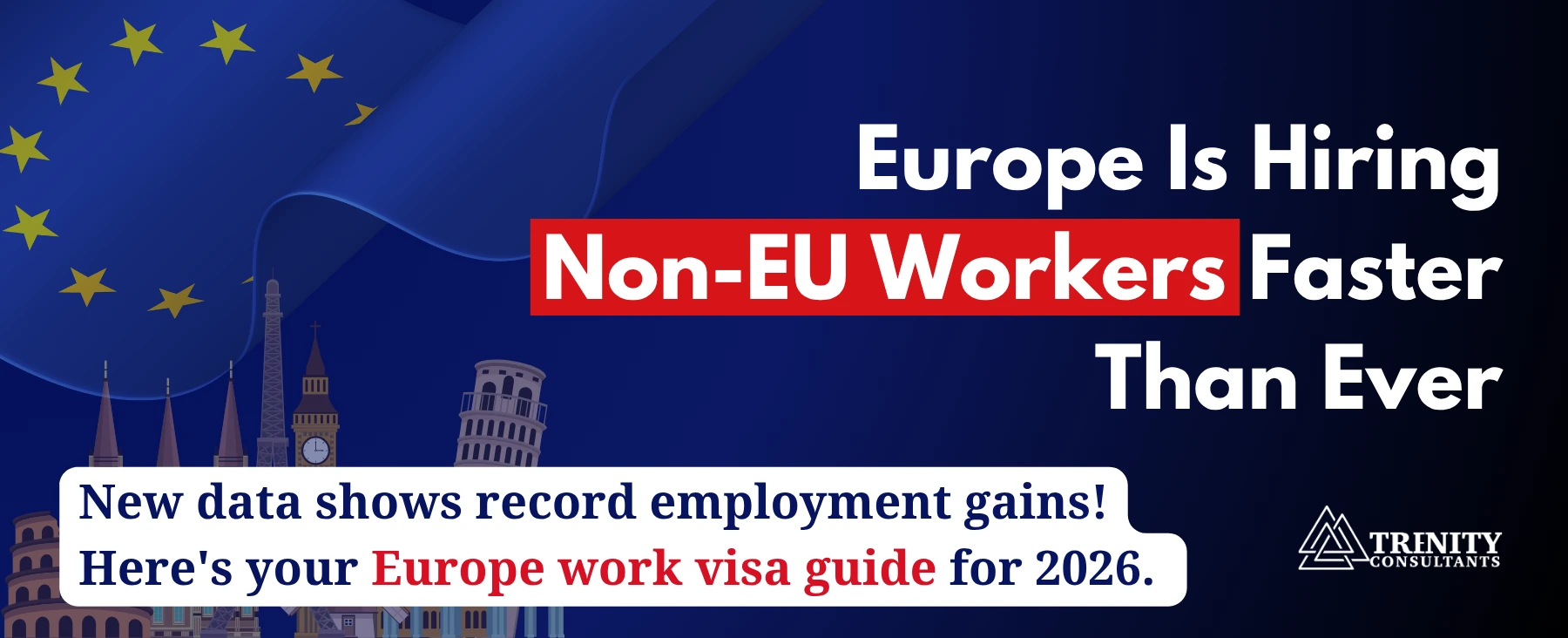
If you’re planning to apply for a Europe work visa in 2026, new employment data gives you a clearer picture of where things stand. A study released in July 2026 found that immigrant employment across the EU reached 68.2% in 2025, the highest rate on record. For non-EU applicants specifically, the numbers are even more encouraging.
Non-EU immigrant employment rose from 59.4% in 2017 to 66.0% in 2025. That’s a gain of 6.6 percentage points in eight years, larger than the improvement seen among EU-born immigrants or native-born workers. In other words, employers in Europe are hiring non-EU job seekers at a faster rate than almost any other group.
Key Highlights
- EU immigrant employment reached a record 68.2% in 2025.
- Non-EU employment increased from 59.4% to 66.0% between 2017 and 2025.
- Healthcare, IT, manufacturing, construction, and hospitality continue to experience strong demand for workers.
- Czech Republic and Serbia currently have comparatively faster processing times based on recent client experience.
- Most Europe work permits require applicants to have a valid job offer before applying.
Why Non-EU Hiring Is Rising
Researchers behind the study, from the Centre for Research and Analysis of Migration at RFBerlin, point to labour shortages as the main driver. The gaps are concentrated in healthcare, IT, construction, and hospitality. These sectors have struggled to fill roles from local labour markets alone, so employers have leaned more heavily on foreign hiring to keep up with demand.
Part of the issue comes down to demographics. Several EU countries have ageing populations and shrinking domestic workforces, which means there simply aren’t enough local workers to fill the roles opening up each year. That gap has been widening for a decade, and it’s now large enough that immigration policy has shifted from a background issue to an active tool governments use to keep their economies running.
Healthcare is the clearest example. Hospitals across the EU are short-staffed on nurses, care workers, and doctors, and several countries have simplified qualification-recognition processes specifically to bring in foreign-trained healthcare workers faster. Germany, Ireland, and the Czech Republic have all expanded fast-track routes for medical professionals in the past two years.
IT shortages are less about ageing and more about a straightforward skills gap. Software development, cybersecurity, and data roles have grown faster than European universities can produce graduates, so companies have turned to skilled migration to fill the difference. This is one of the few sectors where non-EU applicants often compete on equal terms with local candidates, since employers value technical ability more than nationality.
Construction demand is tied to specific national projects — housing shortages in several countries, along with infrastructure and green-energy building programmes, have created a sustained need for tradespeople that local labour markets can’t meet on their own.
Hospitality shortages tend to be seasonal but persistent, particularly in countries with large tourism industries. Staff turnover is high and local workers increasingly avoid the sector, which has pushed employers toward hiring from abroad even for entry-level roles.
How Europe Is Making It Easier to Hire Foreign Workers
Policy has moved in the same direction. The EU Blue Card, the bloc’s main route for skilled non-EU workers, was reformed recently to lower salary thresholds and shorten processing times in several member states, making it easier for employers to sponsor foreign hires with less bureaucracy than before. A handful of countries have gone further with their own fast-track schemes for specific shortage occupations.
Put together, the result is less a single trend than several separate pressures pointing the same direction: fewer local workers available, more roles that need filling, and governments actively adjusting policy to make foreign hiring easier rather than harder. That combination explains the employment gains in the data and why they are concentrated in the same handful of sectors.
Where the Gaps Remain
| Group | 2017 Employment Rate | 2025 Employment Rate | Change |
|---|---|---|---|
| Non-EU immigrants | 59.4% | 66.0% | +6.6 points |
| EU-born immigrants | 71.1% | 74.8% | +3.7 points |
| Native-born workers | 67.2% | 71.6% | +4.4 points |
Germany shows both sides of this trend. Non-EU employment there reached 66.1% in 2025, but native-born employment stood at 79.6%. Demand for foreign workers is strong, but the gap hasn’t fully closed. Researchers noted that employment gaps remain widest among highly educated migrants, which suggests the challenge is less about finding a job and more about finding the right one.
Malta, the Czech Republic, and Ireland recorded the strongest non-EU employment outcomes overall. Belgium and Finland recorded the weakest. The difference, according to the study, comes down to language requirements and how flexible each country’s labour rules are for foreign hires.
What This Means If You're Looking for European Work Opportunities from Dubai or the GCC
A rising employment rate doesn’t simplify the visa process itself. You still need a job offer, the right documents, and time. What it changes is your odds of success.
Employers across Europe are actively sponsoring non-EU hires right now, especially in healthcare, IT, and construction. For anyone considering work in Europe from Dubai, Abu Dhabi, or elsewhere in the Gulf, this opportunity is a practical window worth acting on.
We’ve seen these trends reflected directly in client activity. Interest in a Europe work permit from applicants in Dubai and Riyadh has picked up over the past year, particularly for Bulgaria, Serbia, Slovakia, and Croatia. Applications from Kuwait and Qatar for EU work permit consultants have followed a similar trend, and Romania and Latvia continue to draw steady interest from applicants in construction and IT.
How to Apply for a Europe Work Visa from Dubai
The process for a European work permit from Dubai generally follows the same sequence, regardless of destination country:
- Identify your target country based on your sector and how quickly you need to relocate.
- Check your eligibility against that country’s work permit requirements.
- Secure a job offer from a registered employer.
- Prepare your documents, including degree certificates, experience letters, police clearance, and language test results where required.
- Submit your application through the relevant embassy or consulate in the UAE.
- Complete biometrics or an interview if requested.
- Receive your visa approval and arrange your relocation.
Processing time varies by country. Applications for the Czech Republic and Serbia have generally moved faster this year. Germany and Luxembourg tend to take longer, mostly due to higher application volume rather than stricter requirements.
Country Snapshot: Where the Demand Is
| Country | Sectors in Demand | Common Delay Points |
|---|---|---|
| Czech Republic | Manufacturing, IT, skilled trades | Untranslated documents |
| Serbia | Construction, hospitality, logistics | Incomplete employer paperwork |
| Bulgaria | Manufacturing, agriculture, hospitality | Permit category mismatches |
| Slovakia | Manufacturing, logistics | Employer registration delays |
| Croatia | Hospitality, construction | Seasonal permit quotas |
| Romania | Manufacturing, construction, IT | Document authentication |
| Latvia | IT, logistics | Peak-season processing delays |
| Luxembourg | Financial services, tech | Relocation cost, qualification checks |
| Germany | Healthcare, engineering, IT | Application volume |
This isn’t fixed. Quotas shift and employer demand changes month to month. But it’s a reasonable starting point if you’re narrowing down where to apply first.
Book a Free Consultation
Frequently Asked Questions
Is it easier to find employment in Europe right now?
Do I need a job offer before applying for a European work permit?
Which countries process an EU work permit fastest?
What documents do I need for overseas jobs in Europe?
How can Europe work permit consultants in Dubai help with my application?
Ready to Start Your Application?
Every country on this list has different rules, timelines, and paperwork. Getting the details right the first time is usually the difference between a permit approved in a few months and one stuck in review for twice as long.
Trenity Consultants works with applicants across Abu Dhabi, Dubai, Sharjah, Bahrain, Qatar, Kuwait, Oman, Riyadh & Jeddah.
to identify which route to European employment actually fits their qualifications, then manages document preparation and submission from start to finish.
Book a free eligibility check with Trenity Consultants and find out which country gives you the fastest, most realistic path to work in Europe.
Need Immigration Assistance? Connect With Trenity Consultants Near You
Choose your nearest office and visit your local country page for personalized immigration guidance.
Share:
Categories





- Australia Immigration Updates (17)
- Canada Express Entry Draw (25)
- Canada Immigration Updates (82)
- Citizenship By Investment (17)
- Digital Nomad Visa (2)
- Europe Immigration Update (5)
- Europe Work Permit (25)
- Germany Immigration (1)
- Greece Tech Talent Visa (1)
- Immigration Consultants (174)
- Japan Immigration Update (1)
- Residency By Investment (1)
- Romania Update (1)
- Schengen News (17)
- Study Abroad Updates (22)
- TOEFL for Canada PR (1)
- Ukraine (1)
- Videos (0)