
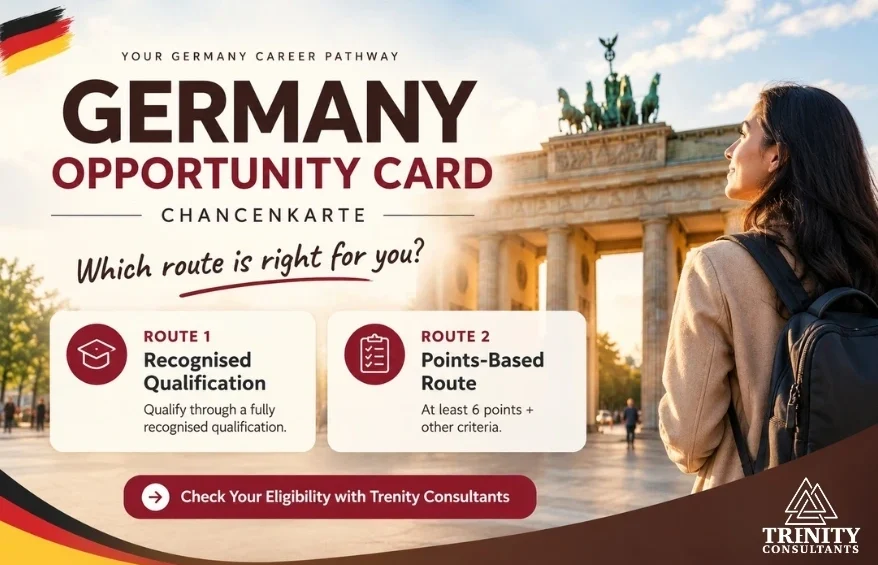

Chancenkarte Requirements (2026) - The Opportunity Card for foreign professionals

Germany Opportunity Card: Application Steps and Required Documents

Germany Opportunity Card (Chancenkarte) application and document checklist 2026 by Trenity Consultants

Germany Opportunity Card: Application Steps and Required Documents

A missing document, unclear qualification evidence or an incomplete financial plan can delay your Germany Opportunity Card application. Preparing these details before booking an appointment can save time and help you understand what the German authorities expect.

The Germany Opportunity Card, also known as the Chancenkarte, gives eligible applicants from outside the EU a way to travel to Germany and search for qualified employment without securing a job offer first.

Whether you live in the UAE, another GCC country, or elsewhere, the application starts with the same essentials: understanding which route applies to you, gathering the right evidence, and following the procedure for your country of residence.

Speak with Trenity Consultants, Germany immigration consultants, to discuss your profile, understand the application requirements and prepare for your next steps.

Germany Opportunity Card (Chancenkarte): Key Facts 2026

Germany Opportunity Card: Key Facts

Understand the main requirements at a glance

DetailWhat to know
PurposeSearch for qualified employment in Germany
Job offerNot required before applying
Initial validityUp to 12 months
Eligibility routesRecognised qualification or points-based route
Points routeAt least 6 points, plus the other eligibility requirements
Language requirementGerman A1 or English B2 for the points-based route
Financial requirement for 2026Generally €1,091 net per month
Work while searchingSecondary employment of up to 20 hours per week
ApplicationThrough the official application process for your place of residence

Check the official Germany Opportunity Card guidance and the requirements of the German mission responsible for your application.

Before You Apply: Which Route Fits Your Qualification?

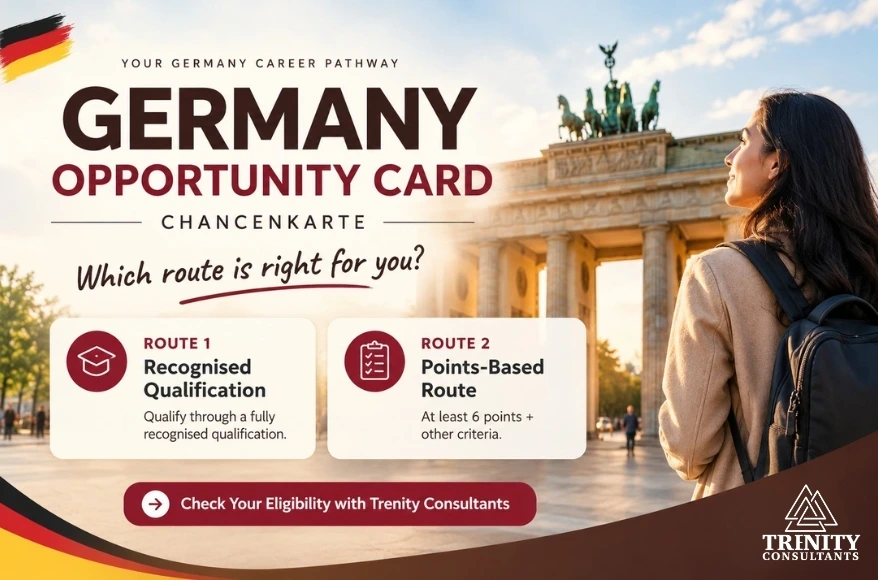
There are two ways to qualify for the Opportunity Card/Chancenkarte.

1. Recognized qualification:

If you hold a German qualification or a foreign academic or vocational qualification fully recognized in Germany, you may qualify without collecting points. For a foreign university degree, ANABIN information or a Statement of Comparability from the Central Office for Foreign Education (ZAB) may be relevant. Vocational qualifications follow their own recognition requirements.

2. Points-based route:

If your qualification meets the requirements in the country where you obtained it but is not fully recognized in Germany, you may qualify by meeting the basic conditions and scoring at least six points. You generally need a university degree or a vocational qualification involving at least two years of training, along with German at A1 level or English at B2 level.

Points can be awarded for factors such as professional experience, language ability, age, partial recognition of qualifications, and previous lawful residence in Germany.

The official Opportunity Card self-check is a useful starting point. Keep evidence for the answers you give; a self-check result does not replace the supporting documents required for your application.

Germany Opportunity Card Documents Checklist 2026

Start collecting your documents early, particularly if you need qualification recognition, translations, or certificates from previous employers.

Germany Opportunity Card Documents Checklist

Prepare your documents before submitting your application

DocumentWhat to check
PassportValidity, required copies and available pages
Visa applicationCompleted and signed as instructed
PhotographsMeet the applicable biometric photo requirements
Qualification documentsDegree or vocational certificate and supporting records
ANABIN or ZAB evidenceRelevant evidence for your qualification route, where required
Language certificateAccepted test and required level, if applicable
CVClear education and employment history
Work-experience certificatesJob titles, duties and dates should be consistent with your CV
Financial evidenceBlocked account or other accepted proof, as applicable
Job-search planTarget roles, employers, location and career goals
Cover or motivation letterWhy you want to work in Germany and how you plan to find employment
Accommodation evidenceDocuments required by the German mission handling your application
Medical insurance evidenceCoverage accepted for the intended stay
Previous visas or residence permitsCopies where requested

**This is a preparation checklist, not a substitute for the official list issued by your German mission. Documents in languages other than English or German may need translation.

Applying from the UAE? Pay attention to these details.

The German Consulate General in Dubai’s Opportunity Card checklist contains additional instructions for applicants it serves.

In particular:

  • Residence documents: Prepare copies of your UAE residence permit and Emirates ID as specified in the checklist. Confirm that you fall within the consulate’s jurisdiction before applying.

  • Payment: The published checklist states that the visa fee must be paid in cash in AED and that exact change is required.

  • Insurance: Travel insurance alone is not sufficient. The checklist calls for incoming medical insurance or acceptable public or private insurance evidence as specified by the consulate.

  • Accommodation: Proof of accommodation in Germany for at least the first month is listed.

  • Job-search evidence: Prepare a plan identifying potential employers and your intended employment direction. Evidence of correspondence with employers can also be relevant.

Applicants living outside the UAE should follow the checklist issued by the German mission responsible for their place of residence.

How to Apply for the Germany Opportunity Card

The application is easier to organize when you tackle it in a practical order.

  1. Identify your eligibility route. Establish whether you qualify through a recognized qualification or the points system. Gather evidence for your qualification, language level, and professional experience.

  2. Check your qualification records. Review the relevant ANABIN information or find out whether you need a ZAB Statement of Comparability or vocational qualification evidence. Do not treat a submitted recognition request as proof that recognition has been granted.

  3. Complete the self-check and prepare your job-search plan. Identify the roles you want to pursue, the regions where you intend to look, and potential employers. Make sure your CV supports the experience you describe.

  4. Arrange your financial evidence and insurance. For 2026, the general guidance uses €1,091 net per month as the financial benchmark. Confirm the accepted evidence and any additional requirements for your application.

  5. Submit through the official process. Use the German Consular Services Portal and follow the instructions from the German mission responsible for your residence. Prepare the required forms, photographs, copies, and originals in the requested format.

  6. Attend your appointment and prepare for follow-up. Bring the documents requested by the mission and pay the applicable fee using its accepted method. Incomplete applications can require another appointment, and additional documents or an interview may be requested.

Once your visa is issued, check its validity dates and conditions before finalizing travel arrangements.

Proof of Funds: How Much Should You Prepare?

For 2026, the official German government guidance lists €1,091 net per month as the financial benchmark for the Opportunity Card.

For a full 12-month stay, that works out to €13,092. Additional return-flight funds may also be required under the relevant mission’s instructions.

The official guidance identifies a German blocked account or a declaration of commitment as ways to demonstrate financial support. The Dubai consulate’s checklist describes these options for applicants it serves.

Germany Opportunity Card: Expenses to Budget For

Plan for application costs and your initial stay in Germany

ExpenseWhat to budget for
Living expensesThe required amount for your intended stay
Visa feeGenerally €75 for a German national visa; confirm the current fee and payment method
Qualification recognitionAny applicable assessment or documentation charges
Language testingTest fees if you need an accepted language certificate
Translation and document preparationCosts based on the documents you need to submit
InsuranceSuitable coverage for your intended stay
Travel and accommodationFlights, initial accommodation and arrival expenses

Remember your proof of funds

For 2026, the general financial benchmark is €1,091 net per month. For 12 months, that amounts to €13,092. Additional funds for a return flight may also be required. Check the latest official Opportunity Card guidance and your responsible German mission's requirements.

Your total budget will depend on your circumstances and how much preparation your application requires. Check the current financial requirements before opening an account or arranging sponsorship.

Common Application Mistakes That Are Easy to Overlook

Small inconsistencies can create unnecessary questions during an application. Pay particular attention to these areas:

  • Qualification evidence that does not match the claim: Check the university and degree information in ANABIN rather than assuming that one entry settles every recognition question.

  • Experience that is difficult to verify: Make sure employment dates, job titles, and duties are consistent across your CV and work-experience certificates.

  • A weak job-search plan: Naming a broad industry is less useful than explaining the roles you intend to pursue, the employers you have researched, and where you plan to look.

  • Insufficient financial preparation: Calculate the amount for your intended stay and account for any additional funds required by the mission.

  • Incorrect insurance: For UAE applicants, the Dubai consulate specifically states that travel insurance alone is insufficient.

  • A checklist taken from another country: Requirements published by one German mission should not automatically be treated as the checklist for another.

The Dubai consulate also warns that submitting a complete set of documents does not guarantee that a visa will be granted.

What Can You Do With the Opportunity Card?

The Opportunity Card is designed to help eligible applicants search for qualified work in Germany. During the job search, holders can undertake secondary employment totalling up to 20 hours per week. Job trials of up to two weeks per employer are also permitted when they meet the official conditions.

Finding a suitable job does not automatically convert the card into a long-term work residence permit. You will need to follow the appropriate process for the employment or residence category that applies to your circumstances.

Germany Opportunity Card to permanent residency

The Germany Opportunity Card can be a starting point for building a long-term future in Germany, but it does not lead to permanent residency automatically.

  • Find a qualifying job: The Opportunity Card allows you to search for employment in Germany for up to 12 months.

  • Switch to a work residence permit: Once you secure suitable employment, you may apply for an appropriate residence permit through the local foreigners authority (Ausländerbehörde).

  • Explore the EU Blue Card: In 2026, the general salary threshold is €50,700 per year, or €45,934.20 for eligible recent graduates and certain shortage occupations, subject to the applicable conditions.

  • Consider a skilled-worker permit: If you do not meet the EU Blue Card requirements, a skilled-worker residence permit may be another option, depending on your qualifications and job.

  • Work towards permanent residency: Eligible EU Blue Card holders may qualify for a settlement permit after 27 months with A1 German or 21 months with B1 German, subject to other requirements.

  • Meet settlement requirements: The route and waiting period depend on your residence permit, employment history, pension contributions, language ability and other legal conditions.

  • Understand the citizenship process: German citizenship is a separate application with its own eligibility requirements.

Explore our Living and Working in Germany guide to learn more about residence options and the pathway towards long-term settlement.

How Trenity Consultants Can Help

The Opportunity Card is designed to help eligible applicants search for qualified work in Germany. During the job search, holders can undertake secondary employment totalling up to 20 hours per week. Job trials of up to two weeks per employer are also permitted when they meet the official conditions.

Finding a suitable job does not automatically convert the card into a long-term work residence permit. You will need to follow the appropriate process for the employment or residence category that applies to your circumstances.

Book a Free Consultation

Book a free consultation today and get expert guidance tailored to your profile.

Frequently Asked Questions

Can I apply for the Germany Opportunity Card/Chancenkarte without a job offer?

Yes. The card is intended for eligible applicants who want to search for qualified employment in Germany before securing a job offer.

Can I apply from a country other than the UAE?

Yes, if you meet the requirements and follow the application procedure for your place of residence. Check the German mission responsible for your application because local document and submission instructions can differ.

How long can I stay in Germany on the Opportunity Card?

The initial job-search Opportunity Card can be issued for up to 12 months. The period granted depends on the applicable requirements and the validity stated on your visa.

Can I work while looking for a job?

Yes. Secondary employment of up to 20 hours per week is permitted. Job trials of up to two weeks per employer are also allowed under the official conditions.

Does the Opportunity Card guarantee employment?

No. It allows eligible applicants to search for work; finding a job depends on their qualifications, experience, language skills, employer requirements and the labour market.

Need Immigration Assistance? Connect With Trenity Consultants Near You

Choose your nearest office and visit your local country page for personalized immigration guidance.

🇦🇪
Abu Dhabi
United Arab Emirates
Immigration Consultants in Abu Dhabi
Visit Page
🇦🇪
Dubai
United Arab Emirates
Immigration Consultants in Dubai
Visit Page
🇦🇪
Sharjah
United Arab Emirates
Immigration Consultants in Sharjah
Visit Page
🇰🇼
Kuwait
Kuwait
Immigration Consultants in Kuwait
Visit Page
🇧🇭
Bahrain
Bahrain
Immigration Consultants in Bahrain
Visit Page
🇶🇦
Qatar
Qatar
Immigration Consultants in Qatar
Visit Page
🇴🇲
Oman
Oman
Immigration Consultants in Oman
Visit Page
🇸🇦
Riyadh
Saudi Arabia
Immigration Consultants in Riyadh
Visit Page
🇸🇦
Jeddah
Saudi Arabia
Immigration Consultants in Jeddah
Visit Page

Share:

Express Entry 2026 Changes: CRS Points & LMIA Rules - Trenity Consultants

Express Entry 2026 Changes: New CRS Points for High-Wage Jobs and No LMIA

What Is Changing in Express Entry on November 3, 2026

Express Entry 2026 Changes: New CRS Points for High-Wage Jobs and No LMIA

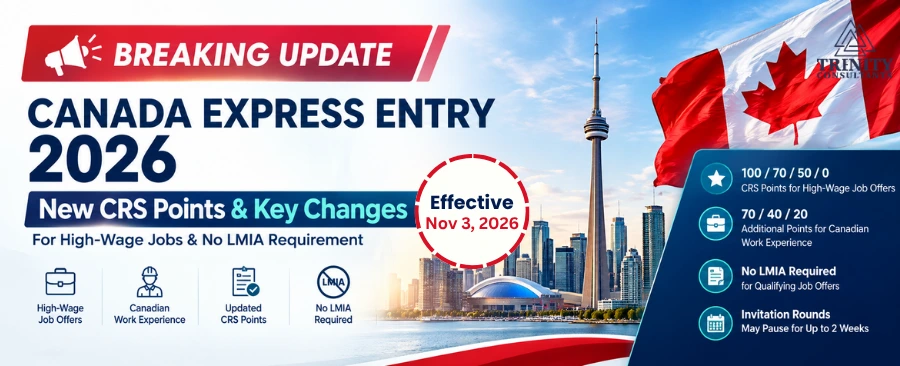
On October 16, 2026, Immigration Minister Lena Metlege Diab announced a major change to Canada’s Express Entry scoring system, following the removal of job offer points in March 2025. From November 3, 2026, eligible candidates can earn new CRS points for a qualifying job offer or for Canadian work experience in a high-wage occupation. Qualifying job offers will also no longer require a Labour Market Impact Assessment (LMIA) for specified Express Entry purposes.

IRCC says the objective is to give greater weight to factors associated with stronger economic outcomes and help Canada attract and retain skilled workers who can contribute to its labour market.

If you are working in  Abu Dhabi, Dubai, Sharjah, Bahrain, Qatar, Kuwait, Oman, Riyadh, or Jeddah and considering Canada PR, the important question is whether a Canadian job offer could improve your CRS score. It may, but only if the offer and occupation meet the applicable requirements.

Whether you’re just starting to look at Canada or already have an invitation to apply, Trenity Consultants can guide you through each stage, from checking your eligibility to submitting a complete application. Our licensed team is available at our branches across the GCC and online, and your first assessment is free.

IRCC has announced three major changes.

IRCC has announced three major changes.

  1. A New Labour Market Integration Factor

A new Labour Market Integration Factor (LMIF) will award CRS points for a qualifying job offer in an eligible high-wage occupation or eligible Canadian work experience in such an occupation. Candidates cannot combine both routes under this factor; IRCC will assess the applicable options and award the higher score.

  1. No LMIA Requirement for Qualifying Job Offers

Qualifying job offers will no longer need an LMIA to receive the new CRS points or to meet specified job-offer requirements under the Federal Skilled Worker Program (FSWP) and Federal Skilled Trades Program (FSTP), subject to the applicable rules and policy conditions.

Removing the LMIA requirement does not mean every Canadian job offer qualifies. The offer must still meet the relevant program requirements and be genuine.

  1. A Temporary Pause in Express Entry Invitations

IRCC will temporarily pause invitation rounds while it recalculates the scores of existing candidates under the new system. The recalculation may take up to two weeks.

Which Occupations Qualify as High-Wage?

IRCC compares the median wage of an occupation in Canada with the median wage of the overall Canadian workforce. To qualify for the new high-wage factor, an occupation must meet at least 1.3 times the national median wage.

The occupation is assessed using its National Occupational Classification (NOC) code and the applicable wage data, not simply the applicant’s personal salary.

For example, earning a high salary in the GCC does not automatically make your occupation eligible. The duties performed in a role matter more than the job title alone. Applicants should compare their job duties with the official NOC descriptions before drawing conclusions.

How Many CRS Points Can You Get for a High-Wage Job Offer?

Occupation's Median Wage Compared with the National MedianCRS Points
At least 2 times the national median wage100
At least 1.5 times, but less than 2 times70
At least 1.3 times, but less than 1.5 times50
Below 1.3 times the national median0

These points apply only when the job offer and the applicant satisfy the applicable requirements.

How the New Canadian Work Experience Points Work

Candidates with qualifying Canadian work experience may receive their usual CRS points based on the duration of that experience, plus additional points if the experience meets the new high-wage occupation requirements.

Qualifying High-Wage Canadian Work ExperienceAdditional Points
At least 12 months at the 2-times median-wage level70
At least 12 months at the 1.5-times level, where the higher tier does not apply40
At least 12 months at the 1.3-times level, where the higher tiers do not apply20

The minimum qualifying period for these additional points is generally 12 months, or 1,560 hours, of eligible Canadian work experience in a qualifying high-wage occupation.

The duration-based Canadian work experience points are separate from the additional high-wage points. The maximum score under the new factor is 150 points without an accompanying spouse or partner and 140 points with an accompanying spouse or partner.

What Do the Changes Mean for Applicants in the GCC?

For professionals living in Abu Dhabi, Dubai, Sharjah, Bahrain, Qatar, Kuwait, Oman, Riyadh, or Jeddah, the impact depends on whether they have a qualifying Canadian job offer, eligible Canadian work experience or neither.

If You Do Not Have a Canadian Job Offer

If you are applying from the GCC without a qualifying Canadian job offer, you will not receive the additional CRS points associated with the job-offer route.

However, your international work experience may still contribute to your Express Entry profile under the applicable eligibility and CRS assessment rules. Factors such as age, education, language proficiency, and skills transferability can also influence your overall CRS score.

If You Have a Qualifying Canadian Job Offer

Professionals based in the GCC who secure a genuine Canadian job offer in an eligible high-wage occupation may be able to benefit from the proposed additional CRS points, depending on the applicable wage tier and eligibility requirements.

The proposed changes to the LMIA requirement for these points would not mean that every job offer qualifies. Applicants must still meet the relevant Express Entry criteria, and removing the LMIA requirement for CRS points does not guarantee a work permit or permanent residence approval.

If You Already Have Canadian Work Experience

GCC-based applicants who have previously worked in Canada may be eligible for additional points if they meet the requirements for qualifying Canadian work experience in an eligible high-wage occupation.

Work experience gained in the UAE, Saudi Arabia, Kuwait, Qatar, Bahrain, or Oman does not count as Canadian work experience for this specific bonus. Nevertheless, overseas experience may still be relevant to other parts of an applicant’s Express Entry assessment, depending on the applicable rules.

For GCC professionals planning to move to Canada, understanding how these changes affect their individual CRS profile can help them identify the most relevant immigration pathways and prepare for future Express Entry opportunities.

Canadian Immigration Guidance for GCC Applicants

Changes to Canada’s Express Entry system can create new opportunities, but they can also lead to misleading claims about CRS points, job offers and immigration eligibility. If you are applying from the UAE, Saudi Arabia, Kuwait, Qatar, Bahrain or Oman, Canadian Immigration Guidance for GCC Applicants can help you understand the proposed rules and assess your options before making any decisions.

Before choosing an immigration consultant, verify their credentials and make sure you understand the services, fees and terms of your agreement. For paid Canadian immigration advice or representation, check whether the professional is authorized to provide these services. You can verify a Canadian immigration consultant through the College of Immigration and Citizenship Consultants (CICC) public register.

Not sure how the Express Entry changes could affect your profile? Connect with Trenity Consultants for a personalized assessment of your Canadian immigration options. Our team can help you understand the applicable requirements, review your profile and identify potential pathways based on your qualifications, work experience and immigration goals.

With branches across the GCC, you can connect with our team for guidance closer to home. Contact Trenity Consultants today to discuss your profile and plan your next steps towards Canada with greater clarity and confidence.

Book a Free Consultation

Book a free consultation today and get expert guidance tailored to your profile.

Frequently Asked Questions

Do I need an LMIA for Express Entry after November 3, 2026?

A qualifying job offer will no longer require an LMIA to receive the new Express Entry points or meet specified FSWP and FSTP job-offer requirements, subject to the applicable policy conditions. The offer must still be genuine and meet the relevant programme requirements.

Does my GCC job count as Canadian work experience?

No. Work experience gained in the GCC is not Canadian work experience. It may contribute to other parts of your Express Entry assessment where the rules allow, but it does not qualify for the additional points reserved for eligible Canadian work experience in high-wage occupations.

Will every Canadian job offer earn 50, 70 or 100 CRS points?

No. The occupation must meet the applicable high-wage criteria, and the job offer must satisfy the relevant requirements.

Can a higher CRS score guarantee an Invitation to Apply?

No. A higher score may improve a candidate's ranking, but invitations depend on the type of draw, eligibility criteria, the number of invitations issued and the CRS scores of candidates in the pool.

Planning Your Canada PR Journey? Start With the Right Assessment

The Express Entry 2026 changes may create new opportunities for some skilled professionals, but the right strategy depends on your occupation, qualifications, work experience, language scores and eligibility.

At Trenity Consultants, our team can help you review your profile, understand the applicable Express Entry requirements and identify the factors that may influence your Canadian permanent residence plans.

Whether you are applying from the GCC, considering a Canadian job offer or already have eligible Canadian work experience, a personalised assessment can help you understand your options before making important decisions.

Book a CRS assessment with Trenity Consultants’ highly professional and skilled immigration consultants for Canada.

Disclaimer: Immigration eligibility and CRS scores depend on individual circumstances and the rules in force when an application is assessed. An assessment does not guarantee an invitation to apply or permanent residence.

Need Immigration Assistance? Connect With Trenity Consultants Near You

Choose your nearest office and visit your local country page for personalized immigration guidance.

🇦🇪
Abu Dhabi
United Arab Emirates
Immigration Consultants in Abu Dhabi
Visit Page
🇦🇪
Dubai
United Arab Emirates
Immigration Consultants in Dubai
Visit Page
🇦🇪
Sharjah
United Arab Emirates
Immigration Consultants in Sharjah
Visit Page
🇰🇼
Kuwait
Kuwait
Immigration Consultants in Kuwait
Visit Page
🇧🇭
Bahrain
Bahrain
Immigration Consultants in Bahrain
Visit Page
🇶🇦
Qatar
Qatar
Immigration Consultants in Qatar
Visit Page
🇴🇲
Oman
Oman
Immigration Consultants in Oman
Visit Page
🇸🇦
Riyadh
Saudi Arabia
Immigration Consultants in Riyadh
Visit Page
🇸🇦
Jeddah
Saudi Arabia
Immigration Consultants in Jeddah
Visit Page

Share:

Canada immigration from UAE and GCC

IRCC Processing Times 2026: Latest PR, Sponsorship and Citizenship Wait Times

latest IRCC processing times for 2026 - Trenity Consultants

IRCC Processing Times 2026: Latest PR, Sponsorship and Citizenship Wait Times

If you live in the Gulf and are thinking about Canada, the first question is usually how long the process will take. The latest IRCC processing times for 2026 gives a mixed answer. Express Entry files are being finalised in six to seven months. Spousal sponsorship, provincial nominations and a few business programs take far longer, and some are now measured in years.

IRCC’s September update moved only a handful of categories, but the direction is worth noticing. Below, we go through the current figures program by program, explain how to read them, and set out what they mean for applicants based in Abu Dhabi, Dubai, Sharjah, Qatar, Kuwait, Bahrain, Oman, Riyadh, and Jeddah.

Whether you’re just starting to look at Canada or already have an invitation to apply, Trenity Consultants can guide you through each stage, from checking your eligibility to submitting a complete application. Our licensed team is available at our branches across the GCC and online, and your first assessment is free.

Looking for a trusted consultancy to know more about Skilled pathways?

Trenity Consultants provides professional guidance on  immigration pathways, Express Entry, skilled migration, PNP options, eligibility assessments, documentation, and application support for clients across Abu Dhabi, Dubai, Sharjah, Bahrain, Qatar, Kuwait, Oman, Riyadh, and Jeddah. Trenity supports applicants through the immigration process, from initial profile assessment and pathway selection through documentation and application submission.

Check your eligibility now!

What changed in IRCC's latest update

Compared with the figures published on 10 August, three categories became slower by one month, the largest movement in the update. Two became faster.

Application TypePrevious Current
Federal Skilled Worker Program (Express Entry)6 months7 months
Spouse or Partner Outside Canada (Outside Quebec)17 months18 months
Search of Citizenship Records17 months18 months
Spouse or Partner Inside Canada (Outside Quebec)27 months26 months
Parents and Grandparents Program (Outside Quebec)29 months28 months

Everything else stayed where it was, including the Canadian Experience Class, the Provincial Nominee Program and citizenship grants.

The slower categories share one thing: their queues grew. The Federal Skilled Worker inventory rose by 1,400 to 53,800, and the queue for spouses outside Canada rose by 4,600 to 62,600.

Not sure which program fits your profile? Trenity’s immigration consultants in the GCC can review your situation before you spend money on an application. Get a free consultation or try the eligibility calculator.

Economic immigration processing times

Express Entry

The Canadian Experience Class is at six months, which matches IRCC’s service standard. Federal Skilled Worker applications now take seven months. IRCC does not publish a figure for the Federal Skilled Trades Program, saying it lacks enough data. Around 58,900 Canadian Experience Class files are waiting for assessment, alongside the 53,800 Federal Skilled Worker files.

Most professionals applying from the Gulf have no Canadian work experience, so the Federal Skilled Worker stream is usually the relevant one, and seven months is the number to plan around. The clock starts when IRCC receives your complete application after an invitation, not when you create your profile. Police certificates and medical results can take weeks to collect, so many applicants prepare them early.

Provincial Nominee Program

Applications linked to Express Entry (the enhanced stream) take seven months against a six-month standard. Base applications, which are processed outside Express Entry, take 13 months against an 11-month standard. About 12,800 enhanced and 101,500 base applications are in the inventory.

That gap is worth weighing when you compare provinces, because the nomination stream decides which queue you join.

Quebec programs

Quebec selects its own immigrants, so its programs sit in separate queues. The Skilled Worker Selection Program (PSTQ) is at 11 months, against a six-month standard. The Quebec Business Class shows 75 months, with no published standard.

Atlantic Immigration Program

The Atlantic Immigration Program has stayed at 26 months for a fourth month in a row, more than double its 11-month standard. Its inventory shrank by 300 to 11,800, which is a small step in the right direction.

Start-Up Visa and Self-Employed Persons Program

Both programs show more than 10 years. About 47,500 Start-Up Visa files and 8,000 self-employed files are waiting, and IRCC publishes no service standard for either. Anyone considering these routes should read that figure carefully before committing money.

Family sponsorship processing times

Outside Quebec

Application TypePreviousCurrent
Spouse or Partner Living in Canada27 months26 months
Spouse or Partner Living Outside Canada17 months18 months
Parents and Grandparents Program29 months28 months

The service standard for spousal sponsorship is 12 months, and both spousal figures are well above it. IRCC publishes no standards for parent and grandparent sponsorship. The inventory for partners outside Canada, 62,600, is now larger than the one for partners inside Canada, 54,700. For couples where one partner is in the Gulf, the outside-Canada figure is the one that applies.

Within Quebec

Quebec timelines are longer across the board: 32 months for a partner in Canada, 33 months for a partner outside Canada, and 63 months for parents and grandparents, which fell by one month. IRCC does not publish service standards for Quebec-bound sponsorship.

Planning a family move to Canada from the Gulf? Our consultants across the UAE, Oman, Bahrain, Qatar, Kuwait and Saudi Arabia can walk you through sponsorship options and realistic timelines. Book a free consultation.

Citizenship processing times

Citizenship grants take 12 months, in line with the service standard. Renunciation takes four months. A search of citizenship records now takes 18 months, up from 17. IRCC’s citizenship grant inventory stood at 327,100 applications on 3 September, down 1,100 from the previous update.

Applicants must also have been physically present in Canada for 1,095 days in the five years before applying.

Processing times and service standards: what is the difference?

A processing time is an estimate of how long your type of application may take. It is either historical, reflecting the time needed to finalise 80% of comparable applications, or forward-looking, based on the current inventory and processing capacity. It is not a guarantee, and individual cases can take more or less time.

A service standard is a target IRCC sets for itself, usually aiming to process about 80% of applications within it under normal conditions. Processing times for permanent residence and citizenship are revised monthly, while temporary residence times are revised weekly. Service standards can go untouched for years. Those for Express Entry were last revised in 2019.

What these timelines mean for applicants in the GCC

  • Plan around the processing time, not the standard. The gap between six and seven months, or between 11 and 13, is where plans tend to come apart: a tenancy that ends, a school year, an end-of-service payout, a job offer with a start date. Build in a buffer.
  • Watch your document validity. Passports, police certificates and medical results do not last forever, and a long wait can outlast them. Medical results are generally valid for twelve months. Check each document’s expiry against your realistic timeline, not the optimistic one.
  • Understand where bridging work permits apply. A bridging open work permit lets applicants already inside Canada keep working while they wait, provided they apply before their current work permit expires. Since 9 June 2026, a temporary measure lets many base PNP applicants apply before they receive an acknowledgement of receipt. Applicants still in the Gulf cannot use this, but it matters if you plan to arrive on a work or study permit first.
  • Avoid the delays you can control. Incomplete applications are the most common avoidable cause of delay. Missing documents, unexplained employment gaps, and reference letters that do not match the dates in your application all invite requests for more information, and each request adds time.

How to check your own processing time

  1. Open IRCC’s Check processing times tool on the official Canada.ca website.
  2. Choose your application type and program.
  3. For permanent residence and citizenship, enter the date you submitted your application to see an estimate based on your own submission date.
  4. Compare the result with the service standard, and check again each month.

How to choose a legitimate immigration consultant in the GCC

Long waits attract people who promise to shorten them. Nobody can pay for faster processing of a permanent residence application, and nobody has special access to IRCC decisions. Be cautious of anyone who guarantees approval, avoids a written agreement, or asks for cash payments to a personal account.

In Canadian immigration, only licensed consultants, lawyers and Quebec notaries may give paid advice or represent applicants. Licensed consultants are regulated by the College of Immigration and Citizenship Consultants, and you can confirm anyone’s status on its public register at college-ic.ca before you pay a fee. Ask for a licence number, and a contract that lists fees and services.

Trenity has branches across the GCC, so you can speak with a consultant in person or online.

Book a Free Consultation

Book a free consultation today and get expert guidance tailored to your profile.

Frequently Asked Questions

How long does Express Entry take in 2026?

Based on IRCC's latest update, the Canadian Experience Class takes about six months and the Federal Skilled Worker Program about seven. Both count from the day IRCC receives your complete application.

Is the Provincial Nominee Program slower than Express Entry?

Often, yes. Enhanced PNP applications linked to Express Entry take about seven months, while base applications take about 13. The nomination stage comes before this and varies by province.

Why is spousal sponsorship taking longer than 12 months?

IRCC's service standard is 12 months, but current estimates are 18 months for a spouse outside Canada and 26 months for a spouse inside Canada, outside Quebec. Large inventories are the main factor, and the outside-Canada queue grew by 4,600 applications in the latest update.

Can I apply for Canadian permanent residence from the UAE or another GCC country?

Yes. Express Entry and family sponsorship both allow applications from outside Canada. Your eligibility depends on your profile, and an assessment is the quickest way to find out where you stand.

Can I speed up my application?

Not by paying anyone. What helps is submitting a complete application, answering IRCC requests within the deadline, and completing biometrics and medical exams promptly.

Final thoughts

Processing times will keep moving month to month, and these figures are a snapshot, not a promise. Choose a program that suits your profile, prepare your documents early, and plan around the longer estimate.

Ready to move forward? Trenity’s immigration consultants are available across the GCC. Get a free assessment, check your eligibility with our calculator, or book a free consultation today.

Processing times and service standards are published by Immigration, Refugees and Citizenship Canada and change regularly. Always confirm current figures on the official IRCC website. This article is general information, not legal advice.

Need Immigration Assistance? Connect With Trenity Consultants Near You

Choose your nearest office and visit your local country page for personalized immigration guidance.

🇦🇪
Abu Dhabi
United Arab Emirates
Immigration Consultants in Abu Dhabi
Visit Page
🇦🇪
Dubai
United Arab Emirates
Immigration Consultants in Dubai
Visit Page
🇦🇪
Sharjah
United Arab Emirates
Immigration Consultants in Sharjah
Visit Page
🇰🇼
Kuwait
Kuwait
Immigration Consultants in Kuwait
Visit Page
🇧🇭
Bahrain
Bahrain
Immigration Consultants in Bahrain
Visit Page
🇶🇦
Qatar
Qatar
Immigration Consultants in Qatar
Visit Page
🇴🇲
Oman
Oman
Immigration Consultants in Oman
Visit Page
🇸🇦
Riyadh
Saudi Arabia
Immigration Consultants in Riyadh
Visit Page
🇸🇦
Jeddah
Saudi Arabia
Immigration Consultants in Jeddah
Visit Page

Share: