


new-zealand-graduate-work-visa-2026-eligibility

New Zealand Graduate Work Visa 2026: The Complete Guide for International Students

New Zealand Graduate Work Visa 2026 pathway that gives more international graduates a structured way to stay, work, and build a future here. This guide covers everything you need to know — eligibility, requirements, key differences, and what to do right now to prepare.

New Zealand Graduate Work Visa 2026: The Complete Guide for International Students

You’ve spent months—maybe years—studying in New Zealand. You’ve built a life here, made friends, and fallen in love with the country. And now, as graduation approaches, there’s one question that keeps coming up: what happens to your visa?

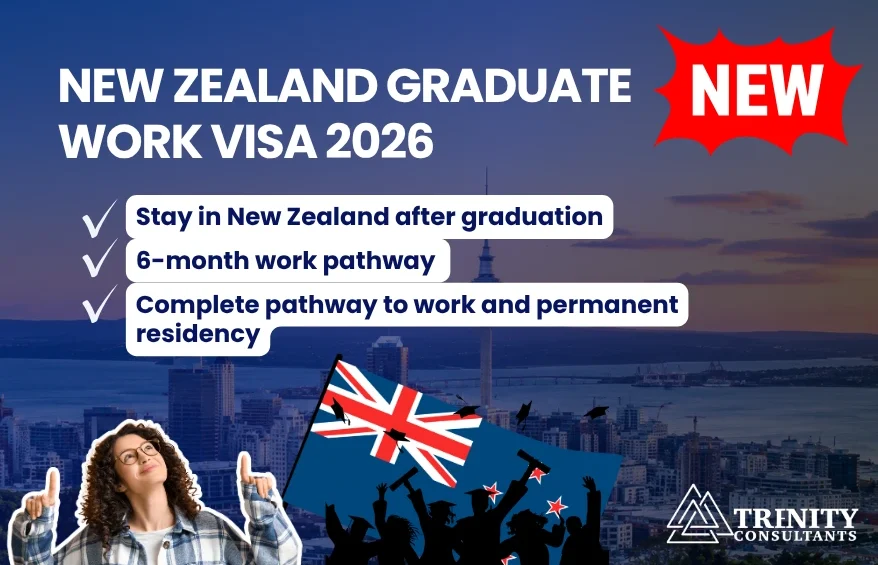
If you don’t currently qualify for a post-study work visa, the answer used to be frustratingly simple—you’d have to leave. But that’s changing. From 16 November 2026, New Zealand is introducing a brand-new New Zealand Graduate Work Visa 2026 pathway that gives more international graduates a structured way to stay, work, and build a future here.

Migrate to New Zealand with expert guidance from the UAE, and book your free eligibility check today with trusted New Zealand visa consultants in  Abu Dhabi, Dubai , Sharjah and across the GCC.

This guide covers everything you need to know — eligibility, requirements, key differences, and what to do right now to prepare.

What Has New Zealand Just Announced?

In March 2026, Immigration New Zealand confirmed two significant updates to the country’s post-study work visa framework, both taking effect from 16 November 2026:

  • A brand-new Short-Term Graduate Work Visa — a 6-month open work visa for graduates who don’t qualify for the PSWV.
  • Expanded eligibility for the existing Post-Study Work Visa—opening the door to Graduate Diploma holders at NZQCF Level 7.

These changes are part of New Zealand’s broader strategy to retain skilled international graduates and address growing skill shortages across key sectors, including healthcare, technology, engineering, and the trades. Put simply, New Zealand wants international students to stay — and these new visa rules make that easier.

These updates are part of New Zealand’s broader effort to make it easier for international students to migrate to New Zealand and transition into skilled employment pathways from the UAE, Bahrain, Kuwait, Oman, Qatar & Saudi Arabia.

What Is the New Short-Term Graduate Work Visa?

Think of the Short-Term Graduate Work Visa as a bridge. It’s designed for international graduates who have completed a qualifying study program in New Zealand but don’t meet the criteria for the longer Post Study Work Visa. Instead of being forced to leave immediately, this visa gives you six months of breathing room to find a job, get your career started, and ideally transition to an Accredited Employer Work Visa (AEWV) for a longer stay.

Here are the key things to know upfront:

  • 6 months of open work rights — you can work for any employer in any industry
  • Available from 16 November 2026
  • One-time only—it cannot be extended, and you cannot apply for it again
  • Primary purpose: to help you secure employment and potentially move to an AEWV

This pathway is especially important for students who want to migrate to New Zealand long-term but do not immediately qualify for the post-study work visa.

Short-Term Graduate Work Visa: Full Eligibility Checklist

Before you apply, you’ll need to tick every box on this list. If you miss even one requirement, your application may be declined.

  • Your qualification must be at NZQCF Level 5, Level 6, or Level 7
  • You must have studied full-time for at least 24 weeks in New Zealand
  • Your qualification must NOT be an English language, foundation, or bridging course
  • Your qualification must disqualify you from eligibility for a post-study work visa.
  • You must have at least NZD $5,000 in available funds to support yourself
  • You must NOT have previously held a Short-Term Graduate Work Visa or Post-Study Work Visa
  • Your application must be submitted within 3 months of your student visa expiry
  • You must meet health requirements—a valid medical certificate and chest X-ray may be required depending on your intended length of stay
  • If you studied under the New Zealand Scholarship Programme, you’ll need written approval from the Ministry of Foreign Affairs and Trade or Education New Zealand

If you’re unsure whether your specific qualification meets the NZQCF Level Criteria, don’t guess—speak with visa consultants for New Zealand in Abu Dhabi, Dubai, Sharjah, UAE, or across the GCC to get it confirmed before you apply. An incorrect application wastes time and money.

What's Changing for the Post Study Work Visa in 2026?

The Post-Study Work Visa (PSWV) has long been the preferred option for graduates wanting to stay and work in New Zealand, offering longer work rights and more flexibility. But previously, it was only available to graduates who completed a degree at NZQCF Level 7 or above.

From November 2026, eligibility is being expanded. Here’s what’s new:

  • Graduates who have completed a Graduate Diploma at NZQCF Level 7 will now also be eligible for the PSWV
  • The Graduate Diploma must have been studied full-time in New Zealand for its entire duration
  • Cross-crediting or recognition of prior learning does not count—the full qualification must be completed in New Zealand
  • Applicants must also hold a bachelor’s degree—this can be from New Zealand or overseas, and there is no time limit on when it was awarded
  • You will need to provide proof of your bachelor’s degree certificate and an official academic transcript

This requirement is a significant change for a lot of students who chose a graduate diploma pathway. If this applies to you, it means you could qualify for the full Post Study Work Visa rather than the short-term option — a much stronger foundation for your long-term immigration plans.

Short-Term Graduate Work Visa vs Post Study Work Visa: Key Differences

Not sure which visa applies to you? Here’s a side-by-side breakdown:

FeatureShort-Term Graduate Work VisaPost Study Work Visa (PSWV)
Duration6 monthsUp to 3 years
Who it's forGraduates not eligible for PSWVEligible Level 7+ graduates
Work rightsOpen — any employerOpen — any employer
Extendable?NoYes (conditions apply)
Business ownershipNot permittedPermitted
Family sponsorshipNot permittedPermitted
AEWV PathwayYesYes
One-time only?Yes — cannot be reappliedNo
Available from16 November 2026Currently available (expanded Nov 2026)

The bottom line: if you can qualify for the PSWV, that’s the stronger pathway. The Short-Term Graduate Work Visa is the safety net — and a genuinely useful one — for those who fall outside the PSWV criteria.

Can This Visa Lead to Permanent Residency in New Zealand?

This is one of the most common questions we get at Trenity—and it’s the right one to be asking.

The Short-Term Graduate Work Visa is not a pathway to permanent residency on its own. It’s a temporary visa with a six-month window. But it can be the first step in a longer journey that does lead to PR.

Here’s how the pathway typically works:

  • Step 1: Graduate and apply for the Short-Term Graduate Work Visa (or PSWV if eligible)
  • Step 2: Find employment with a New Zealand-accredited employer
  • Step 3: Apply for and receive an Accredited Employer Work Visa (AEWV)
  • Step 4: Build work experience and meet the criteria for the Skilled Migrant Category
  • Step 5: Apply for New Zealand permanent residency

This journey takes time — usually several years — and the requirements for each step can change. But thousands of international graduates have successfully walked this path, and New Zealand’s current immigration direction clearly aims to make it more accessible.

What Are the Restrictions on the Short-Term Graduate Work Visa?

Open work rights sound fantastic — and they are. But this visa does come with some restrictions you need to know about before you apply:

  • You cannot own, establish, or operate a business while on this visa
  • You cannot sponsor your partner for a work visa
  • You cannot support dependent children applying for student visas
  • The visa cannot be extended beyond its 6-month validity—no exceptions
  • The visa can only ever be granted once in your lifetime—if you use it, it’s gone

These restrictions are designed to keep this visa focused on its core purpose: helping recent graduates find employment and transition to longer-term work options. If your situation involves family members or business plans, those conversations need to happen separately.

Step-by-Step: How to Prepare Your Application

The visa doesn’t open until 16 November 2026 — but that doesn’t mean you should wait until then to start preparing. Here’s what smart graduates are doing right now:

Step 1 — Confirm your qualification level

Check whether your program sits at NZQCF Level 5, 6, or 7. If you’re not sure, contact your institution’s international student office or check the New Zealand Qualifications Authority (NZQA) website.

Step 2—Check your PSWV eligibility first

Before assuming you need the Short-Term Graduate Work Visa, confirm whether you might actually qualify for the Post Study Work Visa — especially given the expanded eligibility for Graduate Diploma holders from November 2026. The PSWV is the stronger option where available.

Step 3—Gather your documents now

You’ll need: academic transcripts, your qualification certificate, proof of full-time study duration, evidence of NZD $5,000 in available funds, and your passport. If applicable, your bachelor’s degree certificate and transcript. Health documentation (medical certificate / chest X-ray) may also be required.

Step 4—Note your student visa expiry date

You must apply within 3 months of your student visa expiry. Miss this window and you lose your chance at this visa entirely. Put a reminder in your calendar now.

Step 5—Start your job search before you graduate

Six months is not as long as it sounds when you factor in application timelines, onboarding processes, and notice periods. Update your CV, get active on LinkedIn, attend career fairs, and research which New Zealand employers are accredited with Immigration New Zealand.

Step 6 — Submit through the Immigration New Zealand portal

Applications will be submitted through the official Immigration New Zealand online portal from 16 November 2026. Make sure your documents are all in order before you start the online form.

Is New Zealand Still Worth It for International Students in 2026?

With so many countries competing for international students, it’s fair to ask whether New Zealand is still the right choice. And honestly? The answer is yes — and the evidence is in these very policy changes.

When a government expands post-study work rights and creates new visa pathways for graduates, it’s sending a clear message: we want you here. New Zealand is actively investing in retaining international talent, not just collecting tuition fees.

Beyond the visa policies, New Zealand offers something harder to quantify — quality of life. Clean air, safe cities, a welcoming multicultural society, and a job market that genuinely rewards skilled professionals. Sectors like healthcare, information technology, construction, and engineering are experiencing real skill shortages, meaning graduates in these fields often find employment faster than they expect.

At Trenity Consultants, we’ve helped hundreds of students navigate the transition from graduation to employment to long-term residency in New Zealand. The path isn’t always straightforward, but it’s very much achievable with the right guidance.

How Trenity Consultants Can Help You

Visa rules are detailed, and the difference between qualifying and not often comes down to a single document, one missed deadline, or a qualification level you weren’t sure about. That’s not the kind of thing you want to get wrong.

At Trenity Consultants, our New Zealand immigration specialists stay on top of every policy update, so you don’t have to. Whether you’re still choosing your study program, approaching graduation, or have already finished and need to move quickly—we can help.

Here’s what we do for our clients:

  • Full eligibility assessment — we tell you exactly which visa you qualify for and why
  • Document checklist and review — we make sure nothing is missing before you submit
  • Application preparation and lodgement—we handle the entire process end-to-end
  • Post-visa planning—we help you map out the pathway from graduate visa to AEWV to PR
  • Ongoing immigration support — visa conditions change, and we keep you updated

New Zealand Graduate Work Visa 2026 : Frequently Asked Questions

Here are the questions our consultants get asked most often about the new New Zealand Graduate Work Visa 2026 changes:

Q: When can I apply for the Short-Term Graduate Work Visa?

Applications open from 16 November 2026. If your student visa expires before this date, check with Immigration New Zealand about bridging options.

Q: Can I work for any employer on this visa?

Yes. The Short-Term Graduate Work Visa provides full open work rights, meaning you can work for any employer in New Zealand across any industry.

What happens if I can't find a job within 6 months?

The visa cannot be extended and cannot be reapplied for. If you haven't secured employment by the end of the 6-month period, you would need to explore other visa options or leave New Zealand. This is why starting your job search early — ideally before graduation — is so important.

I already held a Post Study Work Visa. Can I apply for the Short-Term Graduate Work Visa?

No. If you have previously held either a Post Study Work Visa or a Short-Term Graduate Work Visa, you are not eligible for the Short-Term Graduate Work Visa.

How much money do I need to have available when I apply?

You must demonstrate access to at least NZD $5,000 in available funds at the time of application. This is to show Immigration New Zealand that you can financially support yourself while you search for work.

Can I bring my family with me on this visa?

No. The Short-Term Graduate Work Visa does not allow you to sponsor a partner for a work visa or support dependent children for student visas. Family sponsorship options would need to be explored separately.

I completed a Graduate Diploma. Do I qualify for the Post Study Work Visa now?

From 16 November 2026, graduates who completed a Graduate Diploma at NZQCF Level 7 will be eligible for the PSWV — provided they also hold a bachelor's degree and completed the entire diploma full-time in New Zealand. Cross-credited or prior-learning recognition does not count.

Q: Do I need to apply within a specific timeframe after graduation?

Yes. Your application must be submitted within 3 months of your student visa expiry date. If you miss this window, you cannot apply for the Short-Term Graduate Work Visa.

Final Thoughts

New Zealand’s decision to introduce the Short-Term Graduate Work Visa and expand Post-Study Work Visa eligibility is a genuine win for international students. More pathways mean more opportunities — but they also mean more complexity. The more options that exist, the more important it becomes to understand exactly which one applies to your situation.

The New Zealand Graduate Work Visa 2026 changes take effect from 16 November 2026. If you’re graduating around or after that date, now is the time to start preparing. Review your qualification level, check your eligibility, get your documents in order, and start thinking about your employment targets.

And if you want someone in your corner who knows this process inside out — that’s what Trenity Consultants is here for.

Need Immigration Assistance? Connect With Trenity Consultants Near You

Choose your nearest office and visit your local country page for personalized immigration guidance.

🇦🇪
Abu Dhabi
United Arab Emirates
Immigration Consultants in Abu Dhabi
Visit Page
🇦🇪
Dubai
United Arab Emirates
Immigration Consultants in Dubai
Visit Page
🇦🇪
Sharjah
United Arab Emirates
Immigration Consultants in Sharjah
Visit Page
🇰🇼
Kuwait
Kuwait
Immigration Consultants in Kuwait
Visit Page
🇧🇭
Bahrain
Bahrain
Immigration Consultants in Bahrain
Visit Page
🇶🇦
Qatar
Qatar
Immigration Consultants in Qatar
Visit Page
🇴🇲
Oman
Oman
Immigration Consultants in Oman
Visit Page
🇸🇦
Riyadh
Saudi Arabia
Immigration Consultants in Riyadh
Visit Page
🇸🇦
Jeddah
Saudi Arabia
Immigration Consultants in Jeddah
Visit Page

Share:

Ccountries with highest Schengen visa approval—Get to know more with Trenity Consultants!

Traveling to Europe in 2026? Here are the top easiest Schengen countries to get visa in 2026

The Easiest Schengen Countries for Quick Visa Approval - Get Fast Schengen Visa Appointments in Abu Dhabi with Trenity Consultants

Which Schengen Country Is Easiest to Get a Visa in 2026?

Getting a Schengen visa is probably one of the first things you should do if you want to go to Europe in 2026.  It can be easier to choose a country with a higher approval rate now that there are new rules and more people applying.  This guide will help you choose the best countries for your application, explain important rules, and help you avoid common mistakes so that your trip goes well.

Top 10 Schengen Countries Where Getting a Visa Is Easy

Recent statistics from 2024 show which countries are most likely to give out Schengen visas.  The average approval rate was about 52.2%, but some countries were much more welcoming than others:

  1. Lithuania: 97.2% approval rate
  2. Estonia: 98% (highest volume-adjusted)
  3. Iceland: 91%
  4. Slovakia: 89%
  5. Italy: 88%
  6. Romania: 88%
  7. Switzerland: 88%
  8. Hungary: 87%
  9. Norway: 87%
  10. Greece: 86%

Applying through one of these countries gives you the best chance of getting your Schengen visa approved. Here is a quick comparison to help you decide:

CountryApproval RateAvg. Processing TimeAppointment WaitBest For
Estonia98%5–7 daysShortFirst-time applicants
Lithuania97%7–10 daysShortIndian & Pakistani applicants
Iceland91%5–7 daysShortFast approval
Slovakia89%7–10 daysShortUAE & Gulf applicants
Italy88%10–15 daysModerateTourism-focused trips
Romania88%7–10 daysShortFirst-time applicants
Switzerland88%10–15 daysModerateBusiness travel
Hungary87%7–10 daysShortUAE & Gulf applicants
Norway87%10–15 daysShortStraightforward applications
Greece86%10–15 daysModerateTourism

Don’t “Visa Shop”: Follow the Correct Schengen Visa Process in 2026

The rules for the Schengen visa in 2026 say that you have to apply based on your real travel plans. You might want to apply in the country with the highest approval rate.  This is how it works:

  • If you’re visiting only one Schengen country, apply for your visa through that country’s embassy or its authorized visa center.

  • If your trip includes multiple Schengen countries, submit your application to the embassy of the country where you’ll spend the most time (your main destination).

  • If you’ll spend an equal amount of time in each country, apply through the embassy of the country you’ll enter first.

You could get your application turned down or have problems later if you don’t follow these embassy rules and apply to the wrong country.

Understanding how long it takes to process and why it was rejected

In 2025, nearly 12 million people applied for Schengen visas—a 1.8% increase on the year before. Processing times remain busy in 2026, especially during the summer and Christmas periods. The overall refusal rate has improved to 14.8% in 2025, down from 17.9% in 2022, which means your chances of approval are better now than they have been in years. Apply as early as possible and book your appointment well in advance to avoid delays.

How Long Does a Schengen Visa Take to Get Approved in 2026?

Most people assume getting a Schengen visa takes forever—but that is not always true. The official processing time is 15 calendar days, but in reality, it depends a lot on which country you apply through.

Countries like Slovakia, Lithuania, and Iceland tend to move much faster. Many applicants get their visa back in 5 to 10 working days when applying through these embassies.

If you apply through France, Germany, or Spain—especially from the UAE—you could wait 3 to 4 weeks just for an appointment, not to mention the additional time for the decision.

A few things that will affect how long your application takes:

  • The embassy you apply through—busy ones like France and Spain are simply slower
  • The time of year—avoid applying close to summer or Christmas if you can
  • Your documents—one missing paper can set you back weeks
  • Your nationality — some passports require extra checks, which adds time
  • The safest approach is to apply at least 4 to 6 weeks before your trip.
  • You are allowed to apply up to 6 months in advance, so there is no reason to leave it last minute.

Easiest Schengen Visa for Indian Passport Holders in 2026

A lot of our clients at Trenity come to us with the same question — which Schengen country is actually easy to get approved from if you hold an Indian passport? The honest answer is that it depends on where you apply, but some countries are consistently easier than others.

From the UAE, Lithuania and Slovakia are currently two of the best options. Appointments are easier to get, processing is faster, and approval rates are strong.

Estonia and Hungary are also worth considering—they do not get as much traffic as the bigger embassies, which means shorter queues and quicker turnaround.

Iceland technically has the highest approval rate at 91%, but appointment availability can be limited depending on where you are applying from.

The most common reasons we see Indian applications get rejected are weak bank statements, a vague travel itinerary, or nothing in the application that shows you plan to come back home. If your bank statements show at least 3 months of steady income, your flights and hotels are confirmed, and your cover letter clearly explains why you are travelling and when you are returning, your chances go up significantly.

Which Schengen Country Is Easiest to Get a Visa Appointment in 2026?

Here is something a lot of people do not realise until it is too late — the hardest part of getting a Schengen visa in 2026 is often not the approval; it is just getting an appointment.

France, Germany, Spain, and the Netherlands are notoriously difficult for appointments right now, especially if you are applying from the UAE or Gulf. Wait times of 4 to 8 weeks are common, and during peak travel season it can be even longer. If you want a faster appointment, these countries are your best bet right now:

  • Lithuania: usually 1 to 2 weeks via VFS Global
  • Slovakia: appointments generally available within 2 weeks
  • Estonia: low demand means shorter waits
  • Luxembourg:  smaller embassy, much quicker
  • Hungary: VFS in the UAE typically has slots within 2 to 3 weeks

One thing worth knowing: if you are visiting multiple Schengen countries and spending roughly equal time in each, you do not have to apply through the most popular one. You can apply through whichever country you enter first—so it is worth planning your itinerary around a country with easier appointments if you have flexibility.

How to Increase Your Schengen Visa Approval Chances

To improve your chances of approval, ensure that you provide accurate and complete documentation. Each Schengen country may have specific requirements, so always check the latest visa guidelines on their official website or consult with experts.

If you are unsure about the application process, it’s advisable to work with experienced professionals such as the Best Europe Immigration Consultants. These experts can help you navigate the complex visa application process and increase your chances of a successful application by providing expert advice on documentation, timelines, and strategies for overcoming common hurdles.

How Nationality Influences Schengen Visa Success Rates

Your nationality and the country you apply through both matters.  For example, in 2024, 97.6% of Liberians approved, but only a small number of people from Comoros and Guinea-Bissau did.  No matter where you’re from, it’s important to be well-prepared, especially if this is your first time applying.

What the EES and ETIAS Mean for Your Schengen Visa in 2026

Here is the EES section rewritten to sound human:


If you are planning to apply for a Schengen visa in 2026, there are two big changes to European border control that you genuinely need to know about before you apply.

EES — Entry/Exit System (already live)

The EES went fully live on 10 April 2026, and it changes things quite significantly. Passport stamping is done. Now, every time you cross into or out of a Schengen country, the system records your fingerprints, photo, and travel document details digitally in a central database.

What this really means is that border guards and embassies can instantly see your complete travel history—every entry, every exit, and crucially, any overstays or past rejections. Even if you overstayed by just a few days on a previous trip, that is now on permanent record, and it will come up when you apply again.

ETIAS—launching later in 2026

ETIAS is essentially Europe’s version of the US ESTA—an online travel authorization you apply for before you travel. It is due to launch in the last quarter of 2026. The key thing to understand here is that ETIAS only applies to people who currently travel to Europe without a visa, like UK, US, or Australian passport holders. If you are Indian, Pakistani, or hold most Asian passports and already go through the Schengen visa process, this does not affect you at all. Your application process stays exactly the same.

What does this mean for your application?

Be honest about your travel history—all of it. The EES means there is no way to hide a previous overstay or rejection anymore. If your record is clean, you have absolutely nothing to worry about. If it is not, be upfront in your application and clearly explain the circumstances instead of hoping it goes unnoticed.

Easiest Schengen Countries for Visa: Final Tips for First-Time Applicants

Refer to the 2025 statistics to find the which were the top Schengen countries for visa approval in summer 2025.  If you want to go to Europe soon.  Pick the country you want to apply to based on where you really want to go, apply early, and obey the rules for 2026.  If this is your first time applying, Lithuania, Estonia, and Iceland are the strongest choices in 2026.

Schengen Visa Questions Answered for 2026

Q: Which Schengen country is the easiest to get a visa in 2026?

Honestly, Lithuania and Estonia are leading the pack right now. Lithuania sits at a 97% approval rate and Estonia is even higher at 98% on a volume-adjusted basis. Iceland, Slovakia, and Romania are also solid choices. If you are applying from the UAE, India, or Pakistan specifically, Lithuania and Slovakia tend to work out best — the queues are shorter and the process is just more straightforward.

Q: Which Schengen visa is easiest to get for Indian passport holders?

From what we see with our clients, Lithuania and Slovakia are consistently the best bet for Indian passport holders in 2026. Appointments come through faster, approval rates are high, and most applications are processed within 7 to 10 days. If you are based in the UAE, Hungary and Estonia are also worth looking at — both have good VFS availability right now.

Q: How long does a Schengen visa take to process in 2026?

The official answer is 15 calendar days, but that is really the maximum — not what usually happens. If you apply through Lithuania, Slovakia, or Estonia, a lot of applicants are getting their visa back in 5 to 10 working days. The one time to be careful is summer, roughly June through August, when every embassy slows down. To be safe, give yourself at least 4 to 6 weeks before your travel date.

Q: Which Schengen country has the highest visa approval rate in 2026?

Based on the latest European Commission data, Estonia is actually at the top with a 98% approval rate, followed by Lithuania at 97% and Iceland at 91%. These numbers are based on 2025 applications so they are as current as it gets. Worth noting though — high approval rates partly reflect the type of applicants these countries receive, so strong documentation still matters regardless of where you apply.

Q: Which Schengen country is easiest to get a visa appointment in 2026?

This is honestly one of the biggest frustrations people face right now. France, Germany, Spain, and the Netherlands are a nightmare for appointments from the UAE — you are often looking at 4 to 8 weeks just to get a slot. Lithuania, Slovakia, Estonia, and Luxembourg are a completely different story. Most people get appointments within 1 to 2 weeks through VFS Global. If timing matters to you, this alone is a good reason to plan your trip around one of these countries.

Q: Is it hard to get a Schengen visa from the UAE in 2026?

It really does not have to be. The overall Schengen refusal rate has actually dropped to 14.8% — the best it has been since before the pandemic. If you apply through Lithuania, Slovakia, or Hungary from the UAE, have your documents in order, and give yourself enough time, your chances are genuinely good. Most rejections we see come down to weak bank statements or a travel plan that does not quite add up — both of which are completely avoidable with the right preparation.

Q: What is the EES and does it affect my Schengen visa application in 2026?

The EES — Entry/Exit System — went fully live on 10 April 2026. In simple terms, it means passport stamping is finished. Every time you cross into or out of a Schengen country, your fingerprints, photo, and travel details are now recorded digitally. It does not change the visa application process itself, but it does mean that if you have ever overstayed a Schengen visa — even by a few days — that is now permanently on record and embassies can see it. If your travel history is clean, you have nothing to worry about.

Q: What is ETIAS and do I need it in 2026?

ETIAS is a new online travel authorisation that is launching in the last quarter of 2026 — think of it like the US ESTA. Here is the important part though: it only applies to people who currently travel to Europe without a visa, like UK, US, and Australian passport holders. If you are Indian, Pakistani, Bangladeshi, or hold most Asian passports and already apply for a Schengen visa, ETIAS has nothing to do with you. Your process stays exactly the same.

How to Get Fast Schengen Visa Appointments in Abu Dhabi, United Arab Emirates

If you’re applying from the Middle East, getting help from reliable specialists for Europe immigration can really speed up the process of getting a Schengen visa appointment.  

Experienced immigration consultants can help you avoid mistakes, make sure your papers are ready, and know the most recent rules for 2026. They can help you make an early appointment, advise you on your paperwork, and improve your chances of getting approved.

Share: