


10 Cheap Countries in Europe to Visit in 2026 | Best Europe Work Permit Consultancy - Trenity Consultants

10 Cheapest Countries in Europe to Visit in 2026: Budget Travel & Schengen Visa Guide

Top 10 cheap countries in Europe worth adding to your trip, what they cost per day, and where each one stands on visas by Trenity Consultants.

10 Cheap Countries in Europe Worth Adding to Your 2026 Trip

Western Europe empties your wallet fast. A coffee in Zurich or a night in central Paris can cost as much as a whole day does a few hundred kilometres to the east. Head toward the Balkans and the eastern edge of the continent, and your money goes a lot further — some of the cheapest countries in Europe are right there, and the visa side is usually simpler too. Here are ten cheap countries in Europe worth adding to your trip, what they cost per day, and where each one stands on visas.

If you haven’t sorted your Schengen visa yet, read Trenity Consultant’s breakdown of which Schengen country is easy to get a visa from in 2026 before you book anything.

Looking for the best Europe work permit consultancy? Trenity Consultants provides professional guidance on Europe work permit pathways, eligibility assessments, and application support for clients across Abu Dhabi, Dubai, Sharjah, Bahrain, Qatar, Kuwait, Oman, Riyadh & Jeddah.

A few of the cheap countries in Europe below are Schengen countries, and picking the right consulate matters more than most people think.

1. Albania

Roughly $30 to $35 a day gets you a private room, three meals, and getting around town — which puts Albania near the top of any cheap countries in Europe list. The Albanian Riviera has quietly become one of the better value coastlines in Europe. Beach towns like Dhërmi and Himarë cost a fraction of what you’d pay on Croatia’s coast for a similar view. Inland, the Accursed Mountains around Theth have multi-day hikes that rival the Dolomites for a tenth of the price. Tirana itself is easy to walk around and cheap to eat well in. Albania sits outside the Schengen zone, so it needs its own visa, separate from any Schengen trip you’re combining it with. Some GCC nationals can enter visa-free for short stays, but that comes down to nationality, not residency — check your passport before assuming anything.

The key thing to understand is what makes this visa different from every other long-term Korean visa. Work visas, student visas, and family-based visas all require some kind of local tie — a Korean employer, a Korean school, or Korean relatives. The digital nomad visa skips all of that. You don’t need a job offer in Korea. You don’t need to enroll anywhere. You just need to prove you’re already gainfully employed abroad and can support yourself while living in the country.

2. North Macedonia

Similar price to Albania, $30 to $35 a day. Lake Ohrid is the main draw — a UNESCO-listed lake ringed by Byzantine churches, with lakeside guesthouses cheaper than a mid-range hotel room back home. Skopje’s old bazaar is one of the largest surviving Ottoman-era markets in the Balkans. Matka Canyon, twenty minutes from the capital, has a kayakable gorge and caves most visitors never even hear about. Also, non-Schengen, so it needs its own visa for most Gulf-based travellers.

3. Bosnia & Herzegovina

The cheapest on this list, at $25 to $35 a day. Sarajevo’s old town mixes Ottoman, Austro-Hungarian, and post-war architecture in a way that feels lived-in rather than staged for tourists. Mostar’s stone bridge is the photo everyone’s seen, but the Blagaj Tekke monastery — built right into a cliff over a spring — gets far fewer visitors and might be even more striking. Non-Schengen, so you’ll need a standard visit visa.

4. Serbia

$30 to $40 a day. Belgrade’s nightlife runs later and cheaper than most Western European capitals — riverside clubs on the Sava, plus a growing scene of natural wine bars in the old town. Novi Sad, an hour north, hosts the EXIT festival every July but is worth a visit any time of year for the fortress views over the Danube. Serbian food doesn’t get talked about enough — heavy grilled meats, ajvar on everything, and portions big enough to make a $10 meal feel like too much. Non-Schengen.

5. Bulgaria

The visa is issued for one year initially and can be renewed annually, if you continue to meet the eligibility requirements. Under the new rules, the total stay has been extended from two years to three years from your first entry into Korea — a meaningful upgrade for anyone who wants to settle in and experience the country long-term rather than treating it as a short stopover.

6. Romania

$35 to $45 a day, also Schengen. Bran Castle gets all the Dracula tourists, but Peleș Castle near Sinaia is the better building — a Neo-Renaissance palace with hand-carved wood interiors that took decades to finish. Sighișoara’s fortified old town, a UNESCO site, is still lived in rather than kept as a museum piece, and that changes how it feels to walk through. Romania also updated its work permit rules recently, so if this trip is really about scouting a longer move rather than a holiday, that’s worth a separate conversation before you go.

7. Poland

$40 to $55 a day — the priciest on this list, but still well under Western European rates. Kraków’s old town survived the war mostly intact, so it’s one of the best-preserved medieval centres on the continent. Warsaw rebuilt itself almost entirely after 1945, and the contrast between the rebuilt Old Town and the modern skyline is worth a day on its own. Wrocław and Poznań get skipped in favour of the bigger two cities — which is exactly why they’re worth adding if you have the extra days. Fewer crowds, same architecture. Schengen member.

8. Hungary

$40 to $55 a day. Budapest’s thermal baths are the obvious draw — Széchenyi and Gellért both have affordable day passes — but the ruin pub scene, built out of abandoned buildings in the Jewish Quarter, is where the evenings actually happen. A walk along the Danube at dusk, Buda Castle lit up on one side and Parliament on the other, is one of the best free things on this whole list. Schengen.

9. Montenegro

$40 to $55 a day. Kotor Bay gets compared to a fjord for good reason — the mountains drop almost straight into the water, and the walled old town at its base is small enough to walk in an afternoon. Tivat has become the yacht crowd’s entry point, but Bar and Ulcinj further south have the same coastline at prices closer to Albania than Croatia. Non-Schengen, so it’s a separate visa process.

10. Portugal

$45 to $60 a day — the most expensive on this list, but still noticeably cheaper than France, Germany, or the Netherlands. Lisbon’s hills and old trams get most of the attention, but Porto’s riverside along the Douro is arguably prettier and a lot less crowded. The Algarve outside peak summer — May, September, October — drops in both price and crowds while keeping decent weather. Schengen member.

Building a Multi-Country Route Across Cheap Countries in Europe

Four countries on this list — Bulgaria, Romania, Poland, and Hungary — are Schengen members. This means that one visa covers all four travellers on a single trip, and it can be applied for through your main destination or first point of entry. Because Schengen rules say you have to apply through your actual main destination, not just wherever’s easiest, check our Schengen country list for 2026 before picking a consulate. Add a Balkan detour into Albania, Serbia, or Montenegro and you’re now running two separate visa processes at once, so leave enough time for both.

This situation is usually where talking to a visa consultant actually pays off. The paperwork itself isn’t hard, but timing two applications against each other, working out which Schengen country is easiest to get a visa appointment through, and making sure your itinerary and bank statements hold up across both — that’s where people trip up. Trenity Consultants deals with these issues regularly for clients in Abu Dhabi, Dubai, Sharjah, Kuwait, Qatar, Bahrain, Oman, Riyadh and Jeddah. If you’re trying to figure out which of the easiest Schengen countries to get a visa approval from fits your route, our guide covers the approval-rate side in more depth.

For a rough sense of how far your money goes, Numbeo’s cost-of-living index is a decent way to check daily budgets against current exchange rates before you lock in an itinerary.

Cheap Countries in Europe at a Glance

🌍 Country💰 Estimated Daily Budget🛂 Visa Zone✨ Ideal For
Bosnia & Herzegovina$25–35Non-SchengenHistoric towns & nature
Albania$30–35Non-SchengenAffordable beaches
North Macedonia$30–35Non-SchengenLakes & culture
Serbia$30–40Non-SchengenNightlife & city breaks
Bulgaria$35–45SchengenMountains & Black Sea
Romania$35–45SchengenCastles & road trips
Poland$40–55SchengenHistoric cities
Hungary$40–55SchengenThermal baths
Montenegro$40–55Non-SchengenCoastal scenery
Portugal$45–60SchengenCoastal cities & food
💡 Note: Estimated daily budgets include budget accommodation, local transportation, meals, and sightseeing. Actual expenses may vary depending on the city, travel season, and travel style.

Not sure which visa route fits your trip or whether a Schengen application or a separate Balkan visa makes more sense for your route through these cheap countries in Europe? Book a free consultation with the top consultancy team for European work permits. We can usually tell you what you actually need in a short conversation before you start filling out any forms.

Book a Free Consultation

Book a free consultation today and get expert guidance tailored to your profile.

Frequently Asked Questions

What is the cheapest country to visit in Europe?

Bosnia & Herzegovina, out of this list. You can get by on $25 to $35 a day there. Albania and North Macedonia aren't far behind.

Which European countries are not part of the Schengen zone?

Albania, North Macedonia, Serbia, Bosnia & Herzegovina, and Montenegro. Each one needs its own separate visa, not the shared Schengen one.

Is Romania a Schengen country?

Yes. Romania and Bulgaria both joined the Schengen zone, so one visa now covers both.

Can one visa cover a trip through several of these countries?

If you're sticking to Bulgaria, Romania, Poland, and Hungary, yes — one Schengen application covers all four. You apply through whichever one is your main stop.

Which Schengen country is easiest to get a visa for?

Honestly, it depends on the season and how busy that consulate is at the time. It's not really about picking the "easy" country — it's about applying through your actual destination with a solid file. We go into this more in our Schengen approval guide.

Do I need a separate visa for Albania, Serbia, or Montenegro too?

Usually, yes. These aren't Schengen countries, so they run on their own visa timeline — plan for that separately if you're combining them with a Schengen trip.

Need Immigration Assistance? Connect With Trenity Consultants Near You

Choose your nearest office and visit your local country page for personalized immigration guidance.

🇦🇪
Abu Dhabi
United Arab Emirates
Immigration Consultants in Abu Dhabi
Visit Page
🇦🇪
Dubai
United Arab Emirates
Immigration Consultants in Dubai
Visit Page
🇦🇪
Sharjah
United Arab Emirates
Immigration Consultants in Sharjah
Visit Page
🇰🇼
Kuwait
Kuwait
Immigration Consultants in Kuwait
Visit Page
🇧🇭
Bahrain
Bahrain
Immigration Consultants in Bahrain
Visit Page
🇶🇦
Qatar
Qatar
Immigration Consultants in Qatar
Visit Page
🇴🇲
Oman
Oman
Immigration Consultants in Oman
Visit Page
🇸🇦
Riyadh
Saudi Arabia
Immigration Consultants in Riyadh
Visit Page
🇸🇦
Jeddah
Saudi Arabia
Immigration Consultants in Jeddah
Visit Page

Share:

Explore the new South Korea Digital Nomad Visa 2026 and discover if you're eligible to live and work remotely from one of Asia's most innovative destinations.

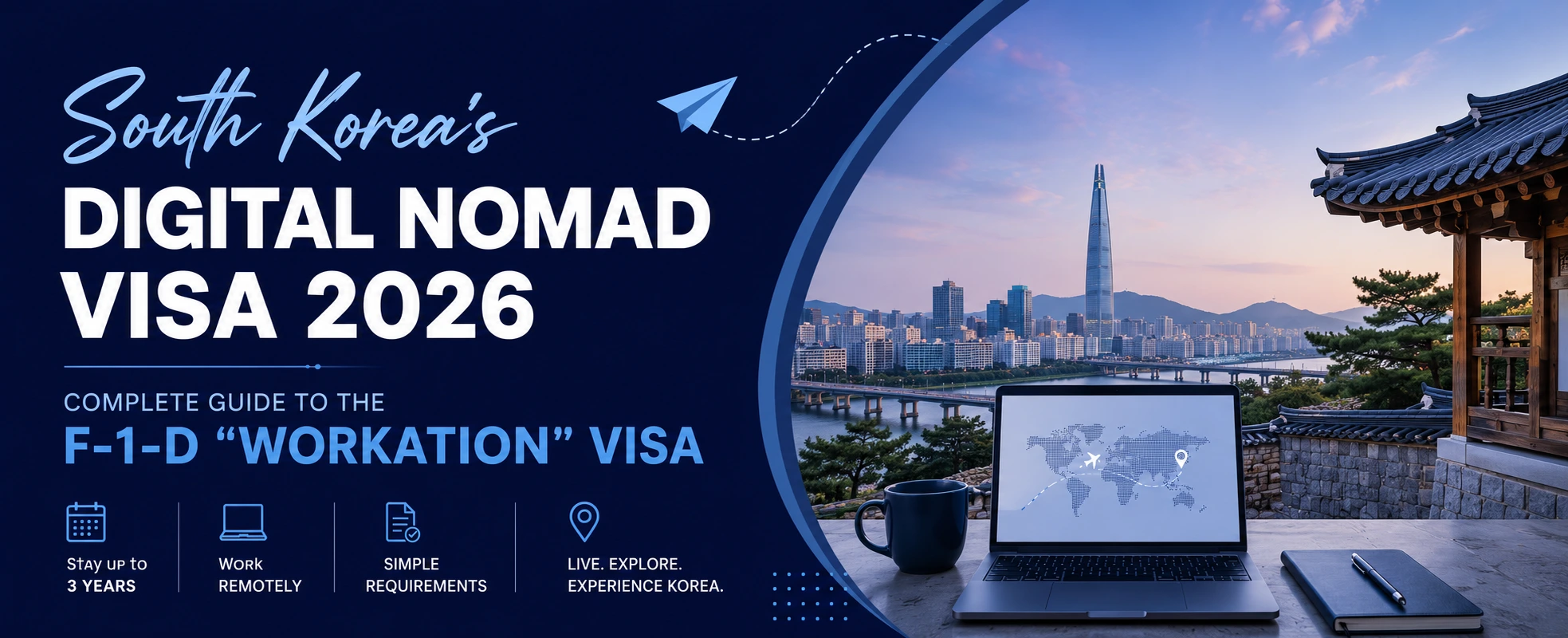
South Korea’s Digital Nomad Visa 2026: Complete Guide to the F-1-D “Workation” Visa

Explore South Korea’s new F-1-D Digital Nomad Visa, including eligibility criteria, income requirements, required documents, and how Trenity Consultants can assist you with your application process.

South Korea's Digital Nomad Visa 2026: Complete Guide to the F-1-D "Workation" Visa

If you’ve been dreaming about sipping coffee in a Seoul café while logging into your remote job, that dream just got a lot more realistic. South Korea has officially rolled out its long-awaited digital nomad visa, and honestly, it’s a much better deal than what was on offer during the pilot phase.

The F-1-D visa, better known as the “workation visa”, went live on June 30, 2026, after more than two years of testing through a pilot program. The Ministry of Justice made it official on July 7, 2026, and the new rules are noticeably friendlier than what early applicants had to deal with. Lower income thresholds, a longer stay, and a real incentive structure for people willing to live outside Seoul — this is South Korea actively trying to attract global remote talent, not just tolerate it.

Here’s everything you need to know about the South Korea digital nomad visa before you start packing. And if the eligibility rules or paperwork start to feel overwhelming, that’s precisely what the best immigration consultants in Dubai, UAE, like Trenity Consultants handle every day — a quick consultation can save you weeks of back-and-forth with your local embassy.

Apply for the South Korea Digital Nomad Visa with confidence. Get your eligibility assessed by Trenity Consultants, experienced immigration consultants serving clients across Abu Dhabi, Dubai, Sharjah, Bahrain, Qatar, Kuwait, Oman, Riyadh & Jeddah.

What Is the South Korea Digital Nomad Visa (F-1-D)?

The F-1-D visa lets foreign nationals live in South Korea while continuing to work for an employer based outside the country or while running their own overseas business. It’s built specifically for people who don’t need to be physically present in a Korean office to do their job — think software developers, marketers, consultants, designers, and freelancers of every stripe.

The key thing to understand is what makes this visa different from every other long-term Korean visa. Work visas, student visas, and family-based visas all require some kind of local tie — a Korean employer, a Korean school, or Korean relatives. The digital nomad visa skips all of that. You don’t need a job offer in Korea. You don’t need to enroll anywhere. You just need to prove you’re already gainfully employed abroad and can support yourself while living in the country.

Pilot Program vs. the New Official Visa: What Changed

Feature🔹 Pilot Program (2024–2026)✅ Official Visa (From June 30, 2026)
Maximum StayUp to 2 yearsUp to 3 years
Income Requirement2× Korea's GNI per capita for everyoneTiered by age and residence location
Regional IncentivesNoneLower thresholds outside Greater Seoul
Processing Time10–15 business daysApproximately 10 business days to 3–4 weeks

The biggest complaint about the pilot was the income bar. Requiring every applicant to earn double the national GNI per capita locked out a lot of younger freelancers and early-career remote workers, even highly skilled ones. The government clearly listened, because the updated rules make the visa much easier for more people to qualify for.

Who Qualifies? Eligibility Requirements for South Korea Digital Nomad Visa 2026

To apply for the South Korea Digital Nomad Visa, the F-1-D visa, you generally need to:

  • Be at least 18 years old (dependent family members can be younger)
  • Have worked for a foreign company, or run your own foreign business, for at least one year in the same field
  • Be able to perform your job entirely remotely from Korea
  • Meet the income threshold that applies to your age group and intended place of residence
  • Have a clean criminal record
  • Carry private medical insurance that covers treatment and repatriation for the full duration of your stay

New Income Thresholds for the South Korea Digital Nomad Visa (2026)

This is where the 2026 update really stands out. Instead of a flat rule for everyone, South Korea now uses a tiered system based on age and location:

  • Applicants 35 and older living in Seoul, Incheon, or Gyeonggi Province still need to earn at least twice South Korea’s GNI per capita — that works out to roughly $65,800+ a year based on 2025 figures.
  • Meanwhile, applicants aged 18–34 planning to live outside the Greater Seoul area only need to meet one year’s GNI per capita., which was $36,963 for 2025. That’s roughly half the original requirement.
  • All other applicants fall into the middle tier and need to earn around 1.5 times the GNI per capita.

If you’re applying under the reduced threshold, you’ll need to prove you plan to live outside Greater Seoul for at least a month — a lease agreement or confirmed booking at approved lodging usually does the trick.

One more detail worth flagging: only the main applicant’s income counts toward the requirement. If you’re bringing a spouse, their income can’t be combined with yours to hit the threshold, even though they’re allowed to join you on the visa.

How Long Can You Stay?

The visa is issued for one year initially and can be renewed annually, if you continue to meet the eligibility requirements. Under the new rules, the total stay has been extended from two years to three years from your first entry into Korea — a meaningful upgrade for anyone who wants to settle in and experience the country long-term rather than treating it as a short stopover.

Documents You'll Need to Apply for South Korea Digital Nomad Visa

Getting your paperwork in order is honestly the most tedious part of any visa process, and this one is no exception. Here’s what applicants typically need to submit:

  1. Completed visa application form
  2. Valid passport (must have at least six months of validity remaining)
  3. Passport-style photo, usually 3.5cm x 4.5cm with a white background
  4. Employment verification letter confirming your job and tenure
  5. Criminal background check from your home country, and from any country you’ve lived in for more than a year over the past five years
  6. Proof of private medical insurance covering hospital treatment and repatriation
  7. Proof of income — tax returns, payslips, and bank statements
  8. Any additional documents your local consulate requests based on your nationality

Depending on where you’re applying from, embassies may ask for slightly different paperwork, so it’s worth checking with your local Korean consulate before you submit anything. This is usually where things get tricky for first-time applicants — a single missing apostille or an outdated bank statement can delay your file by weeks. If you’d rather not risk it, working with experienced immigration consultants like Trenity Consultants can help you get your document checklist right the first time.

Get in touch with Trenity Consultants for a personalized document review before you submit.

This threshold affects:

  • Skills in Demand visa (Subclass 482)
  • Employer Nomination Scheme (Subclass 186)
  • Skilled Employer-Sponsored Regional visa (Subclass 494)
  • Regional Sponsored Migration Scheme (Subclass 187) nominations, where applicable

If you’re sponsoring someone, double-check that the nominated position actually meets the new threshold before you apply. Getting this wrong doesn’t just cost money—it can affect visa eligibility altogether, which is exactly the kind of detail Australia skilled migration consultants are trained to catch before it becomes a problem.

Step-by-Step: How to Apply for the South Korea Digital Nomad F-1-D Visa

  1. Confirm your eligibility. Double-check your age bracket, income, and employment history against the current thresholds.
  2. Gather your documents. Get criminal record checks apostilled or notarized where required — this step alone can take a while, so start early.
  3. Book a consulate appointment. Most Korean embassies require appointments for visa applications, and there’s currently no expedited processing option.
  4. Submit your application in person or by mail, depending on your consulate’s process.
  5. Pay the visa fee. This varies by country — U.S. applicants pay around $45, while Canadian applicants pay roughly $121.50 CAD.
  6. Wait for processing. Expect anywhere from 10 business days to about a month, depending on your consulate’s workload.
  7. Receive your visa and prepare to relocate.

Each of these steps sounds simple on paper, but small errors — a wrong form version, a missed appointment slot, an insurance policy that doesn’t quite meet the coverage minimum — can set your application back by months. This is exactly why so many applicants choose to go through experienced immigration consultants instead of navigating the process solo. Reach out to the team at Trenity Consultants today and let us handle the paperwork while you plan the move.

What You Can and Can't Do on the South Korea Digital Nomad Visa (F-1-D)

What You Can (and Can’t) Do on the Visa

Permitted:

  • Remote work for a company based outside Korea
  • Running or working for a foreign-owned business remotely
  • Multiple entries and exits during your visa validity
  • Bringing your spouse and dependent children along

Not permitted:

  • Taking a job with a Korean employer
  • Doing paid work for a Korean business or client
  • Any profit-generating activity within Korea outside your existing overseas employment

Breaking these rules — or seriously violating Korean law more broadly — can get the visa revoked, so it’s worth taking the boundaries seriously.

Why South Korea's Digital Nomad Visa Is a Game Changer for Remote Workers

South Korea isn’t just opening its doors out of generosity. This is a deliberate play to attract skilled global talent, especially into regions outside Seoul that have been losing population. By offering meaningfully lower income requirements to younger remote workers willing to live outside the capital, the government is essentially using the digital nomad visa as a regional development tool — and remote workers get a genuinely appealing lifestyle upgrade in exchange.

The Ministry of Justice has framed the visa as part of a broader strategy to encourage global professionals to experience the country and, ideally, consider Korea as a longer-term base rather than just a temporary stop.

For remote workers, the appeal is obvious: excellent infrastructure, high-speed internet nearly everywhere, an affordable cost of living outside central Seoul, rich food and culture, and now, a visa pathway that doesn’t punish you for being early in your career.

Interested in exploring other destinations for remote work? South Korea is one of several countries embracing the digital nomad lifestyle. You can also read our guide to the Top Digital Nomad Visas for 2026 to compare popular destinations across Europe and find the best option for your remote work journey.

Book a Free Consultation

Book a free consultation today and get expert guidance tailored to your profile.

Frequently Asked Questions - South Korea DIgital Visa 2026

What's the minimum income needed for the South Korea Digital Nomad F-1-D visa?

It depends on your age and where you plan to live. The standard requirement is twice Korea's GNI per capita, but applicants aged 18–34 living outside Seoul, Incheon, and Gyeonggi Province only need to meet one year's GNI per capita, which was $36,963 based on 2025 figures.

Can I take a job with a Korean company while on South Korea Digital Nomad visa?

No. The South Korea digital nomad visa is strictly for remote work tied to employers or clients outside Korea.

How long can I stay in South Korea on this Digital Nomad visa?

Up to three years total, renewed annually, up from the two-year cap during the pilot phase.

Can I bring my family with me?

Yes — spouses and dependent children can accompany the main applicant, though their income can't be used to meet the income threshold.

How long does processing take for South Korea Digital Nomad Visa?

Typically, it takes 10 business days to about 3–4 weeks for the South Korea digital nomad visa, depending on the consulate. There's no faster processing option.

What insurance coverage is required?

You'll need private medical insurance covering hospital treatment and repatriation for your entire stay in Korea.

Do I need a clean criminal record?

Yes, from your home country and any country you've lived in for over a year during the past five years.

Where do I submit my application?

At the Korean embassy or consulate serving your country of residence.

Is the pilot program still relevant?

Not for new applicants. The pilot officially ended in May 2026, and every application submitted from June 30, 2026 onward falls under the new, updated rules.

Who are the best immigration consultants in Dubai, UAE for the South Korea Digital Nomad Visa?

If you're looking for the best immigration consultants in Dubai, UAE, Trenity Consultants offers professional assistance for a range of immigration and visa services, including the South Korea Digital Nomad Visa. Our team helps clients understand eligibility requirements, prepare the required documentation, and submit complete applications.

Ready to Apply for the South Korea Digital Nomad Visa?

South Korea’s digital nomad visa has gone from a cautious, limited experiment to a genuinely competitive offer in the global remote-work visa space. The eased income rules, the extended three-year stay, and the deliberate push to get remote workers living outside Seoul all point to a government that’s serious about keeping this program growing.

If you’ve been eyeing Korea as your next base — whether for the food, the culture, the tech scene, or just a change of scenery while you keep working your regular job — this is probably the best window there’s been to make the move official.

That said, visa rules can shift again, and eligibility tiers, income thresholds, and documentation requirements are the kind of details you would rather not get wrong. Partnering with the best immigration consultants in Dubai, UAE takes the guesswork out of the process and gives you a much better shot at approval on the first try. Contact Trenity Consultants today for a free eligibility assessment and start your South Korea digital nomad journey the right way.

Need Immigration Assistance? Connect With Trenity Consultants Near You

Choose your nearest office and visit your local country page for personalized immigration guidance.

🇦🇪
Abu Dhabi
United Arab Emirates
Immigration Consultants in Abu Dhabi
Visit Page
🇦🇪
Dubai
United Arab Emirates
Immigration Consultants in Dubai
Visit Page
🇦🇪
Sharjah
United Arab Emirates
Immigration Consultants in Sharjah
Visit Page
🇰🇼
Kuwait
Kuwait
Immigration Consultants in Kuwait
Visit Page
🇧🇭
Bahrain
Bahrain
Immigration Consultants in Bahrain
Visit Page
🇶🇦
Qatar
Qatar
Immigration Consultants in Qatar
Visit Page
🇴🇲
Oman
Oman
Immigration Consultants in Oman
Visit Page
🇸🇦
Riyadh
Saudi Arabia
Immigration Consultants in Riyadh
Visit Page
🇸🇦
Jeddah
Saudi Arabia
Immigration Consultants in Jeddah
Visit Page

Share:

Australia Visa Fee Increase 2026: New PR Costs & Changes

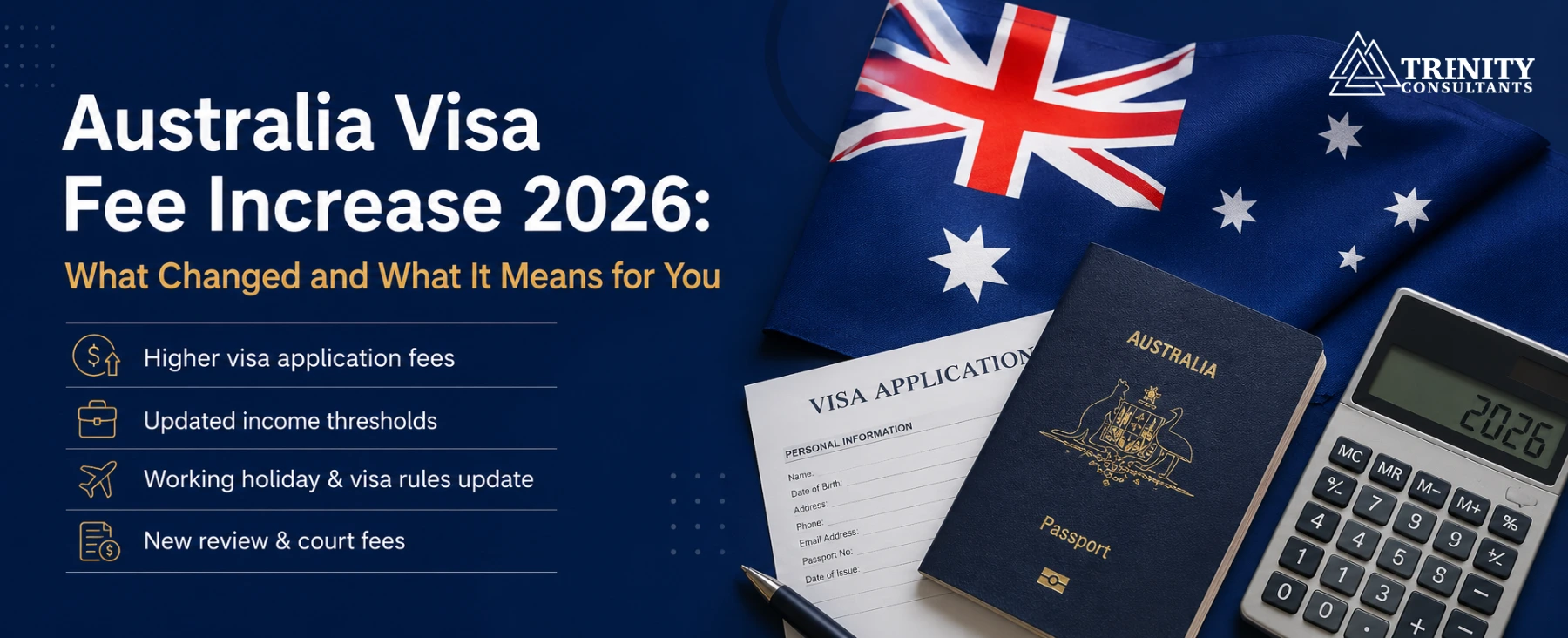
Australia Visa Fee Increase 2026: What It Means for PR, Work & Student Visa Applicants

Australia PR visa fees, skilled migration visas, student visas, employer-sponsored visas, and Working Holiday visas - update 1 July - Trenity Consultants

Australia Visa Fee Increase 2026: What It Means for PR, Work & Student Visa Applicants

If you’re planning to apply for an Australian visa this year, you’ve probably already heard the news—the Australia visa fee increase for 2026 is now in effect, and for many applicants, it’s a bigger jump than usual.

From 1 July 2026, the Australian Government rolled out a wide set of changes covering Australia PR visa fees, skilled migration visas, student visas, employer-sponsored visas, and working holiday visas. Some of these changes are routine annual adjustments, while others represent significant increases that applicants need to plan for. Some of these changes are routine annual adjustments. Others are not — and they’re catching a lot of applicants off guard.

At Trenity Consultants, we’ve broken down exactly what’s changed below, so you know what to expect before you apply.

Looking to apply for Australia PR in 2026? Get your eligibility assessed with Trenity Consultants, experienced Australia skilled migration consultants in Abu Dhabi, Dubai, Sharjah, Bahrain, Qatar, Kuwait, Oman, Riyadh & Jeddah.

Why This Year's Fee Rise Is Different

Most years, Australian visa fees creep up by 3–5%, roughly in line with inflation. This year, many subclasses jumped by around 25% in a single step — a far steeper rise than applicants are used to.

A smaller, CPI-only increase (around 2.6%) applied to a handful of categories, including:

  • Humanitarian and Protection visas
  • Pacific engagement and regional mobility visas
  • Eligible student visa applicants (ELICOS and non-award courses)
  • Eligible citizens of Pacific Island countries and Timor-Leste under relevant programs

Everyone else—including Australia PR applicants, skilled migrants, partner visa applicants, and Working Holiday visa applicants—is now facing noticeably higher visa application charges.

Australia PR Visa Fees 2026 Update: What's Changed

For anyone working toward permanent residency, the Australia PR visa fees 2026 update is one of the most important pieces of this announcement. Here’s a snapshot of how some of the most commonly used subclasses have moved:

Visa SubclassOld FeeNew Fee
(From 1 July 2026)
Visitor (Subclass 600)AUD $200AUD $250
Student (Subclass 500)AUD $2,000AUD $2,500
Student (ELICOS / Non-award)AUD $2,000AUD $2,050
Temporary Graduate (Subclass 485)AUD $4,600AUD $5,750
Skilled Independent (Subclass 189)AUD $4,910AUD $6,135
Skills in Demand (Subclass 482)AUD $3,210AUD $4,015
Employer Nomination Scheme (Subclass 186)AUD $4,910AUD $6,140
Partner (820/801 or 309/100)AUD $9,365AUD $11,710
Working Holiday (417) / Work and Holiday (462) – First ApplicationAUD $840
Working Holiday (417) / Work and Holiday (462) – Repeat ApplicationAUD $1,000
Resident Return (Subclass 155/157)AUD $490AUD $1,475
New Zealand Family Relationship (Subclass 461)AUD $445AUD $1,330

One thing worth understanding about the tie-break date: when two applicants in the same occupation have identical points scores, the one who submitted their EOI earlier gets the invitation. In this round, that cutoff was 24 April 2026. It is a detail that catches people off guard — and it is exactly why we always advise clients not to delay their EOI submission once they are ready.

NOTE: These are indicative base charges for a primary applicant only. Partners, adult dependants, and children included in the same application attract an additional applicant charge on top. Fees can also vary by location and stream, so it’s worth confirming your exact charge on the Visa Pricing Estimator before you apply – or asking your immigration consultant to do it for you.

Apply Before the Deadline or Pay More

One detail catches many applicants out each year: the fee you pay is determined by the date your application is received—not by when you started or finished preparing it. If your application is applied before 1 July 2026, the previous fee applies, even if the decision is made months later. Applications submitted on or after 1 July 2026 are subject to the new fees, regardless of how long they have been in preparation.

Since most application charges are non-refundable, even if an application is refused or withdrawn, lodging an incomplete or poorly prepared application under the new fee structure could prove to be a costly mistake.

Planning for Australian Citizenship? Expect Higher Application Costs

It’s not just visas. Australian citizenship application fees have gone up too, broadly in line with CPI. If citizenship is next on your pathway after a permanent visa, it’s worth factoring this into your overall budget.

Higher Salary Requirements for Employer-Sponsored Visas

If you’re an employer sponsoring overseas talent, or an applicant applying through an employer-sponsored pathway, this is one of the most important changes to be aware of. From 1 July 2026, the minimum income threshold for employer-sponsored skilled visa applications has increased. The Core Skills Income Threshold (CSIT)—previously known as the Temporary Skilled Migration Income Threshold (TSMIT)—is now around AUD 79,400–79,500 per year. As reported figures vary slightly between sources, it’s advisable to confirm the current threshold with the department before lodging a nomination.

This threshold affects:

  • Skills in Demand visa (Subclass 482)
  • Employer Nomination Scheme (Subclass 186)
  • Skilled Employer-Sponsored Regional visa (Subclass 494)
  • Regional Sponsored Migration Scheme (Subclass 187) nominations, where applicable

If you’re sponsoring someone, double-check that the nominated position actually meets the new threshold before you apply. Getting this wrong doesn’t just cost money—it can affect visa eligibility altogether, which is exactly the kind of detail Australia skilled migration consultants are trained to catch before it becomes a problem.

Fair Work High Income Threshold Increases from 1 July 2026

The Fair Work High Income Threshold has increased from AUD 183,100 to AUD 190,100 per year.

This change is particularly relevant for applicants seeking to rely on the high-income age exemption under the Employer Nomination Scheme (Subclass 186). From 1 July 2026, applicants must demonstrate earnings above the new threshold to be eligible for the exemption. If you’re planning to apply under this pathway, it’s important to review your salary against the updated requirement before lodging your application.

Working Holiday Visa: Two Key Changes

There’s good news and a word of caution here, depending on your situation.

The age requirement timing has changed. For both the Working Holiday Visa (Subclass 417) and the Work and Holiday Visa (Subclass 462), you now need to meet the age requirement at the time you apply, rather than at some later assessment point. If you’re close to the age cutoff, don’t wait — apply early, or you risk becoming ineligible partway through processing.

The age limit has been raised for some applicants. The maximum age for Subclass 417 Working Holiday applicants has increased from 30 to 35 for passport holders from:

  • Cyprus
  • Finland
  • Germany
  • Republic of Korea (South Korea)

This follows updated reciprocal arrangements between Australia and these countries. If you hold a passport from elsewhere, the existing age limits still apply unless a separate bilateral arrangement covers you.

Appeals and Court Applications Will Cost More

If your application is refused, challenging the decision has become more expensive.

From 1 July 2026, the fees for lodging an application with the Administrative Review Tribunal (ART) are:

  • Migration review applications: AUD 3,727
  • Protection visa review applications: AUD 2,293 (generally payable only if the review is unsuccessful)

The filing fee for judicial review applications in the Federal Circuit and Family Court of Australia has also increased to AUD 4,180, although reduced fees remain available for eligible applicants.

New Limit on Importing Applications into ImmiAccount

The Department of Home Affairs has also introduced a cap on importing visa applications into ImmiAccount — you can now only import a given application up to three times. After that, further imports are blocked unless the Department manually resets the limit.

If you manage applications across multiple team members or clients, it’s worth switching to the Assign or Share functions in ImmiAccount instead of repeated imports. The Department says this change is about improving privacy and reducing fraudulent activity.

What Should You Do Next?

With so many moving parts, timing really does matter here. A few practical steps:

  • Confirm the exact current fee for your specific visa subclass before applying — don’t rely on last year’s figures.
  • If you’re sponsoring an employee, check the nominated role against the updated salary thresholds.
  • If you’re applying for a Working Holiday visa and close to the age limit, apply sooner rather than later.
  • Budget for higher review or court fees if there’s any chance you’ll need to appeal.
  • If multiple people manage your application, plan around the new ImmiAccount import limits.

Get Australia PR & Visa Process Help from best Immigration Consultants for Australia

Whether you’re applying for Australia PR, an employer-sponsored visa, or a temporary visa, understanding the new Australia visa fees can help you avoid unnecessary costs and delays. Between the fee rise, the new income thresholds, and the tighter working holiday timing rules, it’s easy to get caught out by a detail that costs you money — or worse, your eligibility.

That’s where a bit of Australia visa process help from immigration consultants goes a long way. As the best immigration consultants for Australia PR & visa processes, Trenity Consultants, we help individuals, families, and employers get the numbers right the first time, so you’re not the one discovering a costly mistake after you’ve already paid a non-refundable fee.

If you’re weighing up your options under the new rules, get in touch with our team for Australia migration cost 2026 expert guidance tailored to your situation – before you apply, not after.

Book a Free Consultation

Book a free consultation today and get expert guidance tailored to your profile.

Thinking About Australia PR?

Most people who come to us don’t arrive with a completed file and a clear plan. They arrive with questions. Do I even qualify? Are my points enough? Where do I start?

That is completely normal — and it is exactly what our free consultation is for.

At Trenity Consultants, we work with skilled professionals across the UAE and GCC who are at different stages of their Australia PR journey. Some are just starting to explore the idea. Others have an EOI sitting in SkillSelect and are not sure why invitations haven’t come through. A few have received an invitation and need help making sure their application is airtight before the 60-day clock runs out. Wherever you are in the process, our job is simple: look at your profile honestly, tell you where you stand, and map out the clearest path forward.

Need Immigration Assistance? Connect With Trenity Consultants Near You

Choose your nearest office and visit your local country page for personalized immigration guidance.

🇦🇪
Abu Dhabi
United Arab Emirates
Immigration Consultants in Abu Dhabi
Visit Page
🇦🇪
Dubai
United Arab Emirates
Immigration Consultants in Dubai
Visit Page
🇦🇪
Sharjah
United Arab Emirates
Immigration Consultants in Sharjah
Visit Page
🇰🇼
Kuwait
Kuwait
Immigration Consultants in Kuwait
Visit Page
🇧🇭
Bahrain
Bahrain
Immigration Consultants in Bahrain
Visit Page
🇶🇦
Qatar
Qatar
Immigration Consultants in Qatar
Visit Page
🇴🇲
Oman
Oman
Immigration Consultants in Oman
Visit Page
🇸🇦
Riyadh
Saudi Arabia
Immigration Consultants in Riyadh
Visit Page
🇸🇦
Jeddah
Saudi Arabia
Immigration Consultants in Jeddah
Visit Page

Share: